Douglas
The Turn of the ScrewDouglas introduces the Governess’s story to a gathering assembled around a fire, presenting it as an account involving two children and a degree of horror he considers unmatched. He insists that no one else has heard it, calls it beyond anything he knows, and struggles to name its quality: not merely terror, but a more general uncanny ugliness, horror, and pain. His hesitations turn the act of telling into part of the suspense. The account arrives not as an immediate performance from memory but as a recovered document whose history Douglas carefully discloses.
Identity and Background
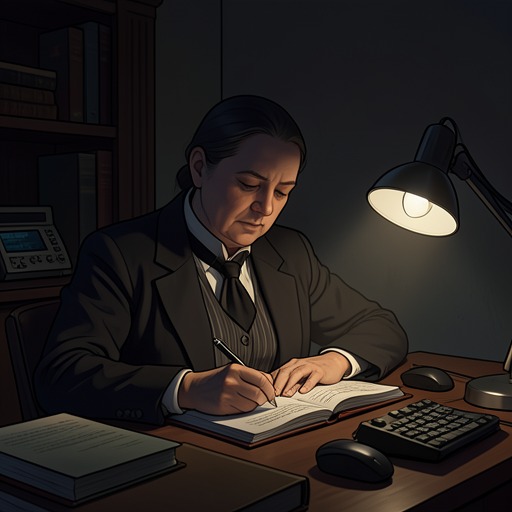
Douglas is a cultivated member of the gathering and the person who possesses the Governess’s manuscript. He says that the experience described was not his own. His connection to the woman who wrote it began years earlier, when he was at Trinity and came down for the summer to his family home. She was then his sister’s governess, ten years older than he, and he recalls her as unusually agreeable, clever, and pleasant in her position. During his visits that summer, they took walks and talked in the garden during her off-hours.
Douglas remembers their attachment as mutual: he says he liked her greatly and was glad to believe she liked him too. He treats that personal history not as proof of what the manuscript describes, but as an explanation for the confidence between them. In his account, she had never told anyone else; he believed this because he felt he could tell that she had not. The manuscript’s authority for him therefore rests partly on intimacy and trust, even though he was not an eyewitness to its events.
The Manuscript and Its Custody
Douglas distinguishes his own lasting impression from the written record. Asked whether he had taken the events down, he says he took the impression into his heart and had never lost it; the manuscript itself was written by the Governess. He describes its ink as old and faded and its handwriting as beautiful. The woman sent him the pages before her death, which had occurred twenty years earlier. The old document thus preserves a testimony passed from its author to a trusted recipient, rather than a contemporary record Douglas claims to have made himself.
For years the manuscript remained in a locked drawer and had not been taken out. When the gathering presses him to begin, Douglas explains that he must send to town for it. He writes to his man at his London apartments, enclosing the key so the packet can be retrieved and sent down. He appears to appeal particularly to the frame narrator for support in overcoming his hesitation. The others resent the delay, but the narrator is moved by Douglas’s scruples and urges him to send the letter by the first post and arrange an early reading.
The Reading and Its Frame
The letter containing the key goes off by the first post. Douglas is left alone until after dinner the following day, when he becomes as communicative as his listeners hope. He explains that the manuscript needs a short prologue for it to be properly understood. This qualification establishes the structure of what follows: the Governess’s account is not simply launched at its earliest point, but is introduced by Douglas’s framing remarks and later presented as a transcript.
Douglas begins reading on the fourth night, by the fire in the hall, to a compact audience gathered around the hearth. The manuscript had reached him on the third day. Women who had expected to stay leave after the preliminary disclosures, reportedly in a rage of curiosity; their departure makes the final listening circle smaller and more concentrated. Douglas opens a thin, old-fashioned, gilt-edged album with a faded red cover and reads in a clear voice that seems to do justice to the beauty of the handwriting. When asked for a title, he says he has none. The frame narrator offers that he has one, but Douglas does not heed him and starts reading.
Narrative Role and Significance
Douglas is a mediator rather than the central witness. He explicitly denies that the experience was his, yet claims an enduring inward impression of it, received through the Governess’s testimony and preserved through their personal connection. That distinction gives the narrative a layered authority: the reader encounters the Governess’s written account through Douglas’s selection, explanation, and reading, and through the frame narrator’s later transcript of that reading.
His manner also regulates the story’s disclosure. Douglas withholds the manuscript while explaining its rarity, its private history, and the writer’s identity; the promise that it is uniquely horrible is therefore joined to the physical delay of a locked drawer and a letter sent for its key. The repeated pauses make suspense arise not only from the haunting the manuscript recounts, but from the conditions under which testimony becomes available. Douglas’s final act is to turn the private pages into a public reading, while the frame narrator’s transcript carries that reading onward after Douglas’s death, when it was in sight. The story’s transmission depends on this chain of confidence, custody, and belated disclosure.