Ghosts
The Turn of the ScrewGhosts in The Turn of the Screw are apparitions whose appearances connect the dead Peter Quint and Miss Jessel with the living children and the governess. They are the engine of the story’s terror and of the governess’s protective mission, yet their reality remains inseparable from the limits of her testimony: she sees them, while the other adults do not confirm her visions, and the children’s responses remain open to interpretation.
Appearance and Introduction
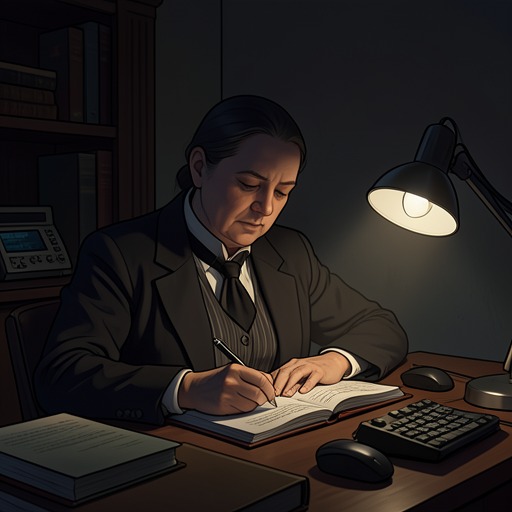
The story first frames a ghostly visitation as an event that reaches a child before an adult. At the Christmas Eve gathering, Douglas describes a case in which an apparition appears in an old house to a little boy sleeping in the same room as his mother. The frightened child wakes her, but she encounters the same sight before she can soothe him. Douglas treats the child’s involvement as an added turn of the screw, then proposes that his own story involves two children. This introductory framing makes the haunting’s connection to childhood a defining feature before the account at Bly begins.
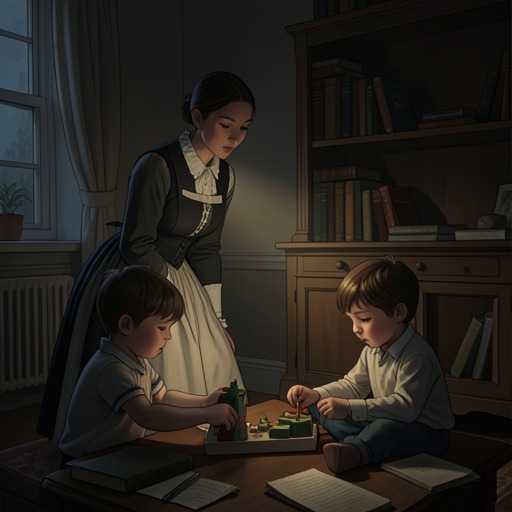
At Bly, the governess identifies one apparition as Peter Quint, a former employee whom Mrs. Grose tells her is dead. The news that Quint died converts the governess’s earlier sighting into a revelation she believes must be faced and interpreted. The exchange also establishes an important division in their knowledge: Mrs. Grose knows Quint’s history but has seen no ghost, whereas the governess claims the experience of direct sight. Their uneasy partnership grows out of that difference rather than a shared supernatural encounter.
The governess understands Quint’s purpose as an effort to appear to the children. Mrs. Grose’s alarm makes the prospect more frightening, but the governess turns it into a private duty: she believes she can offer herself as the sole target and thereby preserve the children’s tranquility. She imagines herself as an expiatory victim who can guard them from the apparition. The haunting therefore becomes not only a threat but the stated cause of her self-appointed role as their defender.
The Apparition at the Lake
A second apparition appears while the governess is with a child beside the lake. She describes a woman in black, pale and dreadful, standing on the far bank, and identifies her as Miss Jessel. In contrast to Quint’s association with the house and its windows, Jessel’s appearance is staged across open water. The governess says the girl was perfectly aware of the woman, but clarifies that she means aware of Jessel, not of Quint. That distinction supplies the governess’s account of a second ghost and a second possible connection between an apparition and a child.
Later, at the lake, the governess points out Jessel again. For a few seconds she experiences the sight as vindication: she believes Mrs. Grose sees the apparition too, and takes the moment as proof that she is neither cruel nor mad. But the girl does not look toward the figure or visibly show fear. Instead, she regards the governess with a grave, accusatory expression. The scene thus gives the supposed proof a destabilizing counterpoint: the governess reads the adult’s blink as recognition, while the child’s silence and composure refuse the response she expects.
The lake encounter makes witnessing itself part of the haunting’s uncertainty. The governess’s certainty is strongest precisely when the girl’s behavior most unsettles her interpretation. Jessel stands across the water, apparently visible to the governess and perhaps to Mrs. Grose, but the girl’s reaction does not confirm the governess’s claim in the way she wants. The apparition’s presence is therefore inseparable from the arguments the governess builds around who sees, who refuses to acknowledge, and what a look can prove.
The Final Confrontation
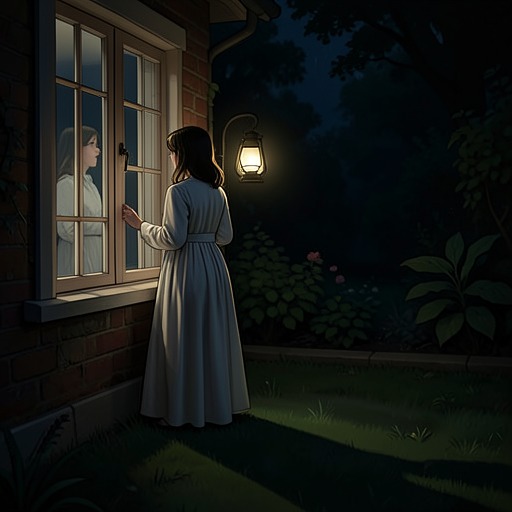
In the final confrontation, Quint appears outside the window while the governess is speaking with Miles. She experiences him as a sentinel before a prison and then as a white face glaring through the glass. The window becomes a boundary across which the apparition can be seen, while the governess moves to keep Miles’s back toward it. She understands that her task is to face Quint without making the boy aware of him, and imagines the struggle as one for a human soul.
Miles admits that he took the governess’s letter and opened it to see what she had written about him. As she holds him close, she keeps watching Quint at the window: his posture shifts, briefly seeming to prowl like a baffled beast, before he fixes his gaze on the room again. The governess takes Miles’s confession and his apparent unawareness of the apparition as evidence that she can defy Quint while protecting the child. The moment intensifies the story’s central contrast between her vigilant sight and the boy’s apparent inability, or refusal, to see what she sees.
The confrontation then turns on a misidentification. When the governess cries out about the figure at the window, Miles asks whether Jessel is there. She insists that the apparition is not Jessel but the presence outside. Pressing for confirmation, she asks whom he means by “he”; Miles names Peter Quint and asks where he is. The governess takes this naming as surrender and as tribute to her devotion, believing that the boy has recognized the ghost and that she has won him away from it.
The apparent victory collapses when Miles looks around and sees only the quiet day. The governess interprets the absence of Quint as the loss she has forced upon the ghost, but Miles cries out as though he has been hurled into an abyss. She catches and holds him, then realizes that his heart has stopped. The ending makes the cost of the confrontation unmistakable while leaving the relation between the ghost’s disappearance and Miles’s death unresolved: the governess’s account presents the scene as a rescue from Quint, yet its final image is the child dead in her arms.
Narrative Role and Uncertainty
The ghosts are presented through the governess’s retrospective first-person account, not through an independent narrative viewpoint that verifies their existence. Mrs. Grose accepts the governess’s story with tenderness without having seen anything herself; at the lake, the governess believes her companion has at last witnessed Jessel, but that perception is filtered through the governess’s reading of a blink. The account offers neither an external confirmation that settles the apparitions as supernatural nor a definitive explanation that reduces them to delusion.
That uncertainty shapes the ghosts’ dramatic force. Quint and Jessel are dead figures who, in the governess’s interpretation, threaten the children and demand intervention; the same interpretation also places the burden of proof on the governess’s contested perceptions. Her fierce conviction can look like courage and protection, but it also governs how she reads the children’s silence, gestures, and fear. The final apparition and Miles’s death do not resolve that tension: they sharpen it, leaving the reader with both the governess’s conviction that she faced Quint and the irreversible consequence she narrates.