Miles’s exclusion from school
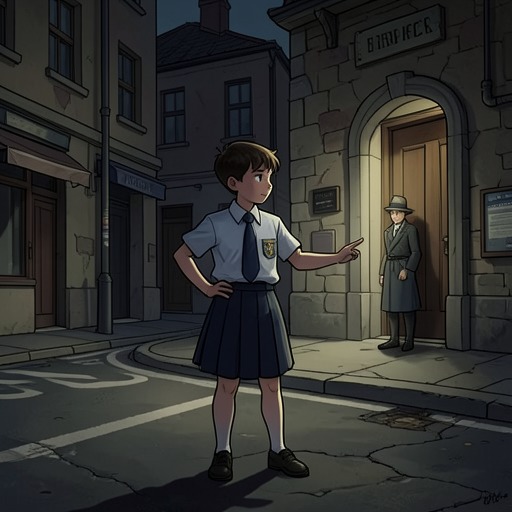
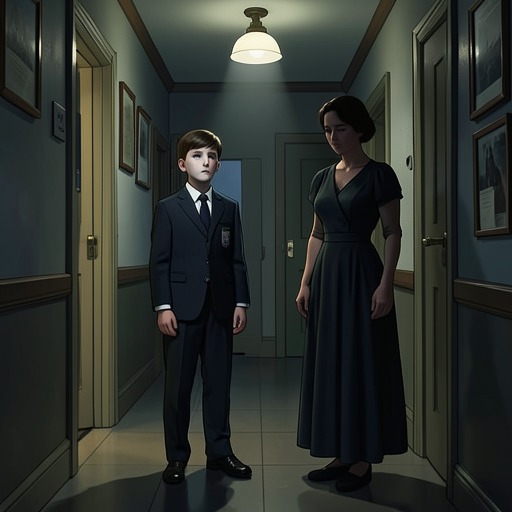
The Turn of the ScrewMiles’s exclusion from school is a disciplinary secret at the center of the final interview between Miles and the Governess: he confirms that the school sent him away for saying things, but supplies neither their content nor a clear account of whom he addressed. The exchange explains why he could not return while preserving the uncertainty that has shaped the adults’ understanding of his expulsion.
The School’s Decision and Its Uncertain Grounds
The Governess approaches the subject by asking whether Miles took letters or other things, and then whether he stole. He answers plainly that he did not. Her question connects the school’s decision to the possibility of theft, but his denial rules that particular explanation out. The scene offers no independent statement from the school and no detailed account of the incident that prompted its action.
Instead, Miles says that he “said things.” When the Governess asks whether that alone was enough to turn him out, he replies that the school thought it was. His account establishes a connection between speech and expulsion, but does not specify what the words were, what circumstances surrounded them, or what rule the school believed he had broken. The institution’s judgment is therefore clear in outcome and obscure in rationale.
Miles’s Recollection and the Governess’s Questions
The interview gives the revelation through a series of questions rather than a direct explanation from the school. The Governess first tests the possibility of theft; Miles responds with dreary surprise, asking whether she knew he could not go back. When she says she knows everything, he gives her a long, strange look and repeats the claim as a question. His reaction shows the distance between her asserted knowledge and what he is prepared to confirm.
Asked what he did, Miles searches for an answer with visible difficulty. He looks around the room in vague pain, draws breath several times, and compares the effort to looking up from the bottom of the sea toward a faint green twilight. He can retrieve only the broad fact that he said things. The image makes the act of recollection feel laborious, but does not establish whether the words themselves have been forgotten, deliberately withheld, or simply cannot be brought to mind.
When pressed about whom he spoke to, Miles tries to remember, but the name or answer eludes him. He says he does not know. The scene thus withholds the most particular details at both ends: neither the content of the speech nor its recipient becomes certain. Miles’s inability to identify the addressee does not undo his admission, but it prevents that admission from becoming a complete account of the offense.
Disclosure Without Resolution
The Governess receives Miles’s answer with a mixture of alarm and tenderness. She blushes at having asked a gentleman whether he stole, yet her hands shake as she holds him, moved by the thought that the question has followed months of torment. His denial appears to reassure her, but it does not resolve what the school considered serious enough to exclude him. The emotional force of the exchange comes from that mismatch: the boy before her seems too gentle to explain so severe a judgment, while his own account remains fragmentary.
Earlier, the Governess recognizes that continuing to pretend she has more to teach Miles has become absurd. Their roles have changed, and she has stopped challenging him about the interval just past. Against that altered relationship, the expulsion becomes more than background information: it is a fact she has long sought to understand, now disclosed only as far as Miles can or will take it. The school’s action is confirmed, but its grounds remain inaccessible.
The episode closes without a verdict on whether the punishment was justified or what the forbidden speech contained. Miles’s admission links his exclusion to words, while his denial excludes theft and his faltering recollection leaves the rest open. In the story’s wider pattern of secrecy and incomplete knowledge, the school’s unexplained decision becomes another unresolved piece of evidence rather than a final explanation of Miles’s character or conduct.