Miss Jessel
The Turn of the ScrewMiss Jessel, the former governess at Bly, is a dead woman whose history remains partly concealed and whose ghost becomes central to the present governess’s increasingly contested account of the haunting. Mrs. Grose confirms that Jessel left Bly and later was reported dead, and eventually calls her infamous; the governess identifies a woman in black seen by the lake as Jessel. Her appearances, and the children’s differing responses to them, make Jessel both a figure in the alleged haunting and a pressure point in the story’s uncertainty about testimony, secrecy, and what can be known.
Identity and Departure
Mrs. Grose first describes Jessel as the young woman who had previously held the governess’s position. When asked whether she died at Bly, she answers that Jessel went away. She explains that Jessel left at the end of the year for what she called a short holiday, having earned time away; a nursemaid who had stayed at Bly took charge of the children in the interval. Jessel never returned. Just as Mrs. Grose expected her back, she heard from the master that Jessel was dead. The account establishes neither where nor how Jessel died, and Mrs. Grose says she did not appear to have become ill in the house before leaving.
This initial explanation is notable for its restraint. Mrs. Grose says she will not tell tales, and the governess senses ambiguity in the brief answer that Jessel went off. When she presses for the whole history, Mrs. Grose first assents only in silence, then acknowledges that there had been everything between Jessel and Quint. The revelation offers a charged connection without specifying its full nature or circumstances.
The Woman in Black
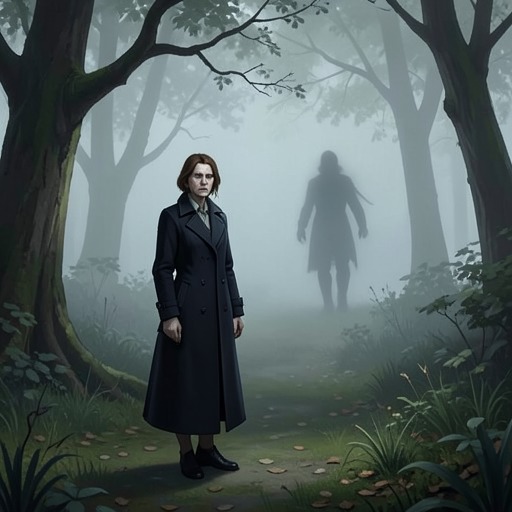
The governess reports seeing a woman in black on the far side of the lake while Flora was with her. She describes the figure as pale and dreadful, with an appearance of evil, and says that Flora seemed aware of the figure. Asked whether the woman was someone she had never seen, the governess answers that she herself had not seen her before, but Flora and Mrs. Grose had. She then identifies the woman as her predecessor, the one who died: Miss Jessel.
The governess’s description also draws on what she has learned of Jessel’s reputation. She characterizes the figure’s clothing as mourning dress, poor and almost shabby, while insisting on her extraordinary beauty. Mrs. Grose responds that Jessel was infamous and adds that both Jessel and Quint were infamous. The word links their reputations, but Mrs. Grose’s terse disclosure leaves the events behind that judgment unstated.
The Lake Encounter and Flora
Later, the governess names Jessel in front of Flora, asking where she is. Flora’s reaction makes the naming itself a rupture in the silence maintained between the adults and child. Jessel then appears on the opposite bank, in the same position as during the earlier lake encounter. The governess takes the apparition as proof that she is neither cruel nor mad, and reads Mrs. Grose’s dazed look across the water as confirmation that her companion sees the figure too.
Flora’s response does not provide the confirmation the governess expects. Rather than look toward the figure or show the agitation the governess anticipates, Flora turns toward her with an expression the governess reads as grave, accusatory, and new. Later, Mrs. Grose reports that Flora repeatedly asks whether the governess is coming in, but has said nothing about Jessel since repudiating any familiarity with something so dreadful. Mrs. Grose also says she took Flora’s behavior at the lake to mean that, at that moment and there, nobody was present. She does not contradict the child. Thus the adult’s conviction that Jessel is visible and Flora’s denial remain in direct conflict.
Final Appearance and Narrative Significance
In the final bedroom confrontation, Miles hears the governess speak and asks whether she is there. When the governess repeats Jessel’s name, Miles angrily returns it to her. The governess corrects him: she says it is not Jessel, but a male figure at the window. Her identification places Jessel and the figure she calls Quint in separate moments of the climax, while Miles’s question shows that Jessel’s name remains part of the children’s charged, uncertain knowledge of the apparitions.
Jessel’s story is consequently marked by gaps as much as by appearances. Her departure is explained as a holiday, her death is reported secondhand by the master, and her connection with Quint is conveyed only through Mrs. Grose’s guarded disclosure. The narrative presents the governess’s sighting at the lake and her certainty that Mrs. Grose also sees Jessel, but Flora’s refusal and the incomplete account of Jessel’s past prevent those claims from yielding a settled explanation. Jessel functions as both a remembered former employee and an apparition whose meaning depends on disputed acts of seeing, naming, and silence.