Supernatural haunting at Bly
The Turn of the ScrewSupernatural haunting at Bly is the recurring apparition of Peter Quint and Miss Jessel as perceived by the governess, a presence that turns ordinary rooms and windows into sites of threat. In the final bedroom scene, the governess believes that her resistance has broken Quint’s hold over Miles; the apparition disappears, but Miles dies in her arms. The ending gives her victory and catastrophe the same instant, without settling whether the haunting is objectively supernatural or shaped by her perception.
The apparition at the window
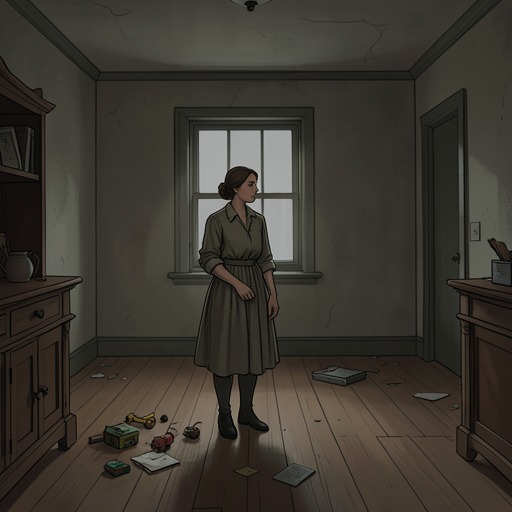
At the climax, the governess asks Miles whether he took her letter from the hall table the previous afternoon. Before she can fully register his answer, her attention divides: she rises, draws him close, and positions him with his back to the window. Quint appears outside the glass, his white face glaring into the room. The governess recognizes the figure as the same presence she has confronted before, but the scene’s immediate evidence is filtered through her first-person account and her intense effort to keep Miles from noticing it.
She interprets her choice to face Quint while concealing him from Miles as an act of protection. Holding the boy away from the window, she watches the apparition’s posture change: the sentinel-like stillness gives way to what she describes as the slow prowl of a baffled beast. When Miles admits that he took and opened the letter to see what the governess had written about him, she reads his confession as proof that his attention is no longer fixed on the apparition. She sees Quint at the glass, then sees the air clear; in her understanding, her defiance has quenched the influence.
The apparition and Miles’s knowledge
The scene keeps Miles’s awareness uncertain. The governess believes that he senses a presence without knowing precisely what it is, and that he does not know she sees it too. His responses, however, do not provide a clear confirmation. When she declares that the apparition is at the window, Miles asks whether Miss Jessel is there. The governess corrects him, insisting that the figure before them is Quint. His question suggests that he associates the crisis with a ghost, but it does not establish that he sees the figure she identifies.
Miles then names Quint and asks where he is. The governess takes the naming as a supreme surrender and as tribute to her devotion: she believes Miles has at last acknowledged the presence she has been trying to expose. Yet when she directs his attention to the window, he turns and sees only the quiet day. That difference between what the governess reports seeing and what Miles can see preserves the scene’s central uncertainty. The apparition vanishes in her account, but Miles’s reaction does not independently verify that it had been there.
The governess’s defense and its cost
The governess frames the encounter as a contest for Miles’s soul. She holds him against her while keeping her gaze on Quint, describing the boy as a vulnerable human soul held at arm’s length. Her protective action is also an attempt to control what Miles sees and understands: she believes she can face the apparition openly while keeping him unaware of it. This makes the scene’s suspense depend not only on the ghost’s appearance but on the fragile distinction between the governess’s perception and the child’s.
When the figure appears again, the governess’s confidence falters. Miles’s movement makes her spring toward him, and the sudden leap, she recognizes, betrays her alarm. She tries to turn the moment into evidence of his liberation, urging him to stop and pressing him against her. Her resolve and fear coexist: she believes she has almost won, but Quint’s renewed appearance revives the struggle at the instant of apparent confession.
Disappearance and death
After Miles names Quint, the governess tells him that the apparition has lost him forever. She then points him toward the window as a demonstration of her success. Miles turns, stares, and sees only daylight. The governess initially experiences this absence as confirmation that her intervention has worked. But the disappearance does not culminate in rescue. Miles gives a cry as if falling into an abyss, and she catches and holds him.
Only after holding him for a minute does the governess understand what she is holding: Miles’s heart has stopped. Her account ends with the quiet day outside and the child dead in her arms. The final contrast is stark: the window has cleared, and the supposed threat is gone, but the boy the governess meant to save has not survived. The haunting’s apparent defeat and its fatal consequence arrive together, leaving no secure boundary between victory over a supernatural force and the governess’s interpretation of a child’s death.
Narrative significance
The haunting is presented through the governess’s retrospective testimony, not through an independent account of the apparitions. That frame makes her confidence consequential but not conclusive. She repeatedly identifies Quint at the window and reads his disappearance as proof that his influence has been broken; Miles, by contrast, sees only the quiet day when she directs him to look. His references to Miss Jessel and Quint reveal that ghosts are part of the encounter’s vocabulary, yet they do not settle what he perceives or what caused his death.
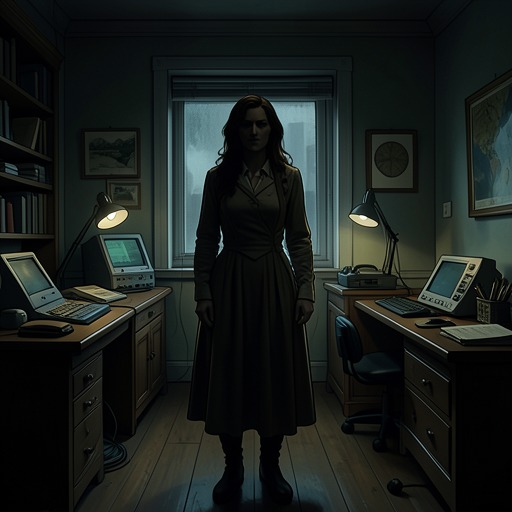
The window concentrates this uncertainty into a recurring boundary between inside and outside, sight and blindness. Quint’s face is described as close to the glass, while Miles’s view of that same place yields only daylight. At the ending, the governess’s conviction that the haunting has been quenched is immediately shadowed by the irreversible fact of Miles’s death. The narrative closes with the event but withholds a final explanation of it, making the governess’s claimed triumph inseparable from the limits of her testimony.