The Governess
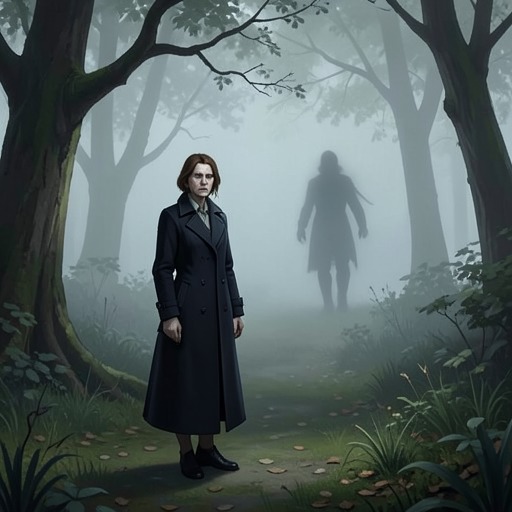
The Turn of the ScrewThe Governess is the unnamed narrator and central adult figure in the account of Bly. She arrives hoping to teach and protect the children, and her powerful attachment to them becomes the force that shapes both her actions and the reader’s access to the haunting. By the ending, she has confronted Peter Quint in the window and holds Miles as he dies; the account presents this as a desperate rescue, but its first-person perspective leaves the nature of the ghosts and the reliability of her interpretation unresolved.
Identity and Arrival
The narrative introduces The Governess through memory rather than detached description: she recalls her first journey to Bly as a succession of emotional rises and drops. After responding to her employer’s appeal in town, she suffers several days of doubt and fears she may have made a mistake. The long, uncomfortable coach ride carries her to the stopping place, where a carriage has been ordered to meet her. Her mood lifts during the drive on a summer afternoon, as the countryside seems to welcome her and the approach to the house gives her a reprieve from her anxiety.
Bly first appears as a strikingly generous setting, not the melancholy place she had expected. The Governess remembers its broad, clear front, open windows, fresh curtains, flower-bright lawn, gravel drive, and treetops above which rooks circle and call. The house seems grand beside her modest home. A civil servant of the household greets her at the door with a little girl in her hand, and The Governess reflects that her employer’s description had given her a narrower idea of the place. She takes the welcome and the apparent scale of the house as signs that her new position may offer more than she had been promised.
Her first impression of Flora intensifies that sense of good fortune. The child strikes her as exceptionally beautiful, and The Governess is surprised that her employer had said so little about her. She sleeps badly from excitement in an imposing room with a state bed, figured draperies, and long mirrors in which she can see herself from head to foot. The room and her small charge both feel like unexpected gifts. That early sense of privilege matters in retrospect: the story’s later dread develops inside a relationship and household that she initially experiences as an almost extravagant welcome.
Life at Bly and Attachment to the Children
The Governess promptly proposes that she and Flora should be waiting when the public conveyance brings Flora’s brother back to Bly. Mrs. Grose agrees warmly, and The Governess takes her manner as a reassuring pledge that the two women will stand together. The boy is due on Friday, travelling by coach under the care of the guard and to be met by the same carriage that brought The Governess. The practical arrangement is also an early expression of her wish to make the children’s arrival and care a shared household undertaking.
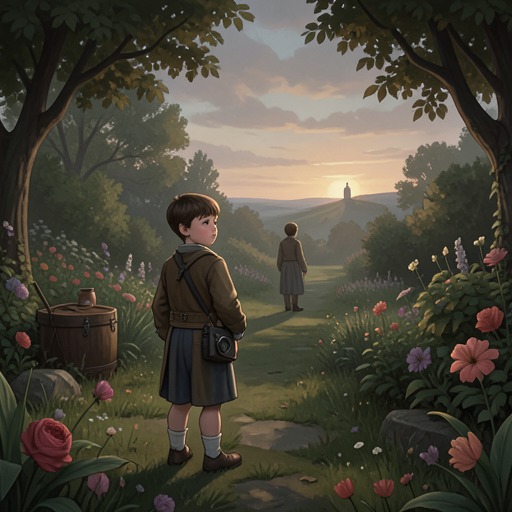
As she takes in the size and extent of her new circumstances, The Governess feels both proud and somewhat frightened. She delays lessons, deciding that her first duty is to win Flora’s confidence by gentler means. She spends the day outside with her and lets the child show her the estate. Flora leads her step by step through rooms and corridors, sharing secrets and talk; within half an hour, the two have become close. The Governess is impressed by the child’s confidence in empty chambers, dull passages, crooked staircases, and even the top of an old square tower that makes her dizzy. In memory, Flora’s golden hair and blue dress turn Bly into a romantic castle, with the child as its bright guide. The adult narrator also acknowledges the distance between that childhood-like vision and how the estate might appear to her older, more informed eyes.
The Governess’s commitment to the children becomes explicit when she later describes her readiness to meet what she regards as a threat in order to shelter them. This resolve stands beside her vulnerability: the narrative calls attention to her susceptibility to impressions and to the burden of being the only person in the house who sees what she believes she sees. Her care and her fear are not separate strands. The very conviction that makes her feel responsible for protecting the children also governs how she interprets their silences, their actions, and the figures she reports seeing.
Alliance with Mrs. Grose
After Mrs. Grose confirms that Peter Quint is dead, the two women retreat together to the schoolroom and shut themselves in to discuss what has happened. The Governess recalls an hour of collapse and a small private ceremony of tears, prayers, vows, and promises. Their exchange establishes the difficult terms on which they are to continue: Mrs. Grose has seen nothing, not even a shadow, and no one else in the household shares The Governess’s alleged experience. Yet Mrs. Grose accepts the account without directly accusing her of insanity.
That acceptance does not erase the difference between their positions. The Governess calls her companion’s response a mixture of consternation and compassion, while recognizing that Mrs. Grose cannot verify the apparitions herself. For The Governess, this unequal knowledge creates both isolation and intimacy. She remembers an awestruck tenderness from her ally and comes to believe that they might bear their situation together, even wondering whether Mrs. Grose, despite her exemption from the visions, carries the heavier burden. Their alliance rests on a shared purpose—sheltering the children—rather than on shared perception.
The unevenness of that partnership becomes decisive at the lake. When Flora speaks as if an outside source has supplied her accusations against The Governess, The Governess understands the child to have turned against her under Miss Jessel’s influence. She says she has lost Flora and orders Mrs. Grose to take the girl away. Mrs. Grose is dismayed, but, unable to see the figure The Governess addresses across the water, she nonetheless recognizes that something terrible has happened and retreats with Flora. The scene tests the alliance: Mrs. Grose’s trust is strong enough to follow the command, but her blindness to the supposed witness also leaves her unable to share The Governess’s confrontation.
Protection, Separation, and Final Confrontation
After Flora’s rejection, The Governess refuses to leave Bly herself, although she admits she had come close to doing so earlier. Instead, she tells Mrs. Grose that Flora must go, away from Bly, away from the other child, and especially away from The Governess. She directs her companion to take Flora straight to the children’s uncle. Her decision frames separation as an act of protection: she believes that her presence has become harmful to Flora, even as she remains committed to protecting the children from the ghosts she perceives.
In the final confrontation, The Governess questions Miles about a letter she believes he took from the hall table the previous afternoon. Before his response can fully register, she springs up, draws him close, and keeps his back to the window. Peter Quint appears outside, glaring through the glass with the white face The Governess has encountered before. The image of the ghost at the window turns the room into a scene of immediate danger, but The Governess’s response is not to direct Miles’s attention toward it. She decides that, while facing the apparition, she must keep the boy unaware of it, and holds him at arm’s length as she tries to preserve him from the sight.
Miles admits that he took the letter. In the moment that follows, The Governess presses him to name the person she believes has claimed him. He cries out Peter Quint’s name and asks where he is. The Governess takes this surrender of the name as proof that her devotion has won Miles away from the ghost. She tells the apparition that it has lost him, then turns to Miles with words of reassurance. Her account presents the exchange as the culmination of her struggle for his soul, but it also reveals how completely she interprets the boy’s speech through the contest she believes is taking place.
Death and Narrative Significance
Miles turns toward the window and sees only the quiet day. The Governess experiences his response as a terrible loss and catches him as he cries out, holding him as if she has caught him falling. Then her account changes its emphasis: she begins to feel what is actually in her arms. She and Miles are alone in the quiet room, and his heart has stopped. The child’s death is the final consequence of the confrontation as The Governess narrates it, and it sharply contradicts the triumph she had just claimed over Peter Quint.
The Governess’s story makes protection and peril difficult to disentangle. Her choices are consistently described through her desire to shelter the children, but the story gives the reader no independent access to the apparitions she reports, while Mrs. Grose remains unable to see them. The Governess’s testimony therefore sustains two pressures at once: the ghosts are real and she is fighting to save the children, or her fear and conviction have shaped events she cannot fully understand. The ending offers no external confirmation that settles the difference. Instead, her final embrace of Miles concentrates the ambiguity in a single image: a protective hold that is also the moment she recognizes the child is dead.