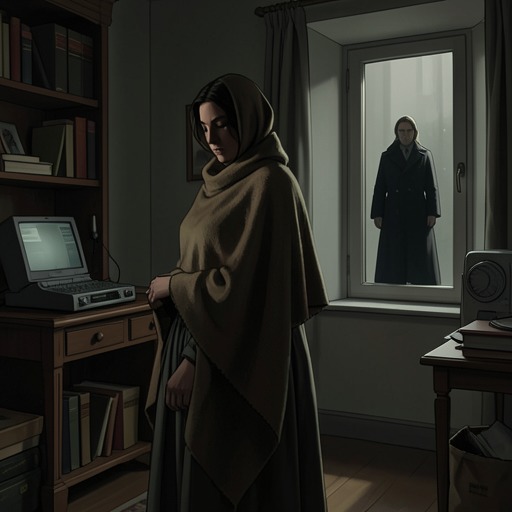
The Headmaster's Letter
The Turn of the ScrewThe Headmaster's Letter is the school’s communication informing the Governess that Miles has been expelled. It supplies a fact but not its explanation: the school refuses to take him back, while the contents that might clarify his conduct remain inaccessible to Mrs. Grose and are not disclosed directly to the reader. The letter therefore becomes more than a notice of exclusion. Its sealed enclosure, its restricted handling, and the Governess’s later plan to place it before the Children’s Uncle make it a material focus for the story’s uncertainty about Miles and the adults’ competing obligations to speak or remain silent.
Arrival and Contents
Two days after the Governess’s first day at Bly, a late postbag brings her a letter from her employer. It consists of only a few words enclosing another letter, addressed to him and still sealed. The employer identifies the inner letter as a communication from the headmaster, calls him an awful bore, and instructs the Governess to read and deal with it without reporting anything to him. He then leaves, placing the responsibility for handling the school’s message entirely on her.
The instruction makes the letter’s arrival an immediate test of the employer’s no-contact condition. The Governess has to decide what to do with a message addressed to someone else, in a situation where she has been told not to report back. She breaks the seal only with great effort, carries the letter to her room, and delays reading it until just before bed. Its contents leave her with a second sleepless night; the next day, lacking counsel, she becomes so distressed that she decides to confide in Mrs. Grose.
The message’s central fact is stark: Miles has been dismissed from school. Mrs. Grose initially asks whether the children have all been sent home, but the Governess distinguishes a holiday return from Miles’s expulsion: he may never go back, and the school absolutely declines to take him. The letter establishes the school’s decision without supplying the grounds for it in the conversation presented here.
Restricted Reading and Disclosure
The Governess attempts to hand the letter to Mrs. Grose, but Mrs. Grose puts her hands behind her and refuses to take it, saying that such things are not for her. The refusal makes the paper’s authority visible even as it blocks access to it: Mrs. Grose is emotionally affected by the news, her eyes filling with tears, but she will not become its reader. The Governess realizes that her counselor cannot read, then begins to repeat the message aloud. She falters, folds the letter again, and puts it back in her pocket instead.
The scene thus separates knowledge from direct possession. The Governess has the document and can interpret its consequence, while Mrs. Grose must rely on what the Governess chooses to say. Mrs. Grose asks whether Miles is really bad and whether the gentlemen say so, but the Governess does not give her the letter to settle the question. The document confirms exclusion; it does not, in the exchange, provide a quoted accusation or a specific account of what Miles did.
A Clue Reconsidered
Later, while pressing Mrs. Grose to explain an earlier qualification about Miles’s goodness, the Governess returns to the school letter as a point in their history. She recalls that, before Miles came back, Mrs. Grose had said she would not pretend he had never been bad. The Governess contrasts that remark with her own experience of him during the weeks she has watched him closely, when she considers him an imperturbable prodigy of goodness. That apparent mismatch leads her to demand the particular exception behind Mrs. Grose’s words.
Mrs. Grose’s answer redirects attention from an unspecified school accusation to a period of several months when Peter Quint and Miles were perpetually together. She had criticized the propriety of their close alliance, hinted at its incongruity, and even approached Miss Jessel about it; Miss Jessel strangely told her to mind her business. Mrs. Grose then spoke to Miles about young gentlemen remembering their station. The letter does not itself establish that this association caused the expulsion, and the account does not disclose the school’s precise charge. Instead, it becomes the occasion through which the Governess draws out Mrs. Grose’s knowledge of Miles’s past intimacy with Quint.
Intended Use and Significance
When the Governess later considers what to do about the letter from Miles’s old school, she asks Mrs. Grose whether she will show it to the Children’s Uncle. Mrs. Grose says she ought to have done so immediately, but Mrs. Grose objects decisively. The Governess nonetheless says she will put it before him, framing the school’s decision as a reason she cannot undertake the question on behalf of a child who has been expelled. Mrs. Grose counters that they have never known what he was expelled for. The Governess answers by calling it wickedness and argues that Miles’s cleverness, beauty, and apparent perfection make some hidden wrongdoing the only explanation she can imagine; she then blames the Children’s Uncle for having left such people at Bly.
This intended presentation does not resolve the mystery within the evidence supplied here. The letter remains a source of institutional judgment whose basis the adults cannot name: the school has declined Miles, but Mrs. Grose insists they never knew why. Its repeated appearance marks a shift from private alarm to a possible appeal to the absent guardian, while its unreadable or undisclosed content keeps the distinction between fact and inference alive. The letter proves Miles’s exclusion; the Governess’s attempt to make that fact explain his character exposes how quickly an unexplained document can become evidence for a theory it does not actually confirm.