The final confrontation with Peter Quint
The Turn of the ScrewThe final confrontation with Peter Quint is the climax of the Governess’s struggle to secure Miles’s confession and protect him from the apparition she believes has claimed him. As Quint appears at the window, she holds Miles close and tries to keep him unaware of what she sees. Miles eventually names Quint, but cannot see him; the Governess declares that the ghost has lost him, and Miles dies in her arms. The scene turns an apparent victory into irreversible loss, while leaving the supernatural encounter inseparable from the Governess’s own account of it.
Causes and Stakes
The encounter grows out of the Governess’s effort to make Miles speak openly. She acknowledges that she had stayed in order to prompt him to disclose what was on his mind. Miles recognizes that she wants him to tell her something, and she confirms that she wants it said plainly. When she asks whether he wants to go out again, he answers eagerly, then promises that he will tell her anything she likes—provided she stays with him—but postpones the disclosure. Their exchange is intimate and strained: the Governess senses resentment beneath Miles’s gaiety, while his willingness to speak makes her fear the harm involved in forcing a confession from a child she has regarded as exceptionally beautiful and dear.
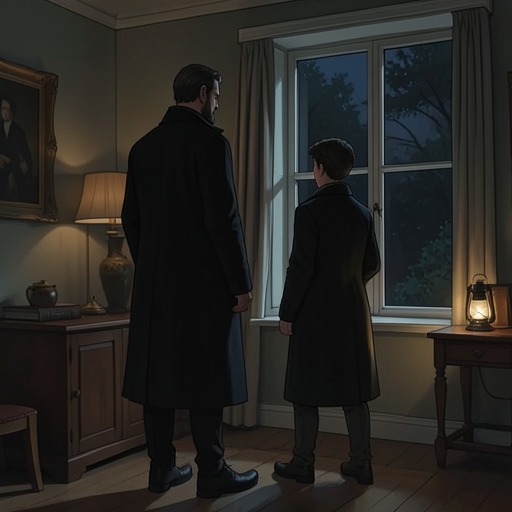
The immediate subject is the letter that had been left on the hall table. The Governess asks whether Miles took it the previous afternoon. Before he answers, Quint comes into view at the window, bringing the Governess’s attention sharply back to the presence she has encountered before. She understands the danger of the moment as a contest for Miles’s soul, but also recognizes that he does not know what she sees. Her immediate purpose becomes twofold: to keep the apparition in view and to hold Miles close without making him aware of it.
Quint at the Window
The apparition appears outside the window, close to the glass, glaring into the room with the same white face the Governess has described before. She springs up and draws Miles toward her, placing him with his back to the window. The action is both protective and strategic: she keeps the boy from looking directly at Quint while maintaining her own watch on the face beyond the glass. Her resolve takes shape in the conviction that she can confront the apparition while Miles remains unconscious of its presence.
Miles answers the question about the letter simply: he took it. The Governess enfolds him and feels his body’s sudden fever and the strong pulse of his heart. Holding him to her breast, she continues to watch Quint, who shifts from the stillness of a sentinel to the slow circling movement of a baffled beast, then fixes himself again at the window as if to wait. The Governess asks what Miles took the letter for. He says it was to see what she had written about him; when she asks whether he opened it, the confession is no longer a threat she must draw out indirectly but a fact he has admitted to her.
The Confession and the Ghosts’ Names
The letter confession does not end the pressure between them. When the Governess asks Miles what he had said at school, her sternness is directed, in her understanding, at the force she regards as his judge and executioner. Miles turns away. At that instant, Quint is again visible against the glass, and the Governess leaps toward Miles, crying out at the apparition and trying to press the boy against her. She interprets the moment as a chance to turn his alarm into evidence of liberation, insisting that the haunting is over.
Miles asks whether she means Miss Jessel. His guess shows that he associates the Governess’s cry with the other apparition and with what had happened to Flora. The Governess rejects that identification: she says it is not Miss Jessel but the horror at the window, and calls it the last time. Miles then reacts to a presence he cannot see. He turns and searches the room, bewildered and furious, asking whether it is Quint. When the Governess demands whom he means, Miles gives the name plainly: Peter Quint. The revelation confirms that Quint’s identity has entered Miles’s speech, but the scene does not establish how Miles knows the name or whether his recognition comes from seeing the apparition. He asks where Quint is, while his gaze fails to find what fills the Governess’s vision.
Apparent Victory and Death
The Governess treats Miles’s naming of Quint as the culmination of her devotion and her work. She tells the apparition that it no longer matters and that she has Miles, while telling the boy to look. Yet Miles turns, stares around, and sees only the quiet day. The contrast is decisive: where the Governess perceives Quint’s overwhelming presence, Miles sees no ghost. Her declaration of rescue therefore coincides with his inability to see the figure she is confronting.
Miles cries out as if falling into an abyss. The Governess catches and holds him with intense force, at first understanding her embrace as the act of saving him from Quint. A minute later, she realizes that what she holds is not a rescued child: Miles’s heart has stopped. The final reversal binds the scene’s two outcomes together. The Governess has secured his confession and believes she has defeated the apparition’s claim, but the boy dies while held against her, and the quiet day remains around them.
Narrative Significance
The confrontation is narrated by the Governess, whose account makes the scene’s emotional certainty coexist with uncertainty about what Miles perceives. She describes Quint in precise visual terms and experiences the encounter as a struggle for a human soul. Miles, however, cannot see the apparition when she directs him toward it. His use of Quint’s name is striking, but does not resolve whether he has shared the Governess’s vision, inferred what she means, or reached the name by some other route. The scene gives the Governess what she has sought—a confession and the spoken name—without allowing either to secure Miles’s survival.
The window concentrates the conflict into a difference of sight. Quint presses his face to the glass; the Governess watches him and tries to control what Miles can see; Miles searches but finds only daylight. Her embrace is at once an effort to shield him, a means of keeping his back to the window, and the final physical act through which she experiences her supposed victory. That action ends not in recovery but in death. The narrative’s closing image thus refuses to separate rescue from loss: Miles’s heart stops in the Governess’s arms, immediately after she has declared that Quint can no longer reach him.