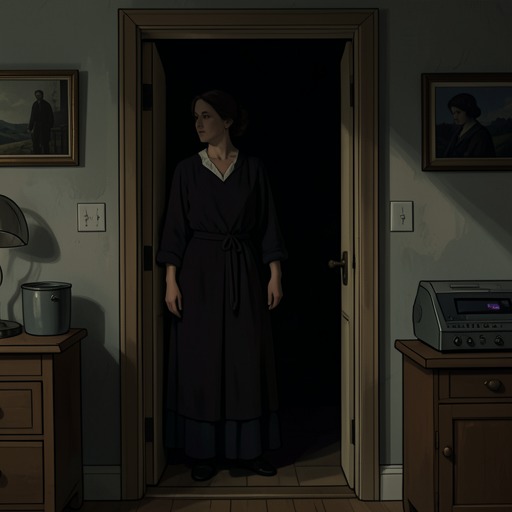
The white face of damnation
The Turn of the ScrewThe white face of damnation is the Governess’s recurring description of Peter Quint’s apparition at the window, where it intrudes on her final confrontation with Miles. More than a mark of horror, the image concentrates the scene’s conflict: she sees Quint and tries to protect Miles from that sight, while Miles’s own account of what he perceives remains uncertain.
Appearance at the Window
In the final room scene, the Governess’s attention splits between Miles and an apparition outside. She springs up, draws him close, and keeps his back to the window; only then does she see Quint close to the glass, glaring into the room with the familiar white face. The image returns as a sentinel-like presence, poised outside the room while the Governess holds the child between it and herself.
The description makes whiteness carry both visibility and menace. Quint’s face is plainly visible to the Governess, yet the scene’s immediate action turns on whether Miles can see it too. She believes that facing the apparition while keeping the boy unaware is the task before her, and she holds him at arm’s length as she tries to preserve that separation.
Recurrence During the Confession
The face appears again when the Governess presses Miles to explain what he had intended to write home. As he turns away, she sees the apparition at the glass once more, seemingly poised to interrupt his confession. She leaps toward Miles and addresses the presence with a cry that the matter must end; in her account, the apparition’s return revives the battle at the very moment she had hoped to secure the boy’s disclosure.
Miles asks whether she means Miss Jessel, following the direction of the Governess’s words with his eyes described as sealed. The Governess corrects him: it is not Miss Jessel but something at the window, which she identifies as the horror that has returned for the last time. His question and her correction keep the image suspended between two kinds of knowledge: the apparition she insists is before them, and Miles’s uncertain understanding of what she is addressing.
Narrative Significance
The repeated face gives the final confrontation a visual center, but does not settle the question of what Miles himself sees. The Governess’s narration presents Quint as physically present at the glass and describes her efforts to shield the child; Miles, by contrast, names Miss Jessel when he catches the direction of her speech. The discrepancy makes the face both an asserted supernatural presence and a test of the Governess’s interpretation.
The window sharpens that ambiguity. Quint is outside, visible to the Governess and addressed as the source of the danger, while she tries to keep Miles turned away and draw from him the truth about his letter. The image therefore joins seeing to testimony: the Governess claims the authority of sight, yet her protective gesture also limits what Miles might see. Its final return marks the climax of that conflict without resolving the difference between her vision and his.