Eve Ensler—Betty Dodson artistic relationship
The Vagina MonologuesEve Ensler’s artistic relationship with Betty Dodson connects the collective testimony at the heart of The Vagina Monologues to a practical tradition of feminist sexual education. In Ensler’s account, Dodson’s work made women’s bodily knowledge a subject for open conversation and personal inquiry; the dedication of “The Vagina Workshop” recognizes that influence directly.
Encounter and influence
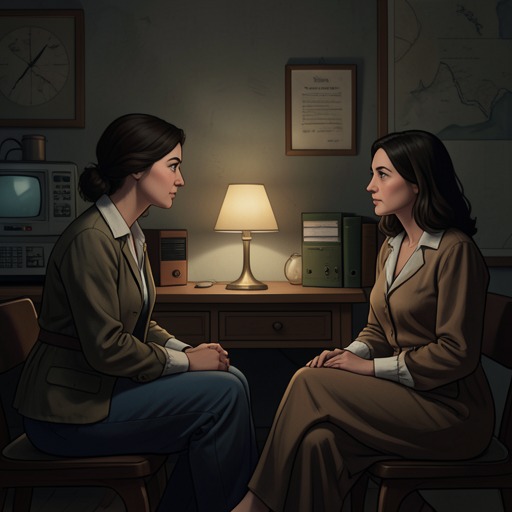
Ensler recalls sitting with Dodson in a New York City coffee shop, trying to appear composed while Dodson cheerfully explained masturbation as a liberating force. The scene offers a compact portrait of their connection: Dodson’s ease in discussing a stigmatized subject unsettles the silence around it, while Ensler observes the response from people nearby. The encounter is not described as a formal lesson or collaboration, but as a vivid example of the public candor that Ensler associates with Dodson.
That candor mattered against a background of incomplete language and knowledge. Ensler writes that she had never heard the word “clitoris” while growing up, and that she was not given an accurate or affirming vocabulary for one area of her body. The resulting silence, she says, left her more exposed to shame and to the assumption that men, including lovers and physicians, knew more about women’s bodies than women themselves. Dodson’s work, as Ensler presents it, belongs to the countertradition: women learning about their own bodies and speaking about that knowledge openly.
From interviews to a workshop account
Ensler’s wider project grew from conversations with women. She says that interviews with more than two hundred women became the monologues, drawing on participants with different ages, relationships, occupations, sexual identities, and racial and ethnic backgrounds. Their initial reserve gave way once they began talking. The project therefore takes women’s accounts not as a single uniform experience but as testimony emerging across varied lives.
Within that larger undertaking, “The Vagina Workshop” turns toward Ensler’s own encounter with bodily knowledge. Before the workshop, she describes her understanding as abstract: she had not regarded the subject as part of her own body and had never actually looked. Participants were asked to use hand mirrors, examine themselves, and report what they saw to the group. Ensler says that, until then, what she knew had rested on hearsay or invention. The exercise makes looking and speaking part of the same process: knowledge is no longer only something received from others, but something participants can investigate and articulate themselves.
Dodson’s work and its reach
Ensler links this workshop experience to Dodson’s long-running practice. During her interviews, she met nine women in their late thirties and early forties who had experienced their first orgasms in the same place. They had participated at different times in one of the groups Dodson led. Ensler describes Dodson as having spent twenty-five years helping women locate, love, and masturbate their vaginas, through both group work and private work with individuals. She says Dodson had helped thousands of women reclaim their center.
These details give the relationship a concrete dimension beyond admiration. Dodson’s influence is represented through a sustained educational practice, its varied settings, and the women whose accounts led Ensler to recognize a shared point of origin. The workshop episode and the interviewees’ recollections are distinct kinds of evidence: one recounts Ensler’s own learning, while the other shows the reach of Dodson’s groups through participants’ later stories.
Dedication and significance
Ensler dedicates “The Vagina Workshop” to Dodson, calling her brave and extraordinary. The dedication makes the connection explicit without claiming that Dodson authored Ensler’s work or that the two had a formal artistic partnership. Instead, it identifies a lineage of practice: Dodson helped create spaces in which women could attend to their bodies and speak about them, while Ensler gathered women’s speech into theatrical monologues.
The relationship thus joins embodied education to literary form. The coffee-shop recollection shows the force of saying plainly what social convention leaves unspoken; the workshop narrative makes self-observation and group testimony part of the same inquiry; and the dedication names Dodson’s contribution to the world of practice from which Ensler’s writing draws. In her acknowledgments, Ensler thanks Dodson for loving vaginas and for starting “all this,” presenting her influence as an important source for the work’s larger challenge to silence.