Eve Ensler—V-Day founding relationship
The Vagina MonologuesEve Ensler’s founding relationship with V-Day joins a work of performance to a campaign against violence toward women: after hearing women’s accounts of abuse as she presented The Vagina Monologues, she worked with activist women to create V-Day, whose first event took place on Valentine’s Day in 1998. The book presents the partnership not as a simple institutional spin-off, but as a practical response to testimony, an effort to make performance itself a catalyst for action.
From testimony to collective action
The account places the founding against a sustained encounter with violence. As Eve Ensler performed The Vagina Monologues in small towns and large cities, women told her stories of rape, incest, domestic battery, and genital mutilation. The repeated accounts made the scale and consequences of violence difficult to treat as isolated private matters; the book says it became clear that something major and dramatic needed to be done.
This background also connects V-Day’s creation to the book’s insistence on naming what is otherwise kept silent. Eve Ensler recalls never hearing the accurate word “clitoris” while growing up, and describes how the absence of truthful language left her vulnerable to shame and to the assumption that men, including lovers and physicians, knew more about women’s bodies than women themselves. The founding relationship is situated within that larger movement from silence toward women speaking about their own experiences, though the account does not reduce the organization’s purpose to language alone: the specific impetus was violence and the need to act against it.
The founding and first event
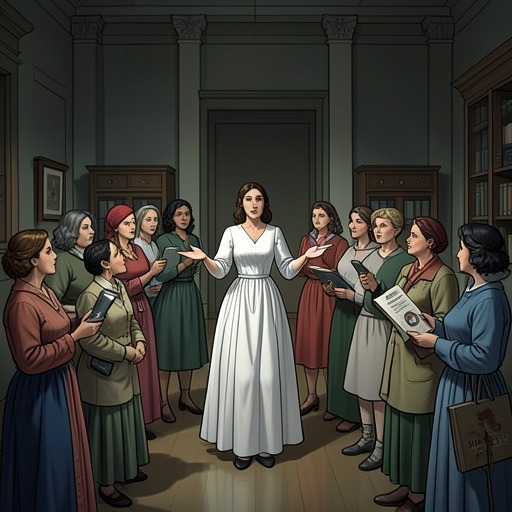
In 1997, Eve Ensler met with a group of activist women, many associated with Feminist.com, and they formed V-Day. The book describes this as collective work: Ensler did not found the initiative alone, but joined with women who helped turn the conviction arising from her encounters with audiences into a shared project.
The first V-Day was held on February 14, 1998, on Valentine’s Day. Twenty-five hundred people lined up outside the Hammerstein Ballroom in New York City for the inaugural event. The date and the scale of the gathering give the founding a distinctly public form: what began in response to accounts women had shared during performances became an occasion that drew a large audience into a collective event. The book calls the first V-Day “born,” making the date both the launch of an initiative and the beginning of a recurring public effort.
The play as origin and instrument
The later account explicitly identifies V-Day as an outgrowth of The Vagina Monologues. The relationship is therefore structural as well as historical: Ensler’s performances brought her into contact with women’s testimony, and the play provided the platform from which an organized response emerged. The initiative did not replace the work that had prompted it; the book presents performance as one of the means through which the campaign could be made visible and shared.
The two forms also carry different but connected functions. The monologues make room for women to tell experiences that are often hidden or treated as shameful; V-Day turns that encounter with testimony toward the demand that violence end. In the book’s formulation, it is simultaneously “a catalyst, a movement, a performance.” That three-part description resists a narrow definition of the founding as the creation of a standard nonprofit or a single production: the work is theatrical, mobilizing, and oriented toward change.
Structure and significance
The book describes V-Day as a “next-step philanthropy” housed in people’s minds and hearts rather than in one physical location. It says the initiative pays no office rent or other traditional organizational expenses because, in this account, it is not an organization in the conventional sense. This description distinguishes the founders’ undertaking from a centrally located institution: its identity rests on participation and shared purpose rather than on a permanent office.
That structure follows the founding logic. Women’s accounts encountered in performances prompted collective action; the first event gave that action a public gathering place, while the broader conception of V-Day allowed the work to extend beyond a single venue. Eve Ensler’s relationship to the initiative is thus one of co-founding and continuing connection to the performance that generated it. The book’s emphasis on testimony, performance, and a demand to end violence makes the founding consequential not merely as an organizational beginning, but as the point where listening to women’s stories was turned into a movement-oriented response.