V-Day
The Vagina MonologuesV-Day is a movement, public campaign, and fundraising effort born from Eve Ensler’s The Vagina Monologues. Its significance lies in converting the play’s exposure of violence against women—and the conversations it opened with audiences—into organized awareness, financial support, and a continuing call for social change. Its name holds both an annual observance and a future aspiration: Valentine’s Day is proclaimed V-Day until violence against women stops, after which it will become Victory Day.
Origins and Formation
The movement developed from Eve Ensler’s experience performing The Vagina Monologues in cities and small towns. After performances, women waited to speak with her about their lives; the play had opened memories and made stories of rape, incest, domestic violence, and genital mutilation speakable in public. The encounters showed Ensler the consequences of violence directly and convinced her and other organizers that performance could lead to work beyond the theater.
In 1997, Ensler met with a group of activist women, including members of Feminist.com, and they formed V-Day. A group of women in New York joined her as founders. The organization describes itself as an outgrowth of The Vagina Monologues: the play supplied a public platform, while the movement made ending violence its explicit purpose. V-Day is presented not as a charity confined to an office or building, but as a cause housed in people’s minds and hearts.
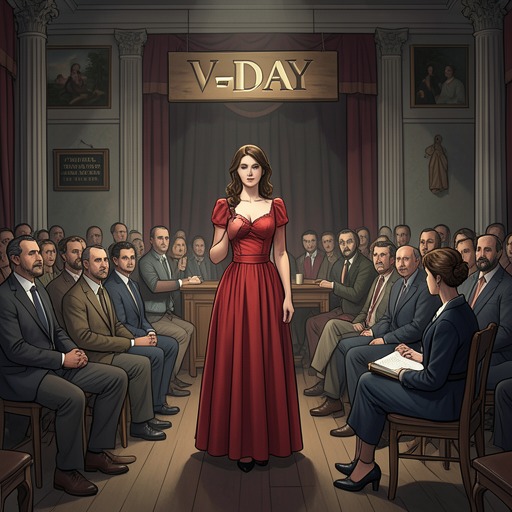
The first V-Day took place on February 14, 1998, at the Hammerstein Ballroom in New York City. Twenty-five hundred people lined up outside. Performers and participants—including Whoopi Goldberg, Gloria Steinem, and other artists—presented The Vagina Monologues in an event that raised more than $100,000 and launched the movement. The crowded venue and the funds raised gave concrete form to the premise that a theatrical gathering could also serve as a public intervention.
Mission and Methods
V-Day’s stated mission is to end violence against women by increasing awareness through events and the media and raising funds for organizations that work to ensure women’s safety. It defines itself at once as a movement—an organized effort toward an end—and as a catalyst that can renew existing initiatives and begin new work in publicity, education, and law. Performance is therefore one instrument among several, linked to public communication and material support rather than treated as an end in itself.
The organization’s vision is a civilization in which women live in freedom and safety. Its account of that vision contrasts a life of creating and thriving with one spent surviving or recovering from atrocities. That contrast gives its mission an affirmative dimension: the aim is not only to respond to violence after it occurs, but to make safety and the possibility of a full life ordinary conditions.
V-Day also makes the calendar part of its method. The annual observance is to continue as V-Day for as long as violence against women persists; only when that violence ends will the day become Victory Day. This conditional naming joins celebration to unfinished work. The date is not presented as proof of victory, but as a recurring occasion to renew the effort until the stated condition is met.
Public Events and Reach
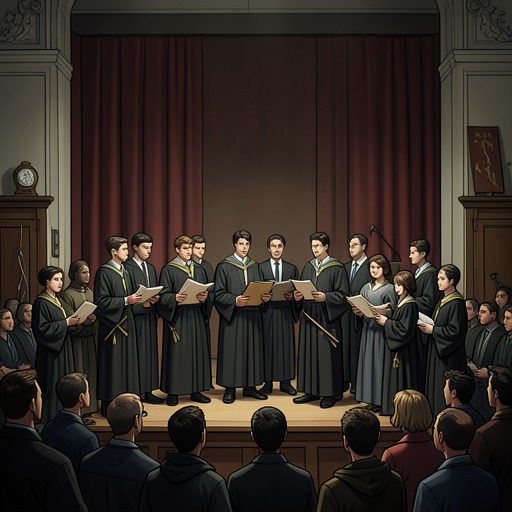
The inaugural 1998 event established a model that traveled beyond New York. V-Day events followed at the Old Vic in London in 1999 and in other cities and colleges. The book describes performances in twelve other cities worldwide and at 150 colleges, alongside an expansion of fundraising for local, national, and international organizations. More than $785,000 was given through this activity to groups working to end violence.
The movement’s reach also depended on what happened after a performance. As Ensler traveled with the play from city to city and country to country, hundreds of women stayed to talk. Later accounts of touring describe women approaching her after shows to tell their stories, offer suggestions, and communicate their responses. Such exchanges made audiences participants in the movement’s knowledge as well as its events: individual testimony connected the public performance to varied experiences of violence and to demands for further action.
The book gives the organization’s wider results as well as the figures associated with particular events. In three years, V-Day had raised and donated more than a million dollars to grassroots organizations fighting violence against women worldwide. It also reports that more than $785,000 went to local, national, and international groups in the described cycle of events. These figures refer to different accounts of V-Day’s activity; together they indicate the scale and reach attributed to its fundraising, without reducing its work to money alone.
Principles and Significance
V-Day’s organizing language links the physical and creative force of women’s lives to the political consequences of violence. The movement describes violence not as an isolated injury but as an attack on life’s capacity to remain open, trusting, nurturing, creative, and alive. Its response accordingly combines public speech, collective gathering, and support for organizations already working for women’s safety. The emphasis on a catalyst acknowledges that V-Day does not claim to replace those efforts; it aims to make them more visible and to help initiate further ones.
The movement also changes the function of the theatrical work from which it emerged. The Vagina Monologues began as a performance assembled through interviews with more than two hundred women, whose experiences differed by age, relationship status, sexuality, profession, and background. V-Day extends that listening outward: audiences gather around the play, some speak about their own lives afterward, and the resulting attention is directed toward awareness and practical support. The sequence from interview to monologue to public event and fundraising gives testimony a collective route without making the women’s experiences interchangeable.
V-Day’s defining significance is therefore both cultural and organizational. It challenges the silence surrounding violence by bringing women’s accounts into public settings, then seeks to turn attention into resources and sustained advocacy. Its promised Victory Day remains prospective, dependent on violence ending; until then, the name marks a movement that treats each observance not as a completed triumph but as another occasion to work toward one.