V-Day—The Vagina Monologues relationship
The Vagina MonologuesThe relationship between V-Day and The Vagina Monologues is both historical and practical: the play gave rise to the movement, while performances of the play became its central public form. As Eve Ensler took the work from city to city and country to country, women stayed afterward to tell her about their lives. Those encounters helped turn a theatrical project into an ongoing effort to end violence against women, with performances serving as occasions for public attention and fundraising.
From Interviews to a Stage Work
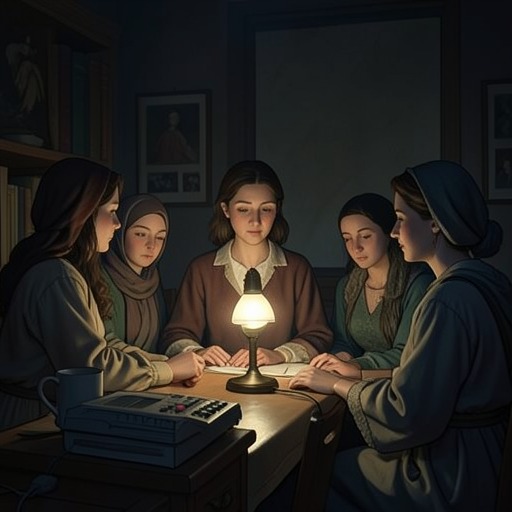
The connection began in a process of listening. Eve Ensler interviewed more than two hundred women, including older and younger women, married and single women, lesbians, college professors, actors, corporate professionals, and sex workers. She also spoke with women from a range of racial, ethnic, and religious backgrounds. Many were initially shy or reluctant; once they began speaking, however, their accounts continued to unfold. These interviews became the material for The Vagina Monologues, making women’s varied experiences the source of the work rather than an afterthought to its theatrical form.
The play’s subject also responds to silence around women’s bodies. Eve Ensler recalls never hearing the word “clitoris” while growing up and describes learning about her own body through hearsay or invention until a workshop asked participants to examine themselves with hand mirrors and report what they saw. Against that background, the interviews and stage monologues create a space in which women can name experiences that had been left unspoken. The relationship between play and movement therefore rests not only on performance, but on the act of making testimony audible.
The Touring Work and Its Audience
As Eve Ensler traveled with the play, its effect extended beyond the staged event. Women waited after performances to speak with her about their lives; in her account, the work had freed memories, pain, and desire. She heard accounts of rape during adolescence and college, among other experiences, and the post-show conversations became a recurring part of the play’s public life. The audience did not simply receive a finished work: women’s responses and stories accompanied it from place to place.
That exchange continued in cities whose enthusiasm surprised her, including Oklahoma City and Pittsburgh. Eve Ensler describes the conversations after performances as a favorite part of traveling with the work: women offered stories, suggestions, and responses in straightforward, matter-of-fact ways. Their participation shows how the play could function at once as a performance and as an invitation to speak, linking individual accounts to the broader purpose that V-Day would take up.
V-Day Emerges from the Play
The book presents V-Day as the greatest of the play’s recurring “vagina miracles”: an energy, a movement, and a catalyst for ending violence toward women, born out of The Vagina Monologues. The institutional origin followed the touring encounters. Eve Ensler performed the piece in towns and cities around the world and heard women describe the consequences of violence, including rape and incest. V-Day grew from the recognition that the stories gathered around the play called for action beyond the theater.
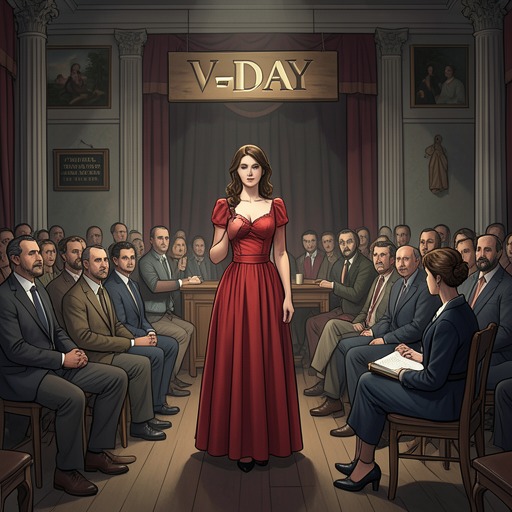
On February 14, 1998, Valentine’s Day, the first V-Day took place at the Hammerstein Ballroom in New York City. Twenty-five hundred people lined up outside. The event brought performers together to present The Vagina Monologues, raised more than $100,000, and launched the movement. The date and the scale of the gathering made the relationship concrete: the play was not merely an influence on V-Day’s founding, but the performance through which the inaugural event assembled an audience and generated funds.
The Play as the Movement’s Centerpiece
The relationship continued after the first event. V-Day was born in 1998 as an outgrowth of The Vagina Monologues, and the play remained the centerpiece of later initiatives. The planned 2001 worldwide initiative, for example, would support events in cities and communities during February, each using the established format: a production of Eve Ensler’s play featuring both celebrated performers and less-known women from the region. Each production would raise money for organizations working to end violence in those communities.
This model preserves the original link between testimony, performance, and action while adapting it to local settings. The monologues provide a shared theatrical framework; regional performers and local beneficiaries connect that framework to particular communities. V-Day thus extends the play’s reach without separating the movement from the work that first gave it form. The relationship is reciprocal: the play supplies the movement’s recognizable centerpiece, while V-Day gives the play a continuing public and organizational purpose beyond any single performance.