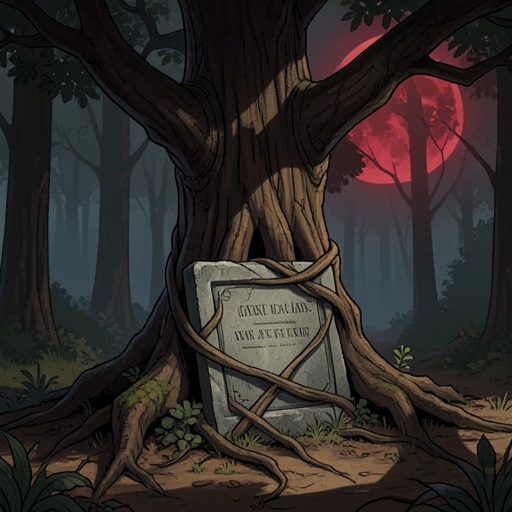
God of the Grove
The Vampire LestatThe God of the Grove is an unnamed ancient deity, also known as the Drinker of the Blood, who gives Marius his blood and immortality and commands him to travel to Egypt to discover why the gods are burning. A figure of a failing religious order, the god links the grove’s sacrificial rites to the origin of Marius’s mission and to the history of the vampires he will encounter.
Identity and Worship
The God of the Grove has no personal name. Mael’s teachings describe him through titles: the Drinker of the Blood, the White One, the God of the Night, the God of the Oak, and the Lover of the Mother. The titles place him within a sacred order rather than presenting him as an isolated supernatural being. He serves the Great Mother, an unseen presence understood to inhabit all things, and is himself described as a child of her world.
The god’s worship is organized around blood and the turning of the seasons. He receives blood sacrifice at every full moon. At Samhain, identified in the account with the first of November, the tribe makes its largest offering of human lives before the community, seeking increased crops as well as the god’s predictions and judgments. The rites connect the natural cycle of cultivation with a divine authority that demands sacrifice.
The Failing Gods
The God of the Grove belongs to a wider company of ancient gods who are enemies of light and live by the moon. A calamity has reached their sanctuaries: the sun has left its natural course, found its way into places where the gods had taken refuge, and burned them. The younger gods perish, while older ones remain alive but suffer from the effects of the disaster. The god’s own survival is therefore not a sign of safety or victory; it leaves him as a witness to the collapse of his order.
His weakened state sets the terms of his appeal to Marius. He needs a successor who is strong enough to escape the worshipers, leave the grove, and investigate the cause of the burning. The threatened sacred world is thus also a practical problem of succession: the god cannot carry out the journey himself, and the person made to replace him must first evade the community that expects to keep its new deity.
Encounter with Marius
Marius meets the god in a small stone chamber at the bottom of narrow steps. The encounter overturns what he expects to find: the being before him is recognizably human in face and limbs, but appears gravely burned. The god asks Marius to remain where he can see him, then explains the calamity and offers to make him immortal. His request is not simply an invitation to inherit a title. Marius must leave that night, escape the worshipers, and go to Egypt to find out what has happened to the old gods.
The god names Alexandria and the older cities as places where Marius should seek surviving gods. He tells him to summon them with the silent voice that will come with the transformation, and to learn who remains and why the disaster occurred. The journey is presented as necessary not only for Marius’s own safety but for the survival of the old order: the god warns that the unnatural sun could find him wherever he hides unless its cause and prevention are discovered.
Transformation and Command
The god gives Marius his blood in a gradual exchange, describing the process as one in which he will take and give repeatedly. He directs Marius to leave before sunrise and to seek protection beneath the earth, then begins the transformation without waiting for Marius’s agreement. In the experience Marius recounts, the gift carries images of Egyptian tombs and temples, two figures seated together, and voices speaking in other languages. Beneath those images persists a command to serve the Mother, take sacrificial blood, and preside over the grove’s worship.
The transformation binds Marius to the god’s mission, but the god’s instructions also require him to break with the worshipers who have preserved the cult. They may be unwilling to release a new and capable deity once the festival has passed. Marius must therefore travel quickly and avoid being confined in the oak. The god’s final act creates a successor while sending that successor away from the very community whose rituals gave the god his authority.
Narrative Significance
The God of the Grove’s role is brief but foundational: he makes Marius immortal and gives him the task that leads toward Egypt and the ancient vampires. His story also places vampire existence within a religious framework of sacrifice, sacred landscape, and contested interpretations of the supernatural. The grove’s worshipers understand the god through inherited ritual and agricultural obligation; the god, facing the destruction of his kind, turns that tradition into an urgent investigation.
The episode sets two forms of darkness against one another. The god’s people serve a deity who rejects the light and depends on lunar rites, yet sunlight has become the force that destroys their sanctuaries. His transformation of Marius is consequently both a transfer of power and an attempt to preserve knowledge: the new immortal is charged with finding the cause of a disaster that neither the old god nor his followers can resolve. The god’s command carries forward beyond the grove, making Marius’s departure the beginning of a history larger than the cult that formed him.