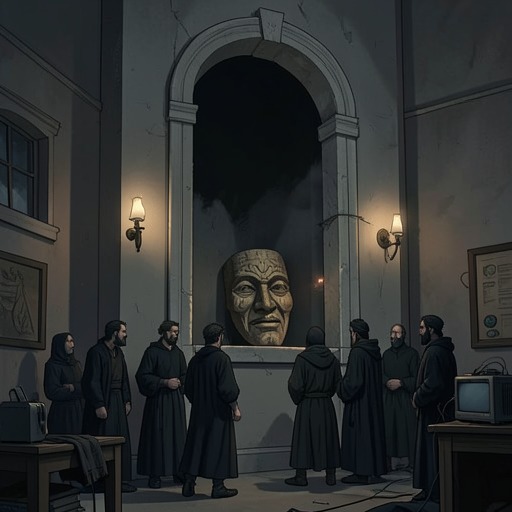
Renaud's theater
The Vampire LestatRenaud's theater is the shabby but artistically vital Paris playhouse where Lestat finds a livelihood, a company, and his first real place onstage. On the Boulevard du Temple, it joins popular entertainment to social ambition: the venue is makeshift and poor, yet its performance becomes a route to public acclaim and a formative model for the theatrical spectacle that later reappears in the Theater of the Vampires.
Setting and theatrical world
In the late eighteenth century, Parisian theater was divided by a state monopoly. The Comédie-Française and the Théâtre des Italiens were the officially sanctioned houses for serious drama, while older Italian commedia dell’arte survived at fairs and in the boulevard theaters that grew from them. Renaud’s theater belonged to this latter world. Its performances had to avoid competing directly with the state theaters’ monopoly on straight plays, so the company combined improvisational comedy with singing and assorted comic business.
The building made the difference between its surroundings and its stage especially striking. It was a rickety wooden structure that seated no more than three hundred, but its small stage and props were elegant; a luxurious blue velvet curtain and screened private boxes lent it an air of distinction. Its audiences were not limited to the poor who could not afford the grand houses. Aristocrats and wealthy bourgeois patrons also filled the boxes, drawn by performances that seemed livelier and less stiff than the canonical plays associated with Racine and Voltaire.
Lestat’s apprenticeship and work
Lestat arrives in Paris with Nicolas and is hired at a theater where his prospects are described as fine, but the day-to-day employment is far from glamorous. He helps actors dress, sells tickets, sweeps the floor, and throws out troublemakers. Their home is a garret reached by six flights of stairs, and the pair’s money runs short after Lestat spends freely on opera, ballet, and drama. They sometimes make ends meet by having Nicolas play violin on the boulevard while Lestat holds out a hat. Even so, the theater’s warmth and activity make it a refuge from the darkness and fear that trouble Lestat at twilight.
The company also gives him a practical education. He memorizes, mimics, asks questions, and studies the actors whom he serves. The theater’s improvised style recalls the commedia dell’arte troupe that first enchanted him in the Auvergne: performers work from a role and character, making the words and actions anew rather than relying on memorized dialogue. That practice suits Lestat’s own talent for invention. He longs for the moment when the actors will trust him with the role of Lelio, the young lover he had once been invited to play among the traveling players.
The company’s working life becomes a shared world in its own right. Lestat spends five or six hours each evening amid the shouting, laughter, quarrels, and backstage alliances of actors and musicians. The labor does not require everyone to be friends; it does require them to depend on one another through the performance. Nicolas is less wholly absorbed in the theater, and his bourgeois student friends regard their precarious arrangement with disdain. Lestat, who has dropped the family name de Lioncourt in favor of the unremarkable de Valois, is content to belong to the troupe rather than to resume the identity and expectations of his birth.
Performances and recognition
Lestat’s apprenticeship turns into a performing career. By September his name appears on the handbills, and the company presents a farce by a famous writer whose work cannot be staged at the Comédie-Française during a general playwrights’ strike. The author’s name is not announced, but the identity of the play is an open secret; the court crowds Renaud’s theater to see it. Lestat is not the lead. He plays the young lover, close in type to Lelio, and makes such an impression that by the fourth performance the playwright has written additional lines for him.
Nicolas has a parallel success in the intermezzo, where his performance of a light Mozart sonata keeps the audience in their seats. The two men’s fortunes improve together: even Nicolas’s student friends return, and invitations to private balls follow. A clipping from the English paper The Spectator praises the play and singles out the blond-haired rogue who wins the ladies’ hearts in the third and fourth acts. Lestat cannot read the review himself, but it gives his mother evidence of the success he has been trying to report from Paris.
The theater’s stage later becomes the site of a more startling display. Lestat throws himself into acrobatic turns, cartwheels, and somersaults, drawing on the fairground performers he had watched before. He sings the little song associated with Flaminia, spins again, and springs so high that he touches the rafters before descending soundlessly to the boards. The sequence transforms familiar theatrical skills into an exhibition of extraordinary physical ability. The audience sees a performance; the scene also makes the stage a space in which Lestat’s nature can exceed ordinary human limits.
From boulevard playhouse to marionette spectacle
The theater’s performance tradition has a later echo in the Theater of the Vampires in Paris. Accounts of that troupe describe performers made up as giant wooden marionettes, with gold cords descending from the rafters to their wrists, ankles, and heads. Their white cheeks bear perfect circles of rouge, their eyes resemble glass buttons, and their stillness is so exact that audience members argue over whether the figures are dolls or living people. The orchestra participates in the illusion: painted musicians mimic the jointed mechanical players that perform when a key is wound.
This marionette act develops the theatrical resources associated with Renaud’s theater—makeup, mimicry, music, choreographed bodies, and the audience’s uncertainty about what it is seeing—into a spectacle built around apparent inanimation. The earlier playhouse is not simply a venue recalled in the later Parisian theater: it establishes Lestat’s intimate knowledge of how performance can turn a body into a role and make artifice feel alive. Across both settings, theatrical illusion depends on the audience watching closely while remaining unsure where imitation ends and reality begins.