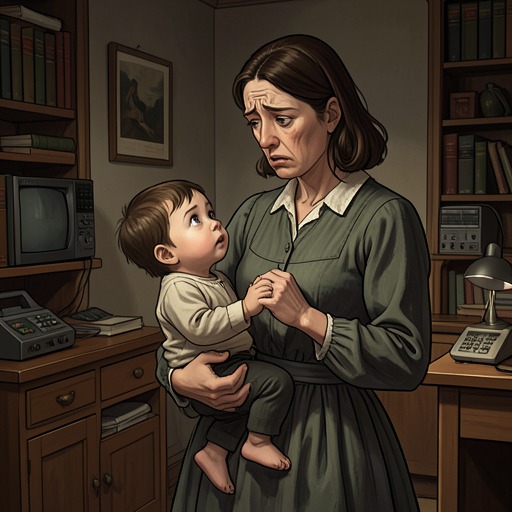
In-hye’s psychological crisis and thoughts of self-destruction
The VegetarianIn-hye’s psychological crisis and thoughts of self-destruction develop from a life organized around endurance, family obligations, and belated recognition of violence. Her distress is not confined to a single breakdown: it surfaces first as a profound estrangement from her own life, then as an impulse to harm herself, while her memories of Yeong-hye’s abuse and her own perceived failures make the crisis inseparable from the family’s treatment of her sister.
The Inheritance of Endurance
In-hye’s retrospective understanding of her family begins with the different positions she and Yeong-hye occupied in childhood. Yeong-hye was the only child subjected to their father’s beatings. In-hye, the eldest daughter, helped their exhausted mother by preparing broth for their father, and he treated her with a degree of care. She had thought of her own hard-working, self-sacrificing role as maturity; looking back, she recognizes it as a survival tactic. Her quiet compliance kept her safer, but it did not protect her sister.
A childhood memory acquires new meaning in light of that history. When the sisters became lost on a mountain, nine-year-old Yeong-hye suggested that they not go back. In-hye could not then understand why she wanted to remain away. Much later, she sees the suggestion as a response to a home in which Yeong-hye had borne their father’s violence alone. Their eventual return to town did not resolve the difference between them: In-hye felt relieved, while Yeong-hye watched the evening-lit poplars without speaking. In-hye’s later questions about what she might have done reveal how deeply she has come to connect her sister’s suffering with her own inability to intervene.
A Crisis in the Ordinary Life
Two years before the present, in the spring when In-hye’s husband made a video of Yeong-hye, In-hye experienced intermittent vaginal bleeding for nearly a month. Each time she washed her bloodstained clothes, she recalled Yeong-hye’s earlier injury. Fear that the bleeding might signal a serious disease led her to postpone a medical examination repeatedly. The possibility of death forced her to assess her marriage: she saw it as a period without happiness or spontaneity, sustained by her own perseverance and consideration.
On the morning she finally went to the obstetrics and gynecology department where Ji-woo had been born, she waited for a delayed train on the open-air platform at Wangsimni Station. Decaying temporary buildings and grasses growing beside unused tracks prompted the recognition that she had never really lived. She understood herself, even as a child, as someone who had endured rather than inhabited her life, and who had tried to be good and do the right thing. The examination identified a minor cause for the bleeding, and the doctor expected it to stop; the reassuring result brought her no happiness. At the station afterward, she hid behind a metal chair when the train arrived, afraid she might throw herself in front of it.
The bleeding stopped after several more weeks, but the sense of an inner wound remained. For months she continued to manage her shop competently, serving customers, recommending products, and supervising staff. That outward competence contrasts with the private feeling that something inside her was pulling her into darkness. At home, familiar belongings—including Ji-woo’s toys and the faded shirt she associated with nursing him—did not restore comfort. Instead, the apartment seemed unfamiliar, and she felt physically constricted by the space around her.
Thoughts of Self-Destruction
One evening, In-hye watched the second hand of a clock while trying to regulate her breathing. The effort did not ease her distress. A sense of having experienced the same moment repeatedly made the pain seem less like a passing mood than an accumulated condition finally brought into view. She thought that her life and the objects in her home did not belong to her, and understood her past as exhausted endurance rather than a life she had freely inhabited. Death felt familiar, like a long-absent member of the family who had returned.
The crisis takes the form of a deliberate preparation to leave home. For a week, In-hye had been taking down a mobile she had decorated with Ji-woo and patiently untying its tightly wound cord. On the night she went out, she put the rolled cord in her pocket, left the apartment while it was still dark, descended five flights of stairs, and walked from the rear gate toward the mountain. The familiar domestic setting, the carefully dismantled mobile, and the cord mark a movement from inward despair toward possible self-harm; the account does not establish that she carries out that intention.
On the mountain path, the folds of the dark landscape seemed deeper than usual. In-hye could not tell whether the moisture on her face was sweat or tears. The pain felt as if it were swallowing her, bringing fear but also a strange quiet. The scene holds these responses together rather than resolving them: the impulse toward disappearance is present, yet so is a moment of stillness within the crisis.
Guilt and Family Violence
In-hye’s distress is sharpened by her recurring belief that she should have prevented the events that harmed Yeong-hye. At the family gathering, their father struck Yeong-hye and forced meat on her after she had refused it. In-hye sprang toward him, but Yeong-hye spat the food out, and the encounter ended with Yeong-hye taking a fruit knife and injuring herself. In-hye’s recollection turns on the question of whether she could have stopped their father or taken the knife away in time. She also asks herself whether she could have prevented her husband, Mr. Cheong, from later casting Yeong-hye aside or from doing something In-hye regards as unforgivable. These questions are expressions of her guilt, not proof that she could have controlled the choices or actions of the other adults.
The family’s earlier violence also links Yeong-hye’s crisis to a longer pattern of coercion. Their father had beaten her through childhood, while his military-service stories and strongly held views made him a formidable presence in the family. His apology to Mr. Cheong astonished the son-in-law, who had never heard him apologize during five years of acquaintance. That rare admission did not undo the history In-hye later confronts: her sister had been left to absorb violence that In-hye, protected in part by her role as the dutiful eldest daughter, had not experienced in the same way.
Crisis and Resistance
The third part places In-hye’s psychological crisis alongside Yeong-hye’s deteriorating condition in the psychiatric hospital. Yeong-hye has stopped eating, become dehydrated, and resisted attempts to administer treatment. In an earlier exchange at the ward, In-hye asks why she had gone into the woods and urges her to eat something, while Yeong-hye asks for water and asks whether In-hye has spoken to the doctor. The scene registers In-hye’s efforts to care for her sister but also the distance between her practical concern and Yeong-hye’s increasingly difficult-to-understand experience.
At a later attempt to feed Yeong-hye through a tube, In-hye hears that the procedure has succeeded and that a sedative is to be given. She rushes back into the room, tells the staff to move away, and pulls the doctor back from the bed. When blood appears at the tube, she orders that it be removed and struggles against the carer trying to restrain her. The intervention is not a resolution of her own crisis, nor does the evidence establish what follows for either sister. It does, however, show In-hye moving from retrospective self-reproach to immediate action: faced with another scene in which Yeong-hye’s body is subject to others’ decisions, she refuses to remain a silent witness.