Ji-woo
The VegetarianJi-woo is In-hye’s son and Yeong-hye’s nephew. Though he is young and often seen through his mother’s perspective, his illness, questions, play, and need for care give concrete form to the responsibilities that keep In-hye attached to daily life. As his family changes, he is at once a child requiring protection and an increasingly perceptive witness to absence and distress.
Identity and Early Family Life
Ji-woo is born after In-hye has established herself as a cosmetics-store manager and secured an apartment. When he is three, he starts nursery, a change that enables In-hye to spend the day at the shop again. Her work and his care are intertwined: she has built a livelihood while raising him, and she continues to carry the household’s practical responsibilities.
His father’s presence in the home is limited even before the marriage ends. When the father arrives late, Ji-woo turns back to his plastic forklift truck; it is impossible to tell whether he is glad to see him. Later, In-hye recalls that Ji-woo had asked every morning whether there was a father in their family, even while his father was still around. The question registers not a single sudden rupture but a longstanding absence in the child’s everyday experience.
Illness and the Disappearance
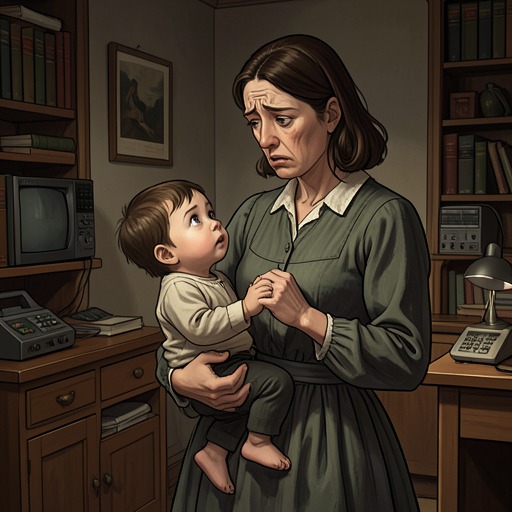
When In-hye receives word that Yeong-hye has gone missing, she is with six-year-old Ji-woo at a hospital, where he is having his lungs X-rayed after several days of fever. He waits by the machine, looking between his mother and the doctor with apprehension. In-hye leaves the examination to take the call, then returns to hug him; he feels light and hot in her arms. He tells her that he did well and did not move, seeking the praise that follows his cooperation.
The crisis involving Yeong-hye does not erase Ji-woo’s immediate needs. In-hye must respond to the hospital while also attending to her sick child, and she tries to reassure him after his coughing brings her into his bedroom. Yeong-hye had once sat hunched in a corner there, but In-hye pushes the remembered image aside and takes Ji-woo’s hand, saying that things are all right. She cannot tell whether she is comforting him or herself. The gesture makes their bond a practical refuge, even as the unresolved family crisis remains close.
Separation and In-hye’s Care
After Ji-woo’s father leaves, In-hye answers his recurring question about whether their family has a dad with a brief no. To herself, she frames their household as consisting of the two of them and resolves that this will have to be enough. The answer gives the child a stark account of the changed family, while In-hye’s inward response reveals the burden she assumes in making their smaller household sufficient.
In-hye makes a rule of spending evenings and weekends with Ji-woo after his father’s departure. When she must remain at the hospital because of a relative, she arranges for the neighbor to look after him and plans around the bus that will bring her back. The unusualness of leaving him with someone else becomes clear to her as she makes the call. Her thoughts turn to his future: he will soon be old enough to read and encounter other people independently, and she wonders how she will explain what has happened without putting his happiness at risk.
Play, Laughter, and Dreams
Ji-woo’s play can briefly interrupt In-hye’s pain and insomnia. When something he says or does makes her laugh, the pain momentarily disappears; the laughter can seem more manic than joyful, but Ji-woo delights in it and repeats the action that produced it. He mimics a horn growing from his forehead, makes clattering sounds, and calls to her in a silly voice. His improvisations become an effort to draw more laughter from his mother, though he cannot know how guilty she feels about the lengths he goes to, or that the relief will not last.
A remembered childhood dream gives Ji-woo another way to express his awareness of his mother’s absence. He tells her that he saw a photograph of her flying in the wind; in the dream, a bird said it was his mother, and two hands emerged from its body. In-hye remembers the sadness in his voice and asks about the dream. The image is not explained, but it joins the book’s recurring language of flight to a child’s intimate fear and longing, without turning him into an interpreter of the adults’ crises.
Narrative Role
Ji-woo’s scenes are grounded in ordinary particulars: a toy forklift, an X-ray appointment, a fever, a bus timetable, a child’s joke, and a question repeated each morning. These details measure the family’s upheaval through the routines that continue around it. His dependence on In-hye helps explain why she keeps returning to the work of care even as her own distress grows; that responsibility is a tether to daily life, not a cure for her suffering.
The novel also limits what Ji-woo can understand. He notices his father’s absence, seeks reassurance when ill, and tries to make his mother laugh, but the consequences of the adults’ choices remain beyond his knowledge. His importance lies partly in this difference of scale: while the family’s conflicts threaten to overwhelm ordinary life, his needs make the ordinary unavoidable.