Adolin Kholin
The Way of KingsAdolin Kholin is Dalinar Kholin’s son, a young Kholin prince, and a Shardbearer whose actions repeatedly turn family loyalty into practical courage. He rides at the front of Alethi power, wears inherited Shardplate, and commands a white Ryshadium stallion, but his most decisive role is moral: when Torol Sadeas exploits war as a contest and deceit threatens Dalinar’s house, Adolin refuses to let his father be reduced to a fool or a traitor. His arc presents a warrior formed by privilege who nevertheless recognizes loyalty, courage, and the attempt to improve Alethkar as values worth defending.
Identity and Introduction
Adolin appears during the royal hunt on the Shattered Plains, riding near King Elhokar Kholin, Dalinar Kholin, and Torol Sadeas at the head of an imposing procession. Behind the leaders march a thousand soldiers in Kholin blue, accompanied by servants and women in palanquins who record the hunt. The placement is significant: Adolin is not a remote noble observing events from safety, but a member of the ruling family positioned close enough to hear the highprinces speak and to enter the danger when it arrives.
He is already an accomplished Shardbearer, though the armor remains demanding rather than effortless. Adolin has worn the suit of Shardplate inherited from his mother’s side of the family since his sixteenth birthday, seven years before the hunt. Its enhanced speed, strength, and dexterity require practice, and he can still be caught off guard by the force of his own movements. The detail gives his martial identity a physical dimension: power is inherited, but mastery must be learned.
His relationship to Torol Sadeas is tense from the beginning. Adolin grips his reins more tightly whenever Sadeas speaks, a small involuntary gesture that reveals distrust before open conflict begins. He also chooses to remain near the front because he wants to listen. Curiosity, vigilance, and impatience therefore accompany his position as prince; he is not satisfied merely to possess rank, armor, or a place in the procession.
Courage in the Chasmfiend Hunt
When the chasmfiend attacks, Adolin’s response distinguishes him from the frightened horses and from the more cautious movements of the royal party. He races for Sureblood rather than charging on foot, and his white Ryshadium stallion remains steady while other animals panic. That steadiness allows him to enter the battle quickly, while Dalinar mounts Gallant and prepares to join him. Adolin’s courage is consequently not presented as reckless bravado alone: it depends on a trained partnership with a remarkable warhorse and on the ability to act while the surrounding formation breaks down.
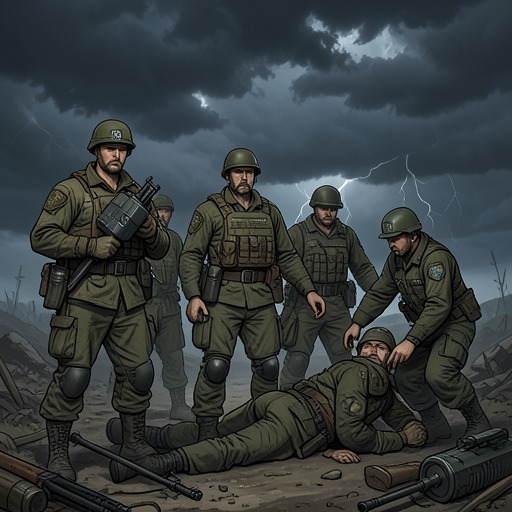
The hunt also establishes Adolin as a direct participant in the defense of the army. The chasmfiend is killing soldiers, arrows are failing to reach its vulnerable flesh, and Torol Sadeas’s grandbow would take too long. Dalinar identifies the situation as a job for the Blade, while Adolin charges into the developing fight. Later, Adolin’s armor is scratched as he fights at the front of a retreat, holding the Parshendi back. From the royal hunt to the battlefield withdrawal, his Shardplate is associated not with ceremonial display but with exposure to danger.
His martial loyalty becomes verbal as well as physical when Torol Sadeas dismisses Dalinar’s conduct. Sadeas argues that every human dealing is a contest in which some succeed and others fail. Adolin interrupts to defend his father, insisting that Dalinar is one of the most renowned warriors in Alethkar and pointing out that Sadeas had remained near the pavilion with his bow while Dalinar held off the beast. His anger nearly carries him into an insult and toward summoning his Shardblade, but Dalinar orders him to restrain himself. Renarin Kholin then places a hand on Adolin’s arm, and Adolin reluctantly backs down.
The scene captures both sides of his character. He possesses the rank and weaponry to make his anger dangerous, yet he can still accept correction from Dalinar and Renarin. His loyalty is immediate and emotionally forceful, while discipline is something he must actively practice. That tension prevents his defense of Dalinar from becoming simple hero worship: Adolin must learn how to protect his father without allowing Sadeas to dictate the terms of the confrontation.
Family Loyalty and Political Conflict
Adolin’s deepest conflict is tied to Dalinar’s attempt to transform the war on the Shattered Plains. Dalinar remembers the command to unite the highprinces and considers using the old specialization of the highprinces as a way to make Alethkar’s fragmented rulers cooperate again. The proposal recalls a system once intended to force the ten highprinces to submit to one another’s authority, but that arrangement disappeared after Alethkar fragmented into ten autonomous princedoms. Adolin’s family therefore stands inside a political struggle larger than a single battlefield quarrel: Dalinar is trying to rebuild collective authority while rivals treat the war as competition.
When Elhokar confronts Dalinar about his visions and the changes they have produced, Dalinar asks what they are willing to sacrifice for vengeance. The king answers that they are willing to give anything, and Dalinar warns that revenge could destroy everything Gavilar Kholin worked to build. Adolin is not the speaker in this exchange, but the dispute defines the world his loyalty must navigate. His father’s reformist purpose is repeatedly endangered by the same culture of vengeance and rivalry that gives the Kholin family its power.
After Torol Sadeas abandons Dalinar’s army, Adolin’s allegiance becomes explicit in the aftermath. Dalinar blames himself for having risked the house for foolish dreams, but Adolin rejects that judgment. He argues that Dalinar should not have become like Sadeas and the other highprinces merely to gain security, and he refuses to blame his father for Sadeas’s deceit. Adolin does regret that the family allowed Sadeas to trick them into the disastrous situation, but regret does not become condemnation. He separates a failed decision from the character of the person who made it.
That distinction is central to Adolin’s role. He does not defend every consequence of Dalinar’s conduct; he defends the principle behind Dalinar’s attempt to make Alethkar better. His loyalty is therefore allied with political judgment. He recognizes deception as the cause of the catastrophe while preserving his father’s right to pursue reform, even when reform exposes the family to immediate danger.
The Kholin House and the Meaning of Honor
Adolin’s presence at the front of the procession places him among the visible institutions of Alethi authority: the king, the highprinces, the soldiers, the servants, and the scribes recording noble action. Yet the narrative repeatedly contrasts public grandeur with private pressure. He must handle a canteen carefully because Shardplate can crush it; he must control his hand when Sadeas provokes him; and he must fight while the political order around him proves unreliable. The armor magnifies his physical capacity without automatically supplying judgment.
Dalinar’s projected reorganization of the war gives Adolin’s family position an institutional consequence. Dalinar plans to accept the title of Highprince of War, enforce the Codes in all ten camps, coordinate plateau assaults, place gemhearts under the Throne, and turn the ten armies from competing forces into a real army. He intends to give his Shardplate to Renarin Kholin and has already given away his Shardblade to fulfill another promise. Adolin’s defense of Dalinar thus supports a transformation that would redistribute military power inside Alethkar, not merely preserve one highprince’s reputation.
The broader book also places Alethi hierarchy beside other systems of authority. In Shinovar, warriors are treated as the lowest men and farmers receive honor and attention; in Babatharnam, authority belongs to the elderly, with the oldest ruler called the Most Ancient. These contrasts sharpen the instability of Adolin’s own society, where power is organized around eye color, rank, inherited privilege, and competitive highprinces. His loyalty to Dalinar matters because it is attached to a proposed alternative: authority should coordinate and protect rather than merely reward the most ruthless competitor.
Development and Narrative Significance
Adolin’s evidence in the novel forms a pattern of increasing moral definition. He begins as a prince in inherited Shardplate, tense around Sadeas and eager to hear the political conversation at the head of the procession. In crisis, he becomes a mounted defender whose Ryshadium carries him steadily into danger. In conflict, he speaks before thinking, then accepts restraint. In the aftermath of betrayal, he gives Dalinar the judgment Dalinar cannot give himself: the attempt to improve Alethkar should not be erased because an enemy exploited it.
His arc also develops through contrast with men who treat warfare as a contest. Torol Sadeas’s smooth confidence, strategic withdrawal, and willingness to abandon fellow Alethi expose a standard of aristocratic self-preservation. Adolin’s instincts run the other way. He moves toward the chasmfiend, toward the enemy lines, and toward his father’s defense. Even when he cannot control the political outcome, he can decide what kind of son and soldier he will be within that outcome.
Adolin’s role is especially important because the novel’s largest threats exceed ordinary military understanding. Dalinar’s visions command him to unite the highprinces and warn that the Everstorm is coming. Dying soldiers speak of an approaching catastrophe, and a mysterious figure declares that someone must lead those who will face it. Against this background, Adolin’s grounded acts of protection acquire larger significance. He is not the source of the visions, nor the interpreter of the dying, but he is one of the people whose loyalty could make unity possible. His defense of Dalinar preserves the human and familial bond on which any broader alliance must depend.