Conclave
The Way of KingsThe Conclave is the monumental scholarly complex at the apex of Kharbranth, and Shallan’s arrival there marks her passage from the city’s noisy, heterogeneous streets into an enclosed world of books, scribes, and lighteyed authority. Carved directly from the mountainside rather than assembled from brick or clay, it embodies knowledge as something ancient, massive, and controlled: a place that welcomes her because she belongs to the educated lighteyed class, yet overwhelms her with its scale and institutional power.
Exterior and Position
The Conclave stands at the highest point of the city, after the crowds and traffic have thinned on the climb uphill. Its white facade is carved from the rock itself. The front pillars grow seamlessly out of the stone, while the rear of the building merges into the cliff, making the structure appear less constructed than extracted from the mountain. Roof outcroppings carry squat domes painted in metallic colors, giving the severe stone complex a deliberate decorative finish.
The building’s setting separates it physically and symbolically from ordinary urban life. Below, Shallan encounters foul alley smells alternating with spicy food, dense traffic, foreign travelers, street vendors, bells, wheels, and the cries of skyeels. At the summit, the Conclave replaces that disorder with stone, elevation, and architectural permanence. The contrast establishes the institution as a world apart, though not an entirely silent one: even deep within it, distant bells continue to carry from the city outside.
Institutional Threshold
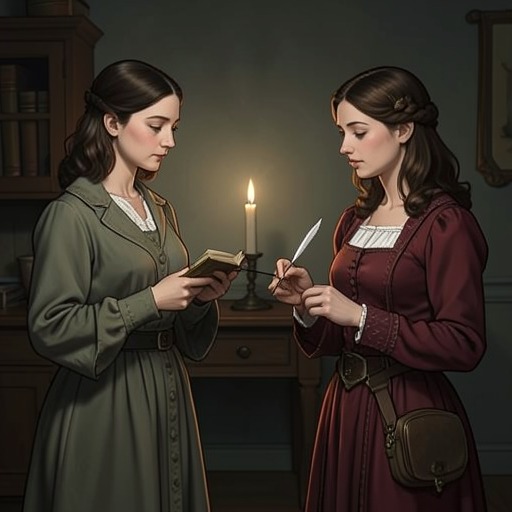
The people entering and leaving the Conclave reveal its social character. Lighteyed women carry scribing utensils and wear dresses like Shallan’s, with their left hands properly cuffed. Men wear military-style Vorin coats and stiff trousers, the coats extending to the knee and closing up the sides beneath a collar that encircles the neck; many also carry swords. The building therefore joins scholarship to rank, gendered custom, and military authority rather than presenting learning as socially neutral.
Shallan approaches the entrance accompanied by Yalb and a porter, whose dispute over the travel price briefly punctures the solemnity of the place. After the porter attempts to inflate the fare and offers to split the difference, Yalb helps Shallan down from the cart and gives her an elaborate bow. She preserves the scene mentally for a later sketch, showing that even at the threshold of the Conclave she remains an observer and artist, attentive to ordinary gestures amid institutional grandeur.
Interior Architecture and Illumination
Shallan experiences entering the Conclave as being swallowed by the building. Inside, Stormlight lamps cast an even white glow through the hallways, probably using diamond broams, the highest denomination of sphere and a source of light comparable to several candles. The illumination is practical but also transformative: it softens the vast stone interior and makes the corridors legible without making the space feel domestic.
The interior is organized as one broad, high, lengthy tunnel burrowed into the rock. Grand chambers open along the sides, while subsidiary corridors branch from a central promenade. Attendants, scribes, and lighteyes move through the illuminated passageways, creating a disciplined bustle that contrasts with the chaotic sounds and smells of Kharbranth’s streets. Shallan feels more comfortable indoors than outdoors because the Conclave’s servants, lesser brightlords, and brightladies belong to a social environment she recognizes.
The complex also descends into the mountain. A servant leads Shallan farther along the hallway, which eventually slopes steeply downward. The descent does not cut the Conclave off completely from the city: when the half-hour arrives, Shallan can still hear bells ringing behind her. The auditory connection preserves a faint sense of the world above even as the architecture draws her into increasingly secluded depths.
The Grand Chamber
At the end of this approach, the servant brings Shallan to a pair of grand steel doors and bows before leaving her. Their surfaces are covered in intricate geometric carvings of circles, lines, and glyphs. The designs form a chart divided between the two doors, turning the entrance itself into an object of knowledge whose details Shallan would like to study but has no time to examine.
Beyond the doors lies a breathtakingly large chamber. Smooth rock walls rise so far into dimness that Shallan cannot determine their full height; only flickers of distant light indicate the scale above. Dozens of small balconies are set into the walls, resembling private theater boxes, and many emit a soft glow. The chamber is almost hushed, filled only by the turning of pages and faint whispers. Its silence and vertical immensity make the Conclave’s intellectual life feel both intimate and inaccessible: countless readers work in secluded recesses, while the newly arrived Shallan stands below, dwarfed by the room’s magnificence.
Narrative Significance
The Conclave functions as a threshold space. Shallan leaves behind the sensory excess of the open city and enters a stone interior whose order, lamps, servants, writing tools, and lighteyed occupants feel familiar to her. Yet familiarity does not eliminate vulnerability. The descent, the enclosing corridors, the coded steel doors, and the immense chamber continually remind her that access to knowledge is governed by structures larger than any individual visitor.
Its architecture also fuses beauty with intimidation. The carved rock, metallic domes, geometric doors, distant lights, and page-turning silence invite admiration, while the building’s depth and scale make Shallan feel absorbed and diminished. The Conclave consequently represents more than a location for scholarship: it materializes the power of institutions to preserve knowledge, regulate entry, and transform a personal search into an encounter with a world whose history and authority are literally embedded in stone.