Dalinar Kholin
The Way of KingsDalinar Kholin is a highprince, general, Shardbearer, and father whose decisive significance lies in the conflict between the warrior he has been and the leader he is trying to become. He rides beside the king as a somber, square-faced veteran with white at his temples, but his authority is not merely ceremonial. Shardplate fits him like a natural state, and the reputation of one of the greatest warriors and generals alive follows him even when he feels he is no longer doing enough to deserve it. His central movement is therefore not from weakness to strength, but from strength used as inheritance and spectacle toward strength disciplined by responsibility.
Identity and Martial Authority
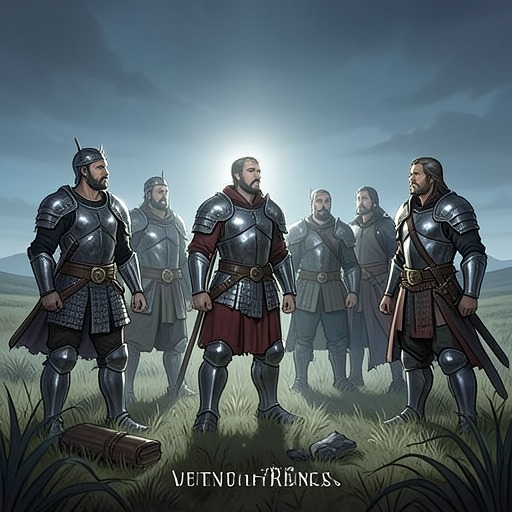
Dalinar’s public identity is inseparable from Shardplate and Shardblade. He has carried Oathbringer since his youth, bonding it when he was twenty Weepings old. The six-foot Blade is long, slightly curved, serrated near the hilt, hooked at the tip, and cold with dew when it appears; to Dalinar, it feels less like an instrument than an extension of his body. Summoned on the tenth beat of his heart, it gives physical form to the older warrior ethos that defines him: life seems fully known only in the charge into battle with Plate and Blade.
Yet Dalinar’s relationship with his armor differs sharply from that of the king, Torol Sadeas, and even his son Adolin Kholin. Their painted and ornamented Plate helps them flaunt rank and magnificence. Dalinar leaves his armor its natural slate-grey color. Mounted on the enormous black Ryshadium Gallant, he looks like a soldier rather than a courtly prince, because Plate is, to him, a tool rather than an ornament. He handles its heightened speed, strength, and dexterity without the uncertainty that can still catch Adolin, making the armor appear to be his natural condition.
The Command to Unite
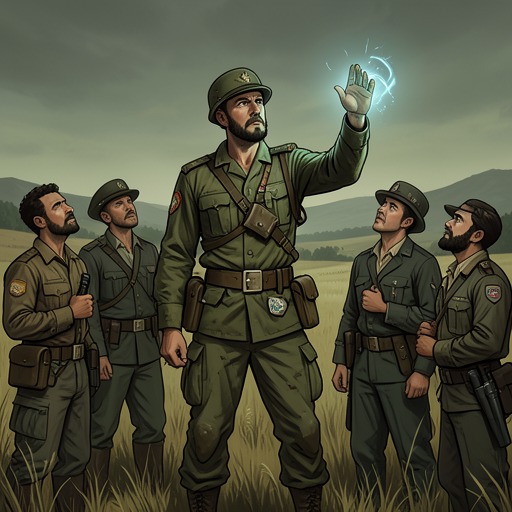
Dalinar’s plot trajectory is shaped by an unexplained imperative that repeatedly breaks into his consciousness: “Unite them.” The words consume him while he rides across the Shattered Plains, turning military movement into an inward summons. They do not initially provide a clear method or even an identified object of unity, but they force him to reinterpret the war around him. The gemhearts and the vengeance sought by the Alethi become meaningless if the highprinces continue to squabble while treating the campaign as separate competition.
His response is political as much as military. He recalls the older system in which each of Alethkar’s ten highprinces held a specialized governing charge, a structure Gavilar had admired because it compelled the highprinces to work together and submit to one another’s authority. That arrangement disappeared when Alethkar fragmented into ten autonomous princedoms. Dalinar recognizes in its history a possible answer to the present crisis: unity cannot remain a slogan or a temporary alliance; it must be built into the organization of power.
Codes, Labor, and Moral Law
Dalinar’s reforming impulse appears first in his treatment of military labor. He challenges Sadeas over the waste of bridgemen’s lives, invoking the Alethi Codes of War, which state that a general may not demand anything he would not do himself. His question is pointed: would Sadeas run at the front of the bridges he uses? Sadeas answers with dry evasion, comparing bridge work to eating gruel or cutting ditches, but Dalinar insists that unarmored, unshielded men being sent into combat are not an inconvenience to be dismissed. The Codes become, in his hands, a standard by which aristocratic command can be judged rather than a decoration for honorable speech.
The same principle governs his conduct away from the battlefield. When he finds civilian workers laboring in a half-finished ditch, he asks who is in charge, orders the workers to leave and relax, then grips his leather-wrapped warhammer and leaps into the ditch himself. The scene reverses the expected relation between rank and labor: the highprince does not merely issue an order from above but takes up the physical task with his own armored hands. His authority is expressed through participation, and the gesture gives practical meaning to the rule he used against Sadeas.
Dalinar’s judgment also develops through contrast with other societies and systems of value. Reports of Shin society describe warriors as the lowliest people, treated almost like slaves, while farmers receive lavish respect and the ruler may work the fields. Sigzil’s account of Babatharnam offers another inversion: authority belongs to the elderly, with the oldest receiving the greatest power and the king called the Most Ancient. Against these arrangements, Alethkar’s hierarchy of light eyes and darkeyes appears not natural but contingent. Dalinar’s concern with law and military organization thus unfolds within a wider world where social rank, labor, age, and violence are distributed according to radically different principles.
Visions and the Expansion of History
Dalinar’s visions place his present political crisis inside a much older history. During one episode, a barrack disappears and he finds himself in a dark barn smelling of dried grain, dressed in a homespun tunic and sandals rather than a uniform, with his side sword gone. He understands that this is the twelfth vision he has experienced since the episodes began a few months earlier. The visions are not ordinary memories: they dislocate him from his own time and confront him with scenes whose meaning he must reconstruct.
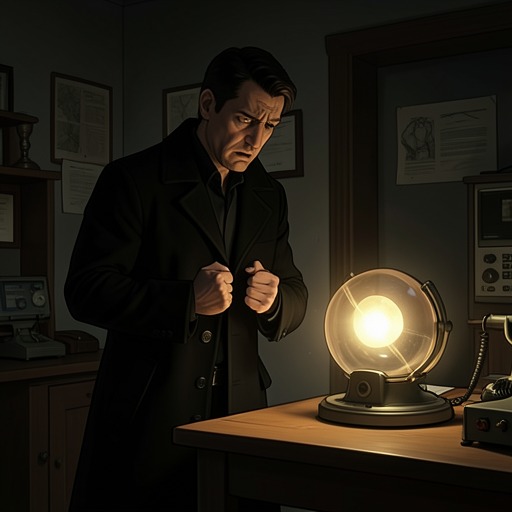
Their credibility becomes decisive when Navani Kholin examines the language Dalinar has encountered. She concludes that it is the Dawnchant, a dead language, and therefore evidence that the visions are real rather than meaningless hallucinations. Dalinar identifies the speaker of one recorded line, a city guardsman whose statement is dated Kakanev, 1173, thirteen seconds before death, as Nohadon. This discovery unsettles those around him, including Adolin, but it also transforms Dalinar’s private torment into historical testimony. The command to unite them acquires the weight of an instruction connected to the ancient past, while the visions make the boundaries between present governance and forgotten catastrophe increasingly unstable.
Political Break and Intended Renewal
Dalinar’s decisive confrontation with the existing order comes after Sadeas abandons the army and allows the Parshendi to destroy it. Dalinar refuses to treat Sadeas as uniquely monstrous. In his judgment, Sadeas is neither worse nor better than the other highprinces; any of them would betray their fellows if they could do so without endangering themselves. The problem is therefore systemic. Personal condemnation cannot solve a political structure that rewards isolated ambition.
He acts against that structure with both symbolic and practical force. Dalinar summons his massive Shardblade, still dripping with water, while Stormlight rises through the cracks of his armor, then drives the Blade into the blackened glyph on the stone and declares that the act is for the bridgemen. Later, when Elhokar Kholin calls for guards, Dalinar reveals that his own men have been ordered not to enter or allow anyone else inside, even if the king cries for help. The guards’ loyalty is not accidental: Dalinar trained them, placed them there, and claims responsibility for their obedience.
Dalinar’s proposed solution is a reorganization of Alethkar’s entire war effort. Once named Highprince of War, he intends to enforce the Codes in all ten camps, coordinate which armies attack which plateaus, place all gemhearts under the Throne, and have the king distribute them as spoils. The campaign would cease to be a contest among highprinces and become a real war directed through common command. The goal extends beyond victory over the Parshendi: Dalinar wants the ten armies and their leaders to become real soldiers.
The cost is personal renunciation. He plans to give his Plate to Renarin Kholin to fulfill one promise and has already given away Oathbringer to fulfill another. The man whose identity was built around the inseparability of Plate and Blade therefore chooses to relinquish both forms of inherited power. His reform is credible precisely because it demands the surrender of the symbols that made him formidable.
Character Arc and Narrative Role
Dalinar’s arc joins martial spectacle to ethical self-correction. He remains capable of summoning Oathbringer, commanding loyal soldiers, wielding a warhammer, and imposing his will on a king, but these abilities no longer function as sufficient proof of virtue. The narrative repeatedly places his conduct beside competing models: Sadeas’s efficient but lethal bridges, the king’s regal display, Adolin’s decorated armor, Shin reverence for farmers, and Babatharnam’s rule by age. Through those contrasts, Dalinar’s identity becomes a question of what power is for.
His transformation is incomplete and dangerous. Elhokar predicts that the highprinces will revolt and that the king may not last a week, revealing the scale of the resistance Dalinar’s program will provoke. Dalinar nevertheless chooses coordination over the familiar freedom of aristocratic betrayal. The command to unite them becomes not an abstract prophecy but a political discipline: shared law, shared military direction, protection for expendable men, and the willingness of the strongest leader to lay down the weapons that made him strong.