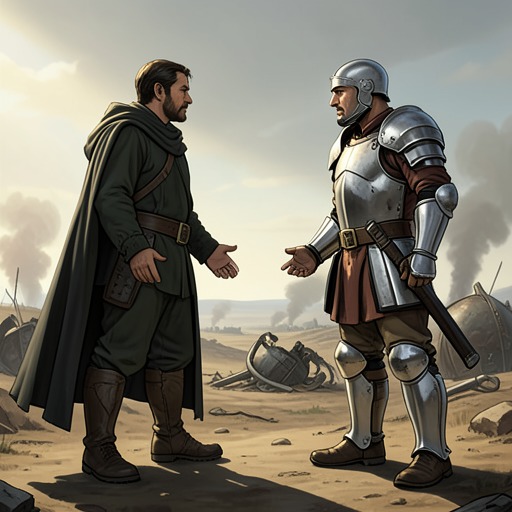
Dalinar's Defense of Elhokar from the Chasmfiend
The Way of KingsDalinar's Defense of Elhokar from the Chasmfiend is the central reversal of a hunt that suddenly becomes a royal emergency. When the enormous beast climbs onto the viewing plateau, Dalinar Kholin does not merely defeat a monster: he places his armored body between King Elhokar Kholin and death, catches the chasmfiend's descending claw, and creates the opening through which the king can kill it. The rescue preserves the political order at the moment when a single death could shatter the kingdom, while also presenting Dalinar as a warrior whose greatest act of strength is protective rather than predatory.
Causes and Background
The encounter begins as a chasmfiend hunt, an organized spectacle in which attendants, female scribes, guests, and soldiers gather to witness the capture of the creature and claim its gemheart. The danger changes when the rope being towed by the chull is discovered to be frayed at the end: the expected bait is absent, and something far larger than the intended quarry rises from the chasm. Instead of remaining on the small plateau prepared for the hunt, the creature climbs onto the viewing plateau where Dalinar, Adolin Kholin, Elhokar, and the unprepared company are assembled.
The setting makes the disaster especially consequential. The people on the viewing plateau include many who are unarmed or poorly positioned to respond, while the king is exposed in the confusion. Elhokar's death would not be an isolated battlefield casualty. Adolin immediately understands that the kingdom could shatter, the highprinces could divide, and the tenuous link holding Alethkar together could be severed. The hunt therefore turns into a test of succession and political survival as much as a contest against a chasmfiend.
The rescue also occurs against the pressure of Dalinar's inner transformation. His visions have told him that he must unite his people, prepare them, build a fortress of strength and peace, and resist the coming Everstorm. He has not yet found a way to explain these experiences without sounding foolish or heretical, and Elhokar has begun to notice that his uncle is changing because of them. Dalinar's defense of the king thus joins an immediate physical duty to a larger, still-unspoken question about what Alethkar must become.
The Attack and Rescue
The chasmfiend fills the plateau with its immense, chitinous body and threatens the gathered crowd before the defenders can organize. Archers draw, and Elhokar shouts orders with his blue cape flapping before Dalinar. When the king falls, his armor cracks at the shoulder and leaks Stormlight. The Plate cushions the impact, but the danger is not over: a claw looms above him, turning the hunt into an execution that may occur within seconds.
Dalinar's first response is movement. He turns Gallant toward the fallen king, aware that he may be too slow, and charges with a speed and grace that exceed ordinary expectations of Shardplate. He leaps over a rock shelf, ducks beneath one claw, and skids under another as the creature destroys the stone behind him. The sequence emphasizes not only his strength but his judgment under pressure: he abandons any safer or more conventional approach and drives directly toward the point where Elhokar will be struck.
At the decisive instant, Dalinar drops his Shardblade. The weapon strikes the ground and dissolves into mist, leaving him without the usual instrument of a Shardbearer. He then raises both hands and catches the third claw as it falls toward the king. The blow forces him down onto one knee, and the impact rings as carapace crashes against armor. Dalinar is bent beneath the weight of a monster many times his size, yet he holds it long enough to keep Elhokar alive. The image reverses the expected relation between ruler and champion: the king is no longer the commanding figure protected by distance, while Dalinar becomes a living shield.
The rescue succeeds through coordination rather than solitary triumph. Once Dalinar has thrown aside the limp claw, he gestures sharply toward the creature's neck. Elhokar understands, summons his own Shardblade, and drives it deep into the chasmfiend's flesh. The beast's green eyes blacken and shrivel as smoke twists upward. Elhokar then plunges the Blade into its chest and reaches into the wound with Plate-enhanced arms to tear out the gemheart, a massive uncut emerald as large as a man's head. Dalinar's intervention therefore does not replace the king's action; it gives Elhokar the time and position needed to deliver the killing blows.
Immediate Consequences
The most immediate consequence is Elhokar's survival. The king rises from the ground only moments after falling, turns toward Dalinar, and sees the fallen beast and the uncle who has shielded him. Dalinar's nod to Adolin and his direction toward the neck show him returning at once from bodily crisis to tactical command. The rescue prevents the succession crisis that Adolin had foreseen and keeps the highprinces from facing the destabilizing shock of a king killed during a public hunt.
The victory also produces a material reward. Elhokar extracts the chasmfiend's gemheart, an enormous emerald whose value exceeds that of the smaller gemhearts already considered fortunes. The gemstone transforms the rescue into a successful hunt by Alethi standards, but its importance is secondary to the political result. The object is a visible trophy of the encounter; the preserved king is its true strategic prize.
For those watching, Dalinar's feat changes the meaning of Shardplate and Shardblades. Observers may believe they understand how such armor and weapons work, yet Dalinar moves beyond their expectations and catches a claw without his Blade in hand. Adolin's stunned reaction, the archers' hesitation, and Torol Sadeas lowering his grandbow mark the moment as something witnessed and difficult to assimilate. Dalinar's reputation as the Blackthorn is reinforced, but the action also gives that reputation a new dimension: overwhelming violence is redirected into protection.
Political and Moral Significance
The rescue exposes the tension between vengeance and responsibility that increasingly troubles Dalinar and Elhokar. Elhokar acknowledges that others whisper Dalinar is changing, and Dalinar responds by asking what they are willing to give for vengeance. When Elhokar answers that they will give anything, Dalinar presses the cost further: would they sacrifice everything Gavilar Kholin built and undermine his vision for Alethkar merely to avenge him? The chasmfiend rescue supplies a concrete counterimage to that destructive logic. Dalinar has just risked everything to preserve the living king; his action makes protection, not revenge, the measure of loyalty.
The event also anticipates Dalinar's larger attempt to unite a divided people. His vision commands him to cease squabbling and prepare for the Everstorm, while his political reality remains organized around competing highprinces and a war sustained by vengeance. Saving Elhokar does not resolve that contradiction, but it demonstrates the kind of leadership the visions demand: decisive action in defense of collective continuity, followed by cooperation between uncle and king rather than private glory.
Narrative Role and Ending
As an event, the defense functions as both a rescue plot and a threshold ordeal. The threat arrives from below, overwhelms the planned boundaries of the hunt, and places the monarch at the center of an apparently irreversible fall. Dalinar's catch reverses the expected outcome without erasing danger; the king still has to act, and the chasmfiend still has to be killed. The scene's structure makes courage visible as a chain of exact decisions—charging, leaping, discarding the Blade, catching the claw, and directing Elhokar to the vulnerable neck.
Its final image is consequently double-edged. Elhokar stands alive beside the dead chasmfiend and claims its gemheart, while Dalinar stands as the man who made that survival possible. The kingdom has been preserved for the moment, but Dalinar's subsequent questions show that preservation alone is insufficient. The defense establishes him as a protector capable of saving the present even as his visions force him to confront whether Alethkar can survive the larger storm approaching it.