Dalinar's Trade of Oathbringer
The Way of KingsDalinar's Trade of Oathbringer is a public exchange in which Dalinar Kholin surrenders his massive Shardblade to Torol Sadeas in return for every bridgeman in Sadeas's camp. The act is decisive because it converts the bridgemen from expendable property into lives Dalinar claims responsibility for, while exposing the moral gulf between the two highprinces: Sadeas prices men according to their usefulness, whereas Dalinar treats their lives as beyond ordinary purchase.
Causes and Background
The trade follows the collapse of the highprinces' alliance. Torol Sadeas declares that the alliance has proved unfeasible and frames the failure as the consequence of Dalinar's tired men. Dalinar answers by asking to take the bridgemen with him, but Sadeas refuses to part with them. The refusal is not merely administrative. Kaladin sees the deaths of the bridgemen in Sadeas's eyes, recognizing that their exhaustion has made them disposable within Sadeas's system.
Dalinar first attempts to negotiate in the language Sadeas understands. He offers sixty emerald broams per man, a sum that draws gasps from soldiers on both sides because it is roughly twenty times the price of a good slave. Sadeas still refuses, insisting that the bridgemen are not for sale. The offer therefore establishes the limits of ordinary commerce: even an extravagant payment cannot persuade Sadeas to relinquish property he regards as strategically useful and personally controlled.
The Exchange
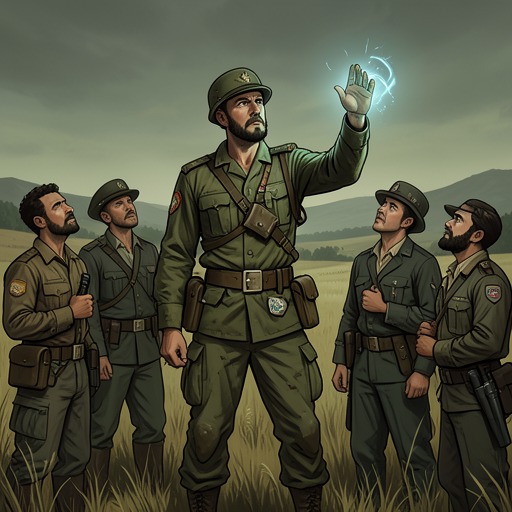
When negotiation fails, Dalinar changes the terms of the encounter. He summons his massive Shardblade, which has just emerged wet and steaming with Stormlight rising from the cracks, and drives its point into the blackened glyph on the stone. The gesture turns the weapon into a visible pledge before the assembled soldiers. His declaration, “For the bridgemen,” gives the act a direct moral object: the Blade is not displayed to threaten Sadeas into submission but offered as the price of the men.
Dalinar then specifies the bargain. Sadeas will receive the Shardblade, while all of his bridgemen will become Dalinar's, with Sadeas forbidden to touch them again. The scale of the offer shocks the field. A Shardblade is worth fortunes, cities, palaces, and kingdoms, yet Dalinar treats it as exchangeable for people whom Sadeas calls worthless. The scene's tension comes from the gap between those valuations. Dalinar risks an object capable of altering political and military power; Sadeas sees the weapon and calculates what it can give him.
Sadeas hesitates only briefly after glancing from the Blade to Kaladin. His desire for the weapon overcomes that hesitation, and he takes it by the hilt, accepting the bridgemen with contempt. Dalinar responds with a curt nod and immediately turns toward his entourage. The physical transfer is therefore also a transfer of authority: the Shardblade passes to Sadeas, while the bridgemen pass into Dalinar's protection.
Value, Honor, and Moral Conflict
Sadeas calls the decision madness and predicts that it will be remembered as the most ridiculous decision ever made by an Alethi highprince. His judgment rests on conventional rank, property, and military value. To him, the bridgemen are worthless creatures and the Blade is an object whose value can be measured in political power. His acceptance preserves that hierarchy even as it removes the men from his control.
Dalinar's reasoning follows a different moral scale. When asked what a life is worth, he immediately answers by quoting his father: “A life is priceless.” He then explains that this is coincidentally the exact value of a Shardblade, allowing him to claim that the exchange purchased twenty-six hundred priceless lives with one priceless sword. The formulation is deliberately simple but carries the full logic of the act. Dalinar does not argue that the men are economically valuable, militarily indispensable, or useful to his reputation; he argues that their lives possess a value equal to the greatest object he owns.
The trade also fulfills a personal conception of honor. Dalinar tells Kaladin that, for his honor, the exchange was unquestionably worthwhile. Honor here is not ceremonial reputation or obedience to the existing order. It requires accepting a real loss in order to protect people whom the powerful have made vulnerable. The scene thus places deontological obligation beside consequential calculation: the freed lives are an immense consequence, but Dalinar's decision begins with the principle that a life cannot properly be reduced to a price.
Consequences and Aftermath
The immediate consequence is the liberation of twenty-six hundred bridgemen from Sadeas's authority. Dalinar instructs Kaladin to lead the men to safety and says that he will have questions for him later, indicating that the exchange is not a symbolic gesture alone but the beginning of a new relationship and a new responsibility. Kaladin, who had believed that another promise was dying and that Dalinar was ultimately the same as the other lighteyes, is forced to revise that judgment when Dalinar actually pays the impossible price.
The trade also changes the political meaning of the Shardblade. In Sadeas's hands, the weapon represents acquisition and appetite: he looks at it with lust and names the kingdoms it could buy. In Dalinar's hands, it becomes a pledge that can be converted into human safety. The sword's loss weakens Dalinar materially, but the act strengthens the credibility of his moral commitments. His honor is no longer an abstract claim; it has been made visible through an irreversible sacrifice.
Finally, the exchange crystallizes the contrast between the two highprinces. Sadeas's bridgemen policy treats enslaved soldiers as consumable resources, while Dalinar's bargain rejects the premise that usefulness determines whether a person deserves protection. The event's lasting significance lies in that reversal: a force created to absorb deaths becomes the object of a highprince's most expensive act of solidarity, and a weapon associated with domination becomes the instrument by which Dalinar purchases their freedom.