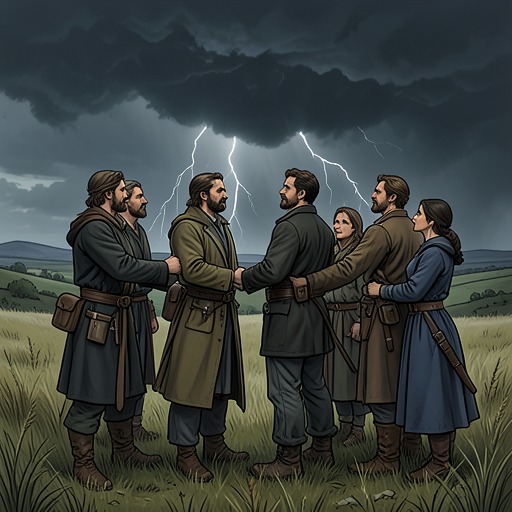
Dalinar–Elhokar relationship
The Way of KingsThe Dalinar–Elhokar relationship joins family affection to the dangerous obligations of Alethi kingship. Dalinar is not merely Elhokar’s uncle: after Gavilar’s assassination, he becomes a protector, political counselor, and potentially unsettling substitute for the brother and father the king has lost. Elhokar, meanwhile, is both a vulnerable young ruler and a sovereign who must fear the intentions of powerful men around him. Their relationship therefore develops through an unstable mixture of loyalty, guardianship, suspicion, and the pressure of public reputation.
Kinship, Loss, and Protection
Dalinar’s care for Elhokar is inseparable from the murder of Gavilar. Elhokar’s fear of assassination is intense, especially of threats that might come when he is not watching, in darkness and quiet rather than in open battle. Dalinar recognizes that this nervousness can look like paranoia, but he refuses to treat it as inexplicable: the king’s father was assassinated, and Dalinar repeatedly remembers the night Gavilar died and silently apologizes to his dead brother for having been absent and unable to protect him. Elhokar’s anxiety thus reaches backward into a family catastrophe that governs the living relationship between uncle and nephew.
Dalinar’s protective role is also practical and institutional. The guards outside Elhokar’s palace sitting room wear the king’s blue-and-gold colors, but they are Dalinar’s men, selected for loyalty to him and placed there under his authority. Their presence troubles them because his orders are irregular, yet they obey. This arrangement shows both the strength and the danger of Dalinar’s guardianship: he can place trusted soldiers around the king, but doing so also makes his protection resemble a private power surrounding the throne.
Political Tension and the Burden of Reputation
Their intimacy is repeatedly tested by the politics of the royal family and the war. Dalinar admits to Adolin Kholin that he had expected Elhokar to possess enough tact to keep a sensitive conversation private, but Elhokar did not retreat when challenged. Dalinar consequently changed tactics. Rather than continue scuffling over gemhearts or accept an indefinite siege, he resolves to win the war through a decisive ambush: lure large numbers of Parshendi onto the Shattered Plains, destroy their capacity to fight, or strike at their center and kill or capture their leaders. The plan is presented as a way to fulfill the Vengeance Pact and bring the Alethi home, but it is also a response to the political limits of arguing with the king.
Dalinar’s relationship with Elhokar therefore contains a sharp contrast between private concern and public calculation. Dalinar is willing to adapt his strategy because he understands that Elhokar will not simply yield, yet he also worries about the reputation of the ruling family. His acknowledgment that Adolin was right to fear damage to their reputation suggests that Elhokar’s decisions affect not only military policy but the standing of the Kholin house. The uncle’s protection is consequently inseparable from managing the king’s authority, even when that management risks appearing disloyal.
Suspicion at the Palace
When Dalinar finds Elhokar in the palace sitting room, the king is wearing Shardplate and studying a map. Elhokar immediately raises rumors concerning Dalinar and Navani Kholin, saying that he knows nothing improper could be occurring but still worries about what people think. His concern reveals how quickly political rumor becomes personal threat in his mind. He does not approach Dalinar simply as a trusted relative; he tests the uncle’s intentions while surrounded by the symbolic armor and strategic maps of kingship.
The confrontation becomes more direct when Elhokar asks what Dalinar is doing with his own men. Dalinar emphasizes that they are men he trained and placed, and that they have always been loyal to him. Elhokar nearly weeps and pleads for an explanation. Dalinar then leans close and recalls the girth on Elhokar’s horse during the hunt. He identifies the hidden mechanism behind the incident: Elhokar had cut the girth himself, while the saddles had been switched before the king reached Dalinar’s camp, so that Elhokar’s favorite saddle would not be ruined when it flew free of the horse. The king’s certainty that the girth had been cut was not merely a fear imposed on him by others; he had arranged the event and therefore knew exactly what had happened.
This revelation complicates the question of whether Elhokar’s suspicions are delusional. Dalinar states that the king’s paranoia may be unfounded, or it may be well founded, but either possibility leaves one fact unchanged: Dalinar is not Elhokar’s enemy. The exchange does not erase the danger surrounding the throne, nor does it prove that every fear is false. Instead, it establishes a more difficult form of trust, one that must distinguish between genuine threats and fears Elhokar himself has manufactured or confirmed.
Affection and Uneasy Trust
The emotional center of the relationship arrives when Elhokar asks whether Dalinar intends to kill him. Dalinar rejects the idea with emphatic disbelief and tells him that he loves him like a son. The declaration clarifies the motive behind the irregular guard arrangements, the political intervention, and the willingness to confront the king’s fears rather than exploit them. Dalinar’s authority over Elhokar is not presented as a simple claim to power; it is grounded in familial attachment and in a determination to keep the young king alive.
Yet the relationship remains unequal and unstable. Elhokar is a king who must preserve independence from the men who protect him, while Dalinar is a high-ranking relative whose military reputation and personal following could make his loyalty appear threatening. Elhokar’s fear is therefore not reduced to weakness, and Dalinar’s protection is not free of political consequences. Their bond matters precisely because affection must operate inside suspicion: the king fears the people closest to him, and the uncle who loves him must prove that closeness is not a prelude to betrayal.
Narrative Significance
The Dalinar–Elhokar relationship dramatizes the overlap between private grief and public rule. Elhokar’s assassination anxiety grows from a real family loss, but it also distorts his reading of present events; Dalinar’s response is neither blind reassurance nor cold dismissal. He acknowledges the possibility of danger while forcing Elhokar to confront his own participation in one apparent threat. Their relationship thus resists a simple division between protector and protected, sane judgment and irrational fear, or loyal family and political rival.
Dalinar’s role is especially painful because Elhokar is the son of the brother he failed to protect on the night of Gavilar’s death. The king’s vulnerability reopens that guilt, while his suspicion tests whether Dalinar can protect him without becoming another figure from whom he must be protected. By the time Dalinar insists that he is not the enemy and loves Elhokar like a son, the relationship has become a compact built from damaged trust: not the absence of fear, but the effort to answer fear with loyalty, candor, and continued responsibility.