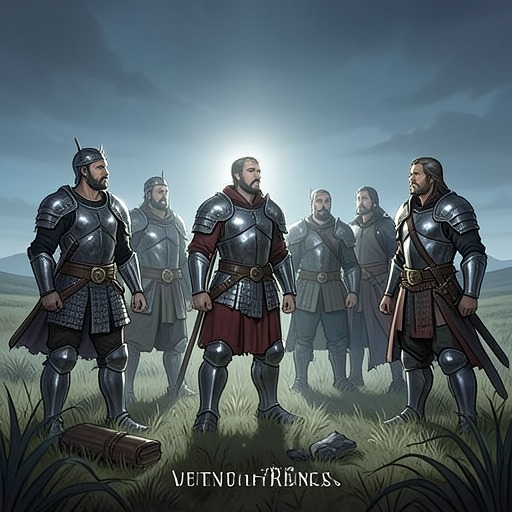
Jezrien
The Way of KingsJezrien is one of the ancient Heralds and the sole companion awaiting Kalak at the meeting place after one of the most furious battles of the Desolation. His presence gives the opening history its first human face: he remains outwardly young, carries the manner of a king, and speaks with calm authority, yet stands amid the evidence of a catastrophe that has reduced the survivors to two. Through Jezrien, the narrative presents the Heralds not as remote legends but as exhausted participants in a cycle of death, return, pain, and increasingly uncertain duty.
Identity and Appearance
Jezrien is recognizable as a royal figure even after centuries without a crown. When Kalak finds him, he appears to be a man barely into his thirtieth year, with short black hair and a neatly trimmed beard. His clothing is white and blue, though it has been scorched and stained with blood by the battle that has just ended. The contrast between his youthful appearance and his immeasurable age makes his identity visibly uncanny: time has not marked his body in the ordinary way, while violence has marked everything he wears.
His bearing reinforces the title associated with him as the King of Heralds. He folds his arms behind his back and turns toward Kalak with a calm, deep, regal voice. The authority is no longer secured by a crown or court; it survives as posture, composure, and the apparent confidence that he will know what must be done. Yet the scene also quietly exposes the fragility beneath that authority. Jezrien is not presiding over triumph. He is waiting among the remnants of a war in which almost all of his companions may have vanished.
The Heralds and the Cycle of Return
The meeting place has been selected before the battle: a large rock formation crowned by a spire, where the survivors are expected to gather. Ten Heralds should have had the chance to return there, but only Jezrien is waiting for Kalak. The battle has been among the worst, and the enemy has become increasingly tenacious. Kalak initially considers whether the other eight have died, a possibility made plausible by the scale of the fighting.
The deeper danger is not simply death. Kalak understands that a Herald who dies is sent back, and that surviving a Desolation is also supposed to lead back to the place of pain and fire. The obligation is therefore circular rather than terminal: death does not release the Heralds, and survival does not free them from returning. Kalak begins to entertain the forbidden thought that one of them might simply refuse to go back. Although the thought seems treacherous and he hurries onward, Jezrien’s presence gives that temptation a concrete political and emotional center. The ancient order is approaching a point at which obedience itself may become intolerable.
At the spire, seven magnificent swords stand point-first in the stone. Each is a unique weapon of power beyond even Shardblades, with flowing designs, glyphs, and intricate patterns. Kalak recognizes every one. Their presence proves that the blades’ masters have not died, because a Blade would have vanished with its dead bearer. The swords therefore turn the apparent absence of the other Heralds into a mystery: most are not confirmed dead, but they have departed. Jezrien’s later explanation—that only one of the ten died this time—makes the scene more disturbing rather than less. Survival has not reunited the Heralds; it has scattered them.
Royal Authority and Ancient Knowledge
Jezrien’s authority is established through restraint. He does not greet Kalak with panic, lament the missing Heralds, or explain the situation at length. Instead, he answers that they have departed and calls the outcome a miracle. The word carries an unstable double meaning. Only one Herald has died, so the immediate military result appears favorable; but the dispersal of the others suggests that the system meant to preserve the world has become difficult to sustain.
His continued youth and confidence also distinguish him from ordinary rulers described elsewhere in the book. Alethkar’s political order has fractured into ten autonomous princedoms, and Dalinar later recalls that Gavilar once admired an older arrangement in which the highprinces held specialized responsibilities and were forced to cooperate. Jezrien represents an even older image of unity: not a coalition of quarrelling lords, but a legendary king standing among chosen champions whose weapons and oaths once formed a single defense. The comparison is not a direct political equivalence, but it gives Jezrien’s scene a structural importance. The modern kingdom struggles to make ten armies act together, while the ancient defenders have already begun to separate from one another.
The same contrast appears in the book’s treatment of other societies. Shinovar reverses Alethi assumptions by making warriors the lowest men and farmers objects of respect; Babatharnam grants greater authority to the elderly, with its king called the Most Ancient. These examples complicate any claim that one social order is naturally authoritative. Against them, Jezrien’s royal manner is not presented as a universal political model. It is a remnant of a particular sacred and martial age, persuasive because it has endured, but unable to prevent abandonment by the very figures who shared his burden.
Names, Images, and Misrecognition
Jezrien is identified in different forms across the cultures and records of the world. In the palace of King Gavilar, statues of the Ten Heralds are associated with ancient Vorin theology; one statue is conspicuously missing, and the absent figure is Shalash. Elsewhere, a search for a foreigner with white hair, a clever tongue, and an arrowlike face invokes the name of Jezrien’s counterpart in a context shaped by disguise, rumor, and incomplete knowledge. These scattered references show how the Heralds survive in the world as names, statues, religious claims, and uncertain descriptions rather than as publicly acknowledged living persons.
That fragmentation of image is central to Jezrien’s narrative role. A figure who looks young after centuries and retains the bearing of a king can pass between history and myth without fully belonging to either. The book places his actual body beside the legendary swords and beside the later political memory of a lost unity. Jezrien is therefore both evidence and absence: evidence that the ancient stories have a material foundation, and absence because the world no longer possesses a stable account of what the Heralds are doing or why they have left.
Narrative Significance and the Threat of Abandonment
Jezrien’s brief appearance establishes the moral problem that the wider story will continue to develop: institutions created to protect humanity can become prisons for those compelled to sustain them. The Heralds are expected to return to suffering after every Desolation, and their continued service depends on accepting a fate that offers neither ordinary death nor ordinary victory. Jezrien’s calm does not resolve that problem. Instead, it makes the cost of endurance visible through the gap between his royal composure and the blood-stained clothing of a survivor.
The later declaration that the Knights Radiant must stand again echoes this ancient crisis. Dalinar is told that people must face their enemies together, because they may otherwise turn against one another and become their own enemies. Jezrien’s meeting with Kalak shows an earlier version of the same fracture: the defenders have survived, yet they no longer remain together at the appointed place. The seven swords left in the stone, the missing companions, and Jezrien’s restrained announcement that they have departed form a visual and moral prelude to the demand for renewed unity.
Jezrien’s significance consequently lies less in the number of actions he performs than in what his presence makes impossible to dismiss. The Heralds are real, their weapons exceed the known Shardblades, their victories have not ended the larger conflict, and their ancient pact is vulnerable to exhaustion and refusal. As the calm king beneath the spire, Jezrien embodies a civilization whose sacred defenders have outlived the certainty that once gave their suffering meaning.