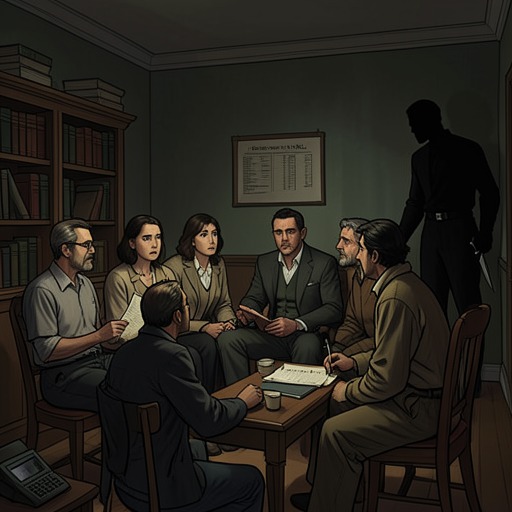
Kabsal
The Way of KingsKabsal is an ardent whose brief relationship with Shallan Davar turns from intellectual companionship into a carefully concealed act of espionage. He presents himself as cultured, witty, and unusually attentive, yet his interest in Shallan is bound to Jasnah Kholin’s Soulcaster and to the larger conspiracy seeking Jasnah’s death. When the truth emerges, Kabsal is already dead from the poison he intended for Jasnah, and the symbol found on his body connects him to the Ghostbloods and to the pressure surrounding Shallan’s family.
Identity and Introduction
Kabsal first appears as a young ardent who mistakes the alcove where Shallan is working for Jasnah Kholin’s alcove. He carries a single white sphere for light and wears simple grey robes; his narrow face, keen blue eyes, trimmed square beard, shaved head, spectacles, and cultured voice establish him as both recognizable and carefully composed. His entrance is hesitant and polite, allowing Shallan to relax because he is not Jasnah arriving unexpectedly while she is secretly examining her work and concealing her real purpose.
His first direct exchange with Shallan is marked by a deliberate reduction of distance. Rather than accept the formal title she gives him, he asks her to call him Brother Kabsal, or simply Kabsal, and then asks her name. He studies her drawings, adjusting his spectacles as he leans over them, and reacts with astonishment at her skill. The encounter therefore gives him an immediate role as an appreciative observer: he sees and praises something Shallan has made, while she is still struggling with the shame of having entered Jasnah’s intellectual world as a thief.
Relationship with Shallan Davar
Kabsal becomes important to Shallan partly because he is an unusual presence in her tightly supervised life. He is older than her and in his mid-twenties, confident, self-assured, earnest, handsome, soft-spoken, and witty. The narration identifies him as practically the only man near her age whom she has spoken with outside her father’s careful supervision. His attention consequently carries a force beyond ordinary flirtation: it opens a possibility Shallan has scarcely been allowed to imagine.
That possibility is also constrained by his status as an ardent. Shallan understands that an ardent’s service should make romance impossible, but Kabsal unsettles that assumption by telling her that a man can leave the ardentia. His steady manner and apparent willingness to abandon the service of the Almighty for her make the relationship dangerous in her judgment, because his words suggest a future rather than a passing kindness. The emotional effect is immediate even before the relationship is fully defined; attraction and suspicion occupy the same space.
Kabsal’s intimacy is inseparable from his interest in Jasnah. He grows solemn when discussing Jasnah’s influence and says that her ideas might be infectious, presenting concern about Shallan’s closeness to her as a religious and social matter. Shallan eventually tells him that Jasnah believes he is getting close to her because he wants the Soulcaster. Kabsal does not reject the accusation. Instead, while slicing himself another piece of bread, he acknowledges that Jasnah is clever, leaving Shallan to ask whether Jasnah is right. His response turns what had seemed like romantic ambiguity into a warning that his attention may have been instrumental from the beginning.
The Hidden Assassination Attempt
The clearest evidence of Kabsal’s objective comes through the poisoned bread. Jasnah later tells Shallan that Kabsal is dead and explains that the bread was dusted with Backbreaker powder, a very lethal poison made to look like flour. Jasnah suspects that the bread was treated in the same way every time Kabsal visited, and that his goal was to persuade Jasnah to eat a piece. The apparently domestic gesture of sharing food was therefore an assassination method, concealed beneath the rituals of companionship and hospitality.
This plan gives Kabsal’s earlier behavior a second meaning. His interest in Shallan was not merely personal, and his concern about Jasnah’s ideas was not simply the anxiety of an ardent guarding religious orthodoxy. He was close enough to Shallan to gain access to Jasnah, close enough to bring or influence food, and sufficiently trusted that the poisoned bread could appear ordinary. His charm functions as operational cover: the same qualities that make him attractive to Shallan help him approach his intended victim without immediately provoking alarm.
Kabsal’s plan fails, but he does not survive its exposure. Jasnah reports that he is dead, while the evidence identifies the poisoned bread as the cause of death. The lethal substance intended for Jasnah becomes the instrument of Kabsal’s own destruction. His death abruptly ends Shallan’s developing attachment and replaces romantic uncertainty with grief, shock, and the recognition that she had been drawn into a lethal plot.
The Ghostblood Connection
Kabsal’s death reveals that the assassination attempt belongs to a wider organization rather than being an isolated act. Jasnah explains that the groups searching for the secrets connected to the Parshendi include one known as the Ghostbloods, and identifies Kabsal as one of its members. The organization’s symbol, three overlapping diamonds, is tattooed on the inside of his arm. A bodily mark that had remained hidden during his life becomes the sign through which his concealed allegiance is made legible.
The symbol also links Kabsal to Shallan’s family history. Shallan recognizes the same design from the mark Nan Balat Davar had shown her, from Luesh, her father’s steward, and from the men who pressured the family to return the Soulcaster. Those men had also been financing Shallan’s father in his attempt to become highprince. Kabsal is therefore not an isolated infiltrator who happened to target Jasnah; his identity joins the events at Jasnah’s side to the coercion, political ambition, and Soulcaster dispute surrounding the Davar household.
The revelation changes the scale of Shallan’s understanding. What had looked like a dangerous courtship becomes evidence of an organized search for secrets powerful enough to affect the fate of the Parshendi and ordinary parshmen. Kabsal’s role is the bridge between private deception and geopolitical conspiracy: he enters through a personal relationship, but the consequences of his actions reach far beyond Shallan and Jasnah.
Narrative Role and Ending
Kabsal’s narrative function depends on reversal. He begins as a courteous stranger in a quiet alcove, then becomes an admirer who seems capable of choosing Shallan over the constraints of the ardentia, and finally is identified as a conspirator and would-be murderer. Each stage revises the preceding one without erasing it. His gentleness was real as a social performance, but its purpose was not the purpose Shallan imagined; his apparent vulnerability about leaving the ardentia is folded into a strategy built on access and trust.
His end is similarly double-edged. Kabsal’s death closes the immediate threat to Jasnah, yet it does not resolve the danger. Instead, it leaves behind the poisoned bread, the lethal Backbreaker powder, and the Ghostblood tattoo as material traces of a network that remains active. The dead man becomes more informative than the living one had been: only after his death can the hidden symbol be compared with the marks already present in Shallan’s family story.
Kabsal is consequently memorable not because his time on the page is long, but because his presence reorganizes several strands of the plot at once. He tests Shallan’s ability to distinguish affection from manipulation, exposes the vulnerability of Jasnah’s research, and confirms that the Soulcaster is entangled with a broader clandestine struggle. His brief courtship is a mask; his death tears that mask away and turns a personal betrayal into a revelation about the Ghostbloods.