Kaladin Stormblessed
The Way of KingsKaladin Stormblessed stands at the center of a transformation from promising soldier to broken slave and, finally, a protector who discovers that his deepest identity lies not in victory but in defending those whom power has abandoned. The evidence presents his reputation as both a source of hope for others and a burden he can no longer carry for himself: soldiers trust that anyone placed in his squad will survive, while Kaladin later regards Bridge Four as the world’s final torment. His story therefore turns on the painful distance between being called Stormblessed and actually finding a reason to live up to that name.
Identity and Introduction
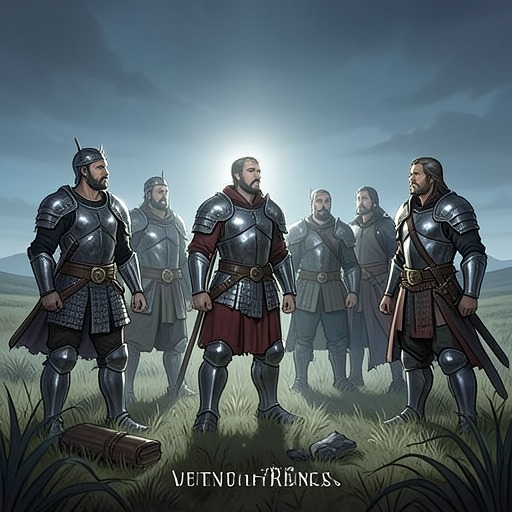
Kaladin first appears through the confidence of other soldiers. Cenn, frightened at the front of a vast army, is reassured by Dallet, who places a hand on his shoulder and tells him that he will be fine because he is in Kaladin Stormblessed’s squad. The nearby soldiers agree, treating Kaladin’s presence as a practical guarantee of survival rather than merely a mark of personal fame. That confidence is significant because the squad has been placed at the very front, where casualties are expected to be greatest, and Cenn has been moved into it at the last moment because of camp politics. Kaladin’s name consequently functions as a small shelter inside a military system that otherwise exposes darkeyes to arbitrary danger.
The scene also establishes the contrast between public faith and private vulnerability. Cenn is surrounded by thousands of soldiers and begins to panic when fearspren gather around his feet. Dallet’s hand and his confident black eyes steady him, but the reassurance depends on Kaladin’s reputation rather than on any visible proof that the squad is safe. Kaladin is already a figure onto whom others project courage. His decisive importance emerges from that projection: before the narrative shows his own condition, it shows what his name means to men who believe that he can keep them alive.
From Soldier to Slave
Eight months later, Kaladin’s circumstances have been reduced to the opposite of military authority. He travels in a cage, accepts a small bowl of grey slop through the bars, and eats overcooked tallew grain flecked with crusted remnants of the previous day’s meal. The food is revolting, yet it is all he will receive. The details make enslavement material and routine: hunger is not an exceptional punishment but the ordinary condition of movement, while the other slaves clutch their bowls because even inadequate food may be stolen.
Kaladin’s response to this environment is harsh isolation. On the first day, another slave tried to take his food, and Kaladin nearly broke the man’s arm. Afterward, the others left him alone, which suits him. The incident shows how far his former protective identity has collapsed. A man once associated with the safety of a squad now preserves the smallest possession available to him through intimidation, accepting solitude because it is less painful than dependence. His violence is not presented as triumph; it is evidence of a survival strategy formed inside a system that has made solidarity dangerous.
The narrative deepens this collapse by placing it after a sequence of losses. Kaladin believes that nothing worse can happen to him after the slave brand marked with a shash, the loss of everything to war, and the failure to protect those to whom he had sworn protection. He discovers that the world has reserved one final torment: Bridge Four. The name becomes an emotional threshold, not simply a military assignment. It identifies the place where his despair is forced into a new form, because bridge duty converts already expendable slaves into equipment carried toward enemy fire.
Bridge Four and the Question of Survival
Kaladin’s mind later becomes so damaged and exhausted that he experiences himself as floating, with his head detached and rebounding from walls and ceilings. Pain is the only sensation he can clearly retain. In this condition, the statement that bridgemen are not supposed to survive troubles him. He remembers using a bridge as a shield, throwing the army off and dooming the assault, and calls himself an idiot in the immediate aftermath.
The apparent contradiction is central to Kaladin’s character. Survival has been the value others attach to him since Cenn’s first scene, but surviving as a bridgeman seems to violate the purpose of the institution. The bridge is meant to be used, exposed, and discarded; a surviving bridge crew unsettles the logic that treats its members as disposable. Kaladin’s guilt therefore does not arise only from tactical failure. It also reflects his inability to accept survival as an achievement when the structure around him defines men like him as expendable.
His condition makes the old reputation almost unbearable. Dallet’s assurance had linked Kaladin’s name with safety, while the bridge system links Kaladin and his crew with death. The movement from one association to the other explains why Bridge Four feels like a final torment: the same capacity that once inspired trust is now trapped inside a role designed to annihilate it. Yet the fact that Kaladin survives, even in a state of mental numbness, leaves open the possibility that endurance may become the first material from which a new identity can be built.
Sylphrena and the Second Ideal
Kaladin’s relationship with Sylphrena begins to change his understanding of what surrounds him when he asks whether she is truly a windspren. She hesitates, shakes her head, and admits that she is not. The exchange matters because Kaladin recognizes that the being accompanying him cannot be explained by the ordinary category he first assigned to her. Sylphrena’s refusal of that label introduces a hidden dimension to his life and makes their connection a matter of discovery rather than simple companionship.
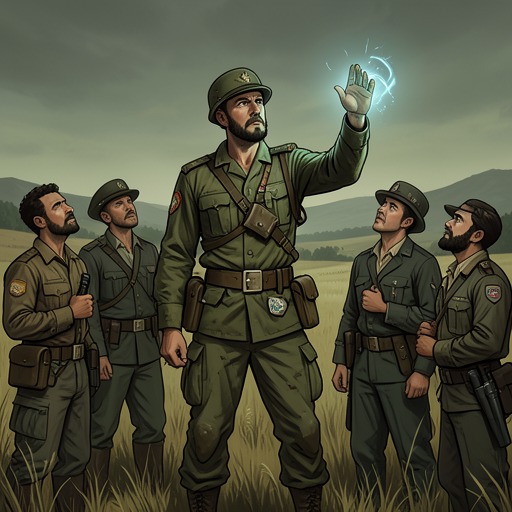
That discovery culminates during a confrontation with the Parshendi. Kaladin strikes a rocky ledge and rises with his legs, mind, body, and blood suddenly alive with energy. A ring of Stormlight expands from his fall and presses against the stones. The Parshendi recoil, their eyes widening as their song falters, while Stormlight closes the wounds on his arm. The scene reverses the image of the broken slave: the body that had seemed detached and barely capable of feeling becomes animated, armed, and physically renewed.
The most important change is not merely physical. A voice tells Kaladin that the Words are at hand, and he realizes that he knows them despite never having been taught them. He whispers the Second Ideal of the Knights Radiant: “I will protect those who cannot protect themselves.” The statement gathers together the conflicting strands of his history. Protection was the reputation others attributed to his squad; failure to protect was the wound that helped define his despair; now protection becomes a freely chosen principle. The Ideal does not erase the losses that produced it, but it gives those losses a direction.
Leadership and Unresolved Choice
Kaladin’s growth is also visible in how others respond to his command. Dalinar Kholin hears from surviving officers that Kaladin gave orders and took charge like a lighteyes. The comparison is socially disruptive: Kaladin is a darkeyes, yet his conduct has crossed the boundary that the lighteyes-and-darkeyes hierarchy treats as natural. His authority is recognized through action, not inherited rank, and the officers’ testimony confirms that he has become a leader even within a system that denies him the status normally associated with leadership.
Dalinar asks how many bridgemen would accept a purse and freedom. Kaladin predicts that many from other crews would do so, but believes an even larger number would refuse because they do not think in terms of escape or freedom and would not know what to do with themselves. His own crew, he says, will probably follow whatever he does: if he stays, they will stay; if he goes, they will go. The statement reveals the consequence of his transformation. Kaladin is no longer only a man trying to survive an imposed role; he has become the point around which other men organize their choices.
Yet he has not reached a settled conclusion. When Dalinar asks what Kaladin himself will do, Kaladin answers that he has not decided. This unresolved response preserves the human cost beneath the emerging heroic pattern. Freedom is available as an offer, but the decision is complicated by responsibility, loyalty, habit, and the dependence of Bridge Four on his example. Kaladin’s journey therefore ends this stage not with a simple escape from slavery, but with a more difficult form of agency: he must decide what kind of freedom can include the people who have learned to follow him.