Kaladin's Rescue of Dalinar's Army
The Way of KingsKaladin's Rescue of Dalinar's Army is the battlefield decision that turns an apparent escape into an act of chosen responsibility. After Bridge Four has completed its bridge assignment and could disappear while presumed dead, Kaladin sees Dalinar Kholin's army trapped at the Tower, abandoned and surrounded by Parshendi. He rejects survival purchased at the cost of leaving them to die, leads Bridge Four back into the battle, and opens the route by which Dalinar's remaining soldiers escape. The action is therefore both a military rescue and a moral reversal: Kaladin chooses the lives of people outside his immediate group over the freedom he has spent years longing to regain.
Causes and Moral Decision
Kaladin's opportunity is unusually stark. The bridgemen have a bridge, the enemy's main attention is fixed on Dalinar's army, and the men could vanish after the fighting and be assumed dead. Their freedom is real enough to make the decision painful; Kaladin recognizes that this is the chance he would once have done almost anything to obtain. Yet the sight of the trapped army unsettles him more deeply than the prospect of remaining in danger. Sylphrena appears beside him in a new, human-sized form, her translucent body turned toward the Tower, her expression horrified and sorrowful. Her reaction makes the violence visible as a moral catastrophe rather than merely a tactical situation, while Kaladin's own heart is twisted by the sight of soldiers fighting hopelessly after being abandoned.
The decision is framed through Kaladin's developing understanding of the First Ideal. He recognizes that the path matters more than a merely safe destination and concludes that Bridge Four must return, despite knowing that he may be leading his friends toward death. His order is not imposed by an officer or extracted by punishment. Kaladin says that they have to go back, and the members of Bridge Four answer by nodding one after another. Men who had once cared only about preserving their own lives deliberately discard the chance to save themselves. Their agreement turns an individual impulse into a collective oath of action.
The Charge Back to the Tower
Once the decision is made, Kaladin draws in Stormlight and commands Bridge Four to raise the bridge. The men cheer, seize the structure, and hoist it high; Kaladin straps on a shield and leads them toward the abandoned blue banner. The bridge, previously an instrument used to expose expendable laborers to enemy fire, becomes the visible sign of their new solidarity and their means of reentering the battle. Their movement is dangerous because thousands of Parshendi stand between Dalinar's army and the chasm, while Bridge Four has no archers to support the advance. The rescue is not presented as an easy heroic maneuver but as a decision made in full awareness that the tactical odds are terrible.
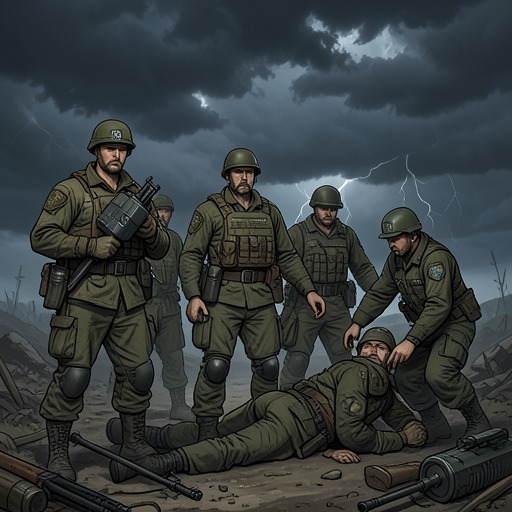
The force succeeds in reaching the threatened bridgehead and holds it against the Parshendi reserve near the chasm. Its importance becomes clear when Dalinar breaks through the enemy line and emerges onto open stone. He is stunned to discover that the bridgemen, rather than fleeing, are fighting ahead of him. The small group holds the bridgehead while Parshendi attempt to force them back, creating the opening Dalinar's army needs. The scene reverses the army's assumptions about bridge crews: those treated as disposable have become the soldiers who make organized retreat possible.
Rescue and Retreat
The rescue does not end with the defeat of the entire enemy force. Dalinar must leave the enemy Shardbearer behind because recovering the armor and corpse is impractical, and his own Shardplate has almost exhausted its Stormlight. He orders a retreat and escapes down the corridor Bridge Four and the other soldiers have purchased with their blood. Gallant carries him forward, a nameless spearman runs behind him, and the Cobalt Guard closes around them. Ahead, Adolin Kholin waits at the bridgehead, holding the bridge for Dalinar's retreat; Dalinar crosses the wooden deck to the adjoining plateau, followed by Adolin and the last of his troops.
The immediate result is survival rather than uncomplicated victory. The Parshendi reach the chasm but do not pursue, and some return to the chrysalis atop the plateau, which had been forgotten during the battle. Dalinar's army therefore escapes through a route that would not have remained open without Bridge Four's intervention. The rescue also leaves a lasting cost: the men have chosen danger and suffered casualties so that Dalinar's force can withdraw, making their freedom inseparable from sacrifice rather than a simple abandonment of military service.
Consequences and Significance
For Kaladin, the action establishes protection as a chosen identity. His earlier life has taught him to distrust commanders, armies, and promises of honor, while slavery has made escape an overriding practical goal. Here he acts against that history without being commanded to do so. The decisive change is not that danger disappears, but that Kaladin accepts responsibility for people whose fate is no longer technically his concern. His leadership is validated by Bridge Four's response: the men follow because they share the decision, not because an external hierarchy compels them.
For Bridge Four, the rescue is a transformation from a penal labor unit into a community capable of discipline, courage, and mutual loyalty. Their bridge remains a weapon of war, but its meaning changes when they carry it back toward the people who have been abandoned. The former social order treats darkeyed bridgemen as replaceable bodies; the battle reveals their strategic and moral agency. Their defense of the bridgehead also creates a striking reversal in perspective. Dalinar, a Shardbearer and high-ranking commander, reaches safety because an improvised force of men beneath the army's notice holds the passage open.
The rescue further exposes the conflict between Dalinar's ideals and Torol Sadeas's conduct. Sadeas has abandoned Dalinar's army while claiming that a shared oath required the protection of Elhokar Kholin and the kingdom. Against that betrayal, Kaladin's return supplies a living contrast: he has no comparable rank, oath, or political stake, yet he acts according to the protective principle Sadeas invokes. The event thus changes the value of loyalty in the narrative. Loyalty is no longer measured by declarations or inherited obligation, but by whether someone returns for those left behind when escape is available.
As a rescue plot, the sequence follows the expected pattern only by reversing its conventional power structure. The endangered army is not saved by its strongest champion alone; Dalinar's breakthrough depends on the bridge crew he and the wider military system have treated as expendable. The crucial turn is Kaladin's recognition that survival without responsibility would be another form of defeat. By choosing the road back, he gives the battlefield a new moral center and makes Bridge Four's act of rescue the foundation of its future significance.