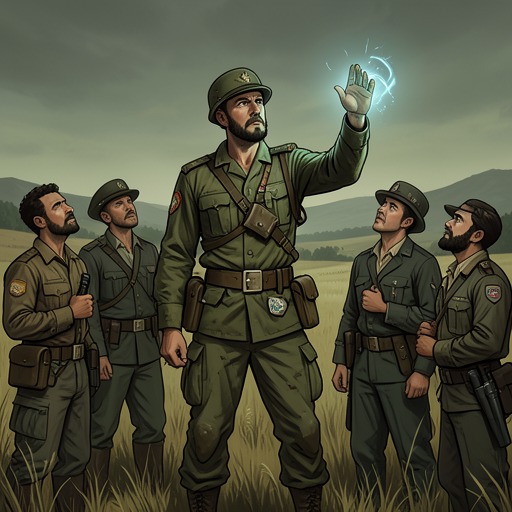
Kaladin–Amaram relationship
The Way of KingsThe Kaladin–Amaram relationship is a study in corrupted trust. Kaladin enters Amaram’s army expecting to defend the Alethi borders, and he does fight—though often against other Alethi forces pursuing territorial claims. Because Amaram is the only lighteyes commander Kaladin feels able to trust, their relationship initially gives Kaladin a possible exception to the rigid hierarchy separating darkeyes from lighteyes. Amaram’s later betrayal destroys that exception: after Kaladin kills a Shardbearer, Amaram takes the Shards, murders the surviving witnesses, and makes Kaladin a slave. The relationship therefore links personal disillusionment to a broader exposure of how military authority converts sacrifice into status.
Initial Trust and the Military Order
Kaladin joins Amaram’s army with a straightforward expectation: military service should defend Alethkar from external enemies. His experience quickly complicates that ideal. The army fights lesser landlords attempting to take pieces of Highprince Sadeas’s territory, while Amaram’s forces sometimes seize land from other highprinces on the claim that it properly belongs to Sadeas. Kaladin cannot distinguish these campaigns from the actions of the armies they oppose. Yet Amaram remains, in Kaladin’s judgment, the sole lighteyes who has shown enough humanity to deserve trust. That judgment matters because it is not abstract admiration for rank; it is a personal ethical exception formed within a system Kaladin already recognizes as morally compromised.
The conflict between military efficiency and individual responsibility appears elsewhere in the same political world. Dalinar challenges Torol Sadeas by invoking the Alethi Codes of War: a general should not demand what he would refuse to do himself. Sadeas answers that his bridges are fast, while Dalinar objects that bridge crews are denied armor and shields. This dispute clarifies the standard by which Kaladin later judges Amaram. The issue is not merely whether commanders win battles, but whether authority accepts the danger imposed on ordinary soldiers. Amaram’s betrayal becomes especially devastating because Kaladin had believed he represented the humane version of command.
The Shardbearer and the Reversal of Allegiance
During a battle, Kaladin’s squad is positioned against Hallaw, a lighteyes commander known for long volleys. The ranks are already forming when an impossible figure charges through the friendly soldiers: a rider in flawless golden Shardplate, carrying a majestic Shardblade. The armor makes every other suit appear ordinary, and the rider’s arrival turns the battle into an immediate test of whether Amaram’s soldiers will stand against a Shardbearer.
Amaram’s honor guard abandons its charge when confronted by the Shardbearer. Amaram himself is left alone on a rearing horse, wearing ordinary-looking silvery plate beside the overwhelming brilliance of the Shardplate. Kaladin and his squad run against the army’s movement, becoming the only soldiers to charge toward the danger while others flee. Their action is both military courage and an attempt to protect Amaram, whose humanity still gives Kaladin a reason to risk his life.
The Shardbearer reaches Amaram first. With one sweep of the Blade, the rider cuts through the neck of Amaram’s horse, leaving the animal dead and Amaram on the ground. The Shardbearer then dismounts at full speed and remains upright after striking the earth. Kaladin continues forward without knowing whether vengeance or loyalty drives him, but the distinction no longer matters in the immediate crisis. His squad attacks, and Kaladin kills the Shardbearer at the cost of the friends fighting beside him.
Afterward, Amaram confirms the result: the Shardbearer is dead because the Blade has vanished and the armor is falling away. He recognizes that Kaladin has killed a Shardbearer, while Kaladin sees only the bodies of the men who were closest to him. The victory gives Kaladin Shardblades and Shardplate, but it also leaves him exhausted and surrounded by the visible price of the achievement.
The Theft of the Shards
Kaladin does not initially claim the Shards for himself. He says that they belong to him only in the sense that he won them, then directs that they be given to Coreb, the highest-ranking and best fighter among the surviving soldiers. Kaladin believes Coreb will care for the Shards and become a lighteyes. His decision rejects the conventional link between battlefield glory and personal advancement: the reward should go to the soldier he considers most capable, not automatically to the commander who holds superior rank.
Amaram accepts this arrangement only on the surface. He orders the window shutters closed, has his attendants draw their swords, and sends them against the four remaining members of Kaladin’s squad. When Kaladin tries to intervene, an officer strikes him in the gut while two others keep him from moving. The violence is deliberate rather than chaotic; Amaram uses the authority of a private room and loyal officers to turn a military reward into an act of seizure.
Amaram then kneels before Kaladin and apologizes, but the apology does not restore any moral connection between them. He explains that the survivors cannot be allowed to tell what they saw. The official story will claim that Kaladin’s squad helped the Shardbearer, while Amaram will be credited with killing him. Amaram openly takes the Shards on the grounds that he is trained in the sword and accustomed to Plate, and that Alethkar will supposedly be better served if he bears them. His language converts theft into duty and murder into administrative necessity.
Betrayal, Silencing, and Consequence
The betrayal has two targets. Amaram steals the material signs of Kaladin’s victory, and he destroys the witnesses who could establish the truth. The surviving members of Kaladin’s squad are killed so that Amaram can claim the Shardbearer’s death as his own. Kaladin is left alive, but the survival is not freedom: Amaram’s false account and the confiscation of the Shards turn him into a disgraced soldier and ultimately into a slave.
This consequence gives the relationship its lasting force. Kaladin had entered military service believing that sacrifice might be recognized within a meaningful code of honor. Instead, the commander he trusted demonstrates that rank can determine whose testimony counts, whose courage becomes property, and whose death can be rewritten as an official story. The difference between Kaladin and Amaram is not simply darkeyes against lighteyes; it is a conflict over whether military power exists to protect soldiers or to accumulate prestige for those already empowered.
The episode also exposes the gap between formal norms and actual enforcement. The Alethi Codes of War can state that a general should do what he asks of his men, while army practice permits unarmored bridge crews to be treated as expendable. Likewise, Amaram can invoke the good of the army while murdering his own witnesses. In both cases, rules become instruments in a hierarchy: they can challenge abuse, but authority decides when they apply and whose interests they protect.
Narrative Significance
Amaram functions in Kaladin’s story as the reversal of a hoped-for exception. Before the betrayal, Kaladin’s trust in him suggests that personal honor might cross the social boundary between darkeyes and lighteyes. After it, the boundary appears not merely cultural but institutional: Amaram’s position enables him to confiscate Shards, control the official narrative, and suppress the soldiers who could contradict him. The relationship thus changes Kaladin’s understanding of both individuals and systems.
Its structure is tragic in the precise sense that the apparent reward produces the catastrophe. Kaladin’s courage wins the Shards, his loyalty sends him toward Amaram rather than away from danger, and his generosity leads him to offer the prize to Coreb. Each action reflects a value Kaladin believes in; each is turned against him by a commander who treats honor as a resource to be claimed. The relationship ends not with reconciliation but with a permanent moral rupture, leaving Amaram as the embodied source of Kaladin’s distrust of lighteyes, military glory, and institutions that call exploitation service.