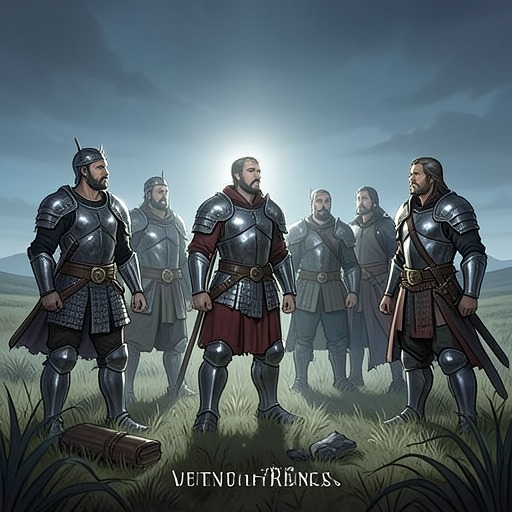
Kalak
The Way of KingsKalak is a Herald whose decisive appearance in the Prelude is defined by survival rather than triumph. He crosses a battlefield littered with human and nonhuman dead, realizes that he has survived the Desolation again, and confronts the unbearable consequence of that survival: returning to the place of pain and fire between Desolations. His fear leads him to reject the role that has governed him for centuries, while the ring of abandoned swords records the sacrifice and betrayal concealed beneath the claim that humanity has finally won.
Identity and Introduction
Kalak appears immediately after a battle in which the landscape itself has been torn apart. He rounds a rocky ridge and stops before a dying thunderclast, an enormous stone creature with broken riblike projections, unnaturally long limbs, and red eyes fading like fire buried inside granite. The sight makes him shiver even after centuries of familiarity with such beasts; he remembers having been killed by hands as long as a man is tall, and the memory is presented not as heroic endurance but as a blunt acknowledgment that dying is rarely pleasant.
He moves through a field marked by the work of Surgebinders and Dustbringers. Stone ridges are scarred by combat, hollows show where thunderclasts tore themselves out of the ground, and blood of several colors lies among bodies that are both human and otherwise. Moans, grief, smoke, burning corpses, and smoldering rock replace any atmosphere of victory. Kalak therefore enters the story inside a contradiction: he is a figure associated with repeated cosmic warfare, yet the immediate evidence of that warfare is exhaustion, mutilation, and loss.
Survival and the Threat of Return
Kalak’s central realization is that he has survived this Desolation. He places a hand to his breast as he hurries toward the meeting place and thinks that he has actually survived this time. The thought is not uncomplicated relief. Survival is dangerous because death sends him back by force, while surviving a Desolation is also supposed to return him to the place where the Heralds endure punishment between Desolations.
That place has become the true object of his dread. Kalak remembers centuries, perhaps millennia, of torture: fires and hooks repeatedly tearing through flesh, burning from skin to fat and then bone, with even the smell remaining vivid. The memory makes his fear physical. He shakes, questions when he became weak, and understands that continued obedience would mean submitting himself once more to a torment he can no longer bear. His crisis is not a generalized fear of battle; it is the recognition that the institution of endless return has consumed the meaning of survival itself.
The Meeting with Jezrien
At the meeting place Kalak finds Jezrien, still appearing young despite the passage of centuries. Jezrien’s white-and-blue clothing is scorched and stained with blood, but his royal bearing remains intact even though he has not worn a crown for centuries. He tells Kalak that the others have departed and calls the outcome a miracle because only one of them died this time.
The missing Herald is Talenel. Kalak identifies him through the absence of his Blade, and Jezrien confirms that Talenel died holding a passage by the northern waterway. Kalak knows Talenel’s pattern: he chooses seemingly hopeless fights, wins them, and often dies in the process. That death means Talenel will return to the place of nightmares, making his sacrifice both militarily necessary and personally horrifying.
Kalak then admits that he cannot return. He steps forward, grips Jezrien’s arm, and whispers his refusal, but the confession feels to him like something breaking inside. The moment exposes the cost hidden beneath the Heralds’ repeated victories: their public duty depends on private willingness to undergo torture, and Kalak’s endurance has reached its limit. Jezrien’s response is not consolation or argument. He tells Kalak to leave his sword.
The Abandonment of the Blades
The swords become the concrete form of the Heralds’ decision. Jezrien asks what they should tell the people and what the people will say of the day. His answer is to announce that they have finally won, even though he recognizes the statement as an easy lie and leaves open the possibility that it might somehow become true.
After watching Jezrien depart across the burned landscape, Kalak summons his own Blade and drives it into the stone beside the other eight. He then turns away and walks in the opposite direction from Jezrien. The action is deliberate: he does not merely lose the weapon or abandon it accidentally, but adds it to a visible arrangement that represents the withdrawal of the Heralds from their old duty.
Yet Kalak cannot leave the scene emotionally. He looks back at the ring of swords and the single open place where the tenth sword should stand. That gap belongs to the one who was lost and abandoned. Talenel’s absence transforms the apparent victory into an ethical wound: the surviving Heralds leave their weapons behind, while one dead companion is sent back to the torment they themselves have chosen to evade.
Change and Narrative Significance
Kalak’s arc in the Prelude is compressed but profound. He begins as a battle-worn survivor moving through the remains of a Desolation and ends as a participant in the abandonment of the swords. The decisive change is inward before it becomes visible: he stops treating return as an unavoidable duty and considers choosing not to go. His thoughts recognize that such a choice may be perilous or even traitorous, but the story gives equal weight to the psychological truth that endless obedience has become intolerable.
The scene also reverses the conventional heroic pattern of return. Kalak does not carry a victory home, restore order, or return with a gift for the people. He turns away from the battlefield and from the path expected of a Herald, while Jezrien supplies a public story that conceals the private collapse. The narrative’s first promise of victory is therefore inseparable from evasion: the people may be told that they have won, but the open place in the sword-ring shows that the victory has been purchased through abandonment.
Kalak’s significance lies in making that concealed cost visible. His fear is not weakness added to an otherwise complete heroic identity; it is the evidence that the heroic system has demanded more than a person can endlessly bear. Through his survival, memory, refusal, and final glance backward, the Prelude frames the larger history of the Heralds as a tragedy of endurance: the world receives the legend of triumph, while the survivors carry the knowledge of the person left behind.