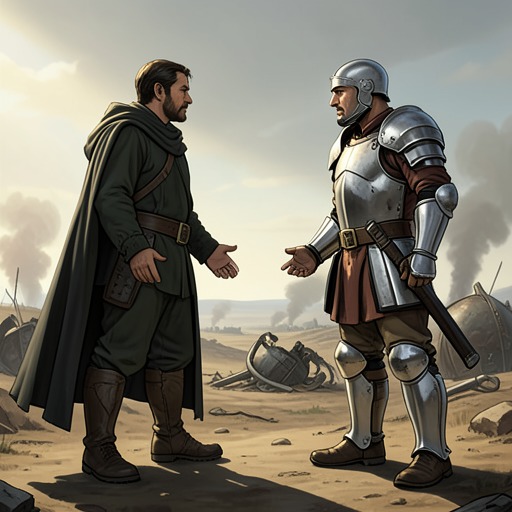
Kholin warcamp
The Way of KingsKholin warcamp is the principal encampment of House Kholin on the Shattered Plains and one of the largest concentrations of Alethi power in the war. Marked by a deep-blue banner bearing white glyphs styled as a sword before a crown, it represents the king’s house while also exposing the disorder, hierarchy, and competing interests beneath the kingdom’s military enterprise.
Definition and Setting
The camp belongs to an immense chain of Alethi armies spread across the Shattered Plains. Kaladin sees ten masses of troops arranged in familiar Alethi patterns: camp followers occupy the outskirts, mercenaries form an inner ring, citizen soldiers stand nearer the center, and lighteyed officers hold the central position. The formations fill enormous craterlike rock structures whose jagged sides resemble broken eggshells, making the warcamp a settlement shaped by the fractured terrain around it.
The scale of the encampment distinguishes it from the smaller army Kaladin left eight months earlier. That force, commanded by Amaram, had been much smaller; the camp before Kaladin stretches for miles north and south, with a thousand banners displaying a thousand family glyphpairs. Most soldiers live in large stone barracks rather than ordinary tents, a sign that Soulcasters have transformed the difficult landscape into a more permanent military infrastructure.
The camp faces the vast Shattered Plains, an expanse of rock divided by chasms twenty or thirty feet wide. The gaps descend into darkness and break the land into uneven plateaus, some large and some tiny. Kholin warcamp is therefore not merely a base behind the battle line: it is a staging ground pressed against the very geography that determines how the war is fought.
House Kholin and Military Organization
The Kholin banner gives the camp its clearest public identity. Its deep blue field and white sword-and-crown design announce House Kholin as the king’s house, and Kaladin recognizes the emblem from books before he has even entered the camp. The banner links the physical settlement to the authority of the throne, but the thousands of other banners reveal that the encampment is also a federation of aristocratic interests rather than a single unified army.
The camp’s internal arrangement makes social rank visible in space. Soldiers and officers are not mixed randomly; each group occupies a designated place within the circular formations. Lighteyed authority is placed at the center, while workers, camp followers, and mercenaries are pushed outward. The organization turns military logistics into a map of Alethi hierarchy, with proximity to the center reflecting status and power.
Later, Dalinar Kholin gives Kaladin one building for each bridge crew, creating barracks for more than a thousand men. For Kaladin, who had never commanded more than twenty-five people, the scale is overwhelming. Bridge Four’s barrack contains a bunk and a locking chest for every man, furnishings that appear almost palatial to someone accustomed to the treatment of bridge crews. Yet the building is not empty of hardship: behind it, the men gather around a firepit while Rock cooks stew, Teft speaks with a bandaged arm, and Shen sits quietly at the edge of the group after being recovered from Torol Sadeas’s camp.
People, Languages, and Social Boundaries
The warcamp functions as a meeting place for people who occupy sharply different positions. Shallan Davar approaches the Conclave, an imposing building within the camp, and finds its broad interior corridors lit by Stormlight lamps. Attendants, scribes, lesser brightlords, and brightladies move through a high, tunnel-like structure burrowed into the rock. When Shallan raises her freehand in a sign of need, a master-servant comes to assist her and addresses her as Brightness in Veden, apparently recognizing her native language from the color of her hair.
The exchange demonstrates how service, language, and rank operate together in Kholin warcamp. The master-servant is a darkeyed citizen of very high rank, probably of the second nahn, yet his role requires polished deference toward a lighteyed visitor. His formal manner reflects Vorin assumptions about Calling and social placement, while his use of Veden marks Shallan as a foreign noblewoman whose identity can be read through speech and appearance.
Kholin warcamp also contains the darker machinery of the campaign. Slaves are assigned to labor, and Kaladin is directed toward the bridge crews with a warning that he is to receive special treatment. The camp’s soldiers laugh as the deserters are pushed along, revealing that their status places them beneath ordinary citizen soldiers in the local social order. The presence of parshmen performing routine work—carrying water, digging trenches, and lifting sacks—further complicates the camp’s definition of enemy and servant, since the Alethi fight Parshendi while relying on parshmen for indispensable labor.
Contrast with Other Societies
The camp’s political and cultural assumptions become clearer when contrasted with the societies described within it. Sigzil speaks of Babatharnam, where age determines authority and the king is called the Most Ancient. Moash regards this as fairer than allowing eye color to determine rule, directly challenging the lighteyes-and-darkeyes hierarchy visible throughout the Alethi camp.
Other accounts widen the camp’s horizon beyond Alethkar. Sesemalex Dar is described as a city built in giant troughs, protected from highstorms by raised lips and drainage cracks. Its treatment of foreigners is notably generous: visitors cannot own homes or shops, but respectful outsiders may be welcomed as distant relatives and invited to dinner after offering fruit. Such stories make Kholin warcamp seem both cosmopolitan and provincial—cosmopolitan because travelers, languages, and foreign customs pass through it, provincial because its military and social order remains governed by Alethi assumptions.
Shinovar provides an even sharper reversal. In Shin society, warriors are treated as the lowest men, almost like slaves, while farmers receive lavish respect. That arrangement overturns the values of the Alethi warcamp, where weapons, military rank, and lighteyed command define prestige. The comparison shows that the camp’s hierarchy is not a universal law but one cultural system among many, even if its inhabitants often behave as though it were natural.
Political Significance and Development
The warcamp embodies the failure of Alethkar’s highprinces to act as a unified force. Dalinar Kholin recalls that Gavilar Kholin once admired an older system in which each highprince held a specialized responsibility for the kingdom. That arrangement had been designed to compel cooperation, but the kingdom had fragmented into ten autonomous princedoms, and the principle had ceased to function.
Dalinar’s response is to transform the camps from competing war parties into a coordinated army. After being named Highprince of War, he intends to enforce the Codes in all ten camps, determine which armies attack which plateaus, and require that every gemheart be won for the Throne before being distributed as spoils. His plan would make Kholin warcamp and the other encampments instruments of central authority rather than private arenas for highprince rivalry.
The proposal is dangerous precisely because it threatens the system the camps represent. Dalinar expects the highprinces to resist and fears that they may revolt, while Elhokar Kholin warns that such a confrontation could destroy them. Kholin warcamp thus becomes a political laboratory: its barracks, banners, command structures, and battlefield resources are the material means through which Dalinar attempts to reconstruct Alethi unity.
Narrative Significance
Kholin warcamp is a threshold location for several major characters. Kaladin enters it as a defeated soldier and slave, seeing the house banner of the power that now controls his fate. Shallan enters its Conclave as an outsider seeking Jasnah Kholin, but the formal interior feels more familiar to her than the open landscape. The same military settlement therefore marks radically different experiences of arrival: coercive capture for Kaladin and access to elite institutions for Shallan.
Its significance lies in the tension between order and fracture. The camp is carefully arranged by rank, company, and function, yet it is surrounded by broken rock and divided among rival banners. It contains the infrastructure of a state—barracks, servants, scribes, officers, and organized labor—but also the instability of a coalition whose leaders pursue personal advantage. By the time Dalinar begins planning a unified command, the camp has already shown why such unity is necessary: it is large enough to resemble a nation, but not yet coherent enough to act like one.