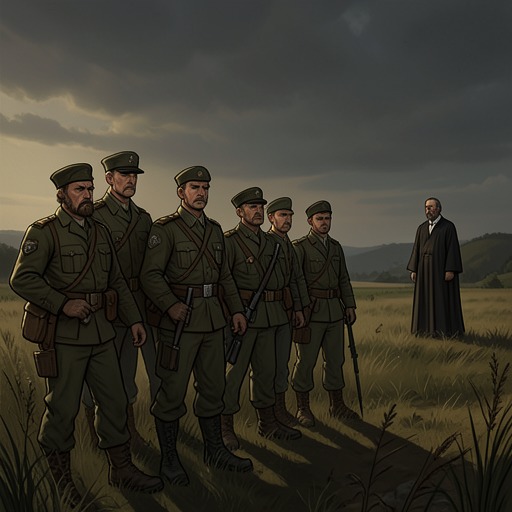
Moash
The Way of KingsMoash is one of the bridgemen whose character emerges through resistance rather than immediate devotion. When Kaladin orders the exhausted men out of their barracks to form ranks, Moash turns over to go back to sleep. Kaladin chooses him as an example because he is strong enough to withstand the confrontation, but Moash answers the attempt to pull him up with open hostility. That first encounter establishes him as physically capable, proud, and unwilling to accept authority merely because it is demanded.
Identity and Introduction
Moash is identified as a lean Alethi with a hawkish face, a short beard, and a build strong enough for Kaladin’s demonstration. He is younger, perhaps close to Kaladin’s age, and is initially among the men who would rather remain in their blankets than submit to another command. His refusal is not presented as simple weakness. He has the strength to fight, but his experience as a bridgeman has made obedience itself suspect, so Kaladin must first overcome his deliberate defiance.
The scene also gives Moash a distinctive relation to the group. Unlike weaker men such as Dunny or Narm, he is selected because he can serve as a credible example; unlike the men who silently turn their backs, he answers Kaladin directly. His hostile response makes him a visible representative of the bridgemen’s distrust, but it also marks him as someone who can become consequential once a leader proves worthy of following.
From Defiance to Responsibility
Kaladin later explains that Moash has been made a squad leader not because he obeyed easily, but because he seemed capable and intelligent and was not readily swayed. Kaladin recognizes his strong will as a usable strength. The promotion therefore converts the quality that made Moash difficult into a practical resource for Bridge Four: skepticism becomes judgment, and obstinacy becomes independence.
Moash does not respond by pretending to trust Kaladin. He openly says that he does not regard Kaladin as a gift from the Almighty and that he does not trust him. His continued obedience rests instead on curiosity. This distinction matters. Moash’s allegiance is earned through observation rather than faith, and his promotion does not erase the suspicion with which he began. He follows because he wants to see what Kaladin is attempting and whether the new order can survive contact with reality.
When Kaladin later asks for volunteers willing to remain slaves no longer, Moash steps forward and says he will do it. His eagerness places him beside Teft, while Sigzil voices the alternative of dying rather than remaining enslaved and Rock promises to sustain the fighters with food. Moash’s movement from refusing to rise from bed to volunteering for danger is a concrete measure of Kaladin’s success: the bridgeman who once resisted a command now chooses a hazardous course for himself.
Loyalty, Vengeance, and Conflict
Moash’s motives are not limited to collective freedom. In conversation on the practice ground, Kaladin asks what he is pursuing, and Moash answers with a single purpose: vengeance. The answer gives his discipline and intensity a private source. He is not merely reacting to the immediate conditions of slavery or to Kaladin’s leadership; he carries a grievance that shapes what he hunts and why he works.
His declaration also creates a deliberate parallel with Kaladin. Kaladin admits that he once lost someone because he was not good enough with the spear and nearly killed himself practicing. Both men connect violence with personal loss, but the evidence presents their desires in different forms: Kaladin speaks of failure and self-punishing improvement, while Moash names vengeance directly. Their shared recognition can support comradeship, yet the difference warns that similar suffering does not guarantee identical moral direction.
Moash’s distrust also places him in implicit opposition to commanders who treat bridgemen as expendable. Dalinar argues that Sadeas’s bridges waste many lives and invokes the Codes’ principle that a general must not ask a man to do anything he would not do himself. The dispute exposes the structure Moash inhabits: the army’s official ideals condemn one kind of cowardice, while its bridge system requires unarmored slaves to run into combat. Moash’s resistance is thus personal, but it is also a response to a military order whose stated rules and practical methods contradict one another.
Conduct in Battle and Narrative Significance
During the retreat from battle, Kaladin orders the bridgemen to pull back and asks whether Moash is strong enough to remain with him. Moash answers confidently, grinning despite a bloody face, and appears excited rather than exhausted. Three men on his side have died, yet he and the others have fought remarkably well. The moment confirms the battlefield competence that first justified Kaladin’s choice of him as an example and later as a squad leader.
Moash’s endurance is significant because it combines danger with appetite for action. He is not merely surviving by accident or obeying under coercion; he remains with Kaladin after casualties and continues to function amid a retreat in which wounded soldiers stumble and the formation dissolves into chaos. His readiness gives Bridge Four a reliable fighter at the point where discipline must be improvised under pressure.
At the same time, Moash remains a character of limited revealed interiority in this portion of the story. The evidence supplies sharp external markers—defiance, suspicion, curiosity, eagerness, vengeance, and courage—without resolving the grievance behind his final motive. That withholding makes his role structurally important. He is both ally and potential source of instability: a man whose loyalty can be real while remaining conditional, and whose commitment to a cause may be inseparable from the desire to settle a personal score.
Development and Ending Position
Moash’s trajectory in the supplied episodes moves from coerced compliance toward chosen participation. He begins by resisting Kaladin’s order and insulting him, then accepts a squad-leader role despite continuing not to trust him. He volunteers when the bridgemen are offered a chance to fight for freedom, and later stands beside Kaladin in a retreat at severe personal risk. Each step preserves his hardness rather than replacing it with submission.
His development is therefore best understood as a change in the object of his will. At first, his strength serves refusal: he will not rise simply because a superior commands it. Under Kaladin, the same strength becomes leadership, volunteer action, and battlefield loyalty. Yet vengeance remains the unresolved center of his identity. Moash’s importance lies in that tension between communal action and private grievance, between curiosity about a better form of leadership and distrust of the man providing it. He embodies Bridge Four’s transformation without becoming uncomplicated proof that transformation has healed the wounds that made resistance necessary.