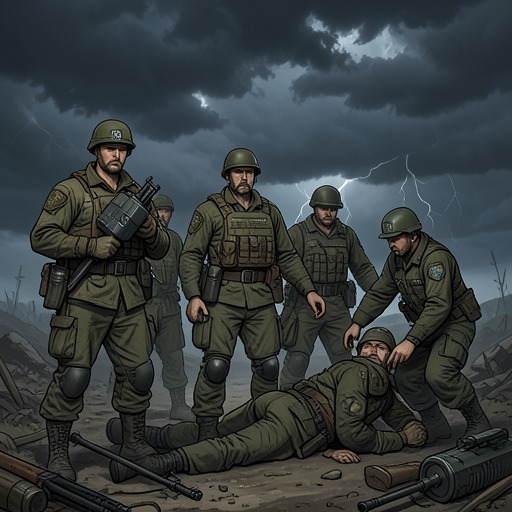
Sadeas's Betrayal at the Tower
The Way of KingsSadeas's Betrayal at the Tower is the decisive reversal of the Battle of the Tower: Torol Sadeas abandons Dalinar Kholin precisely when Dalinar's army is surrounded and unable to retreat. The act is not a battlefield mistake but a premeditated political and military maneuver, carried out through control of the bridges, scouts, attack pattern, and timing of the assault. Its immediate result is the isolation of Dalinar's force; its deeper consequence is the destruction of the trust that had bound the two highprinces together.
Causes and Political Design
Sadeas's betrayal begins before the armies reach the crisis. He has helped shape the conditions under which Dalinar's force will become dependent on his support: the bridges are taken away, the scouts are controlled, and the attack pattern places Dalinar's army on the plateau before a second Parshendi wave arrives. Dalinar and Adolin later recognize that they had effectively been led into the trap themselves, even accepting an arrangement that would leave them surrounded if Sadeas did not follow through.
The maneuver is therefore presented as deliberate rather than defensive. Sadeas's Shardplate and his honor guard remain entirely unharmed when they withdraw. His troops have crossed toward the Tower, disengaged the enemy, and returned, while a fresh Parshendi force pours into the positions Sadeas had supposedly been holding to protect Dalinar's retreat. Dalinar's army is left fighting on the upper middle slope of the wedge, surrounded by the newly arrived force and deprived of the bridges necessary for escape.
Sadeas has also prepared a political explanation for what he has done. He can describe the retreat as an unavoidable response to a battlefield disaster, claiming that the Parshendi attacked in overwhelming numbers and upset the balance of the assault. The other highprinces are unlikely to challenge him openly, even if some soldiers tell the truth, because they are already displeased with Dalinar and because Sadeas's maneuver is too powerful to confront without risking their own position. The betrayal thus operates simultaneously as military destruction and as narrative control: Sadeas intends to determine not only what happens to Dalinar, but how the warcamps understand it afterward.
The Abandonment at the Tower
Kaladin Stormblessed sees the betrayal take shape from the bridge lines. Sadeas's banner still flies, suggesting that he may be alive, but the sight of the adjacent bridge crews pulling away from the battlefield gives the movement its true meaning. Eight lent bridge crews cross from the plateau where Dalinar launched his assault, while another Parshendi force floods onto the Tower. Sadeas then rides toward the chasm in immaculate Shardplate, accompanied by two lighteyed men in ordinary armor, all three carrying their helms under their arms as though they were attending a parade rather than abandoning an army.
Kaladin forces his way up to bridge ten in order to see Sadeas clearly. The honor guard stops him, but the distance is close enough to confirm that Sadeas is unwounded and close enough for Kaladin to watch him look back at the Tower. Dalinar's army is visibly trapped: the second Parshendi army has swarmed Kholin's forces, and even without that attack Dalinar has no bridges with which to retreat. The contrast between the soldiers' desperate position and Sadeas's untouched armor makes the intent unmistakable.
Sadeas's final gesture is as revealing as his withdrawal. He tells Dalinar that Dalinar's honor will get him killed someday, then turns his horse away from the battlefield. The words convert apparent comradeship into accusation. Sadeas does not merely fail to rescue his ally; he presents Dalinar's virtues as the reason for his destruction and leaves while the consequences unfold behind him.
The Oath and Its Corruption
Dalinar survives the immediate betrayal, and the two men later confront one another at close range. Dalinar approaches the edge of the thath glyph, while Sadeas steps forward until only inches separate them. The physical equality of their stance cannot conceal the political reversal: Sadeas is tense and angry because Dalinar's survival has ruined months of planning.
When Dalinar asks why, Sadeas invokes the oath they swore years earlier to protect Elhokar Kholin and the kingdom. Sadeas claims that this oath justifies his action, but his explanation exposes a radically different understanding of protection. Dalinar believes their shared purpose is being served by fighting together; Sadeas believes the kingdom can be secured only by removing Dalinar and pursuing the Parshendi without him.
Sadeas explains that Gavilar Kholin died because he was weak in choosing a treaty rather than conquest. In Dalinar's increasing resemblance to Gavilar, Sadeas sees the same danger returning. Dalinar's influence is spreading to Elhokar: the king dresses like him, speaks to Sadeas about the Codes, considers enforcing them in the warcamps, and is beginning to entertain retreat. Sadeas therefore treats Dalinar's principles not as a possible means of strengthening the kingdom but as an infection that must be cut away.
His invocation of honor finally collapses into an admission of personal ambition. Sadeas has spent years trying to become Elhokar's most trusted adviser, but Dalinar has continued to hold the king's attention and confidence. Sadeas concedes that honor played only a part in the decision. Ultimately, he wanted Dalinar gone. The betrayal's public language of duty thus conceals a private struggle for access to the king and control over the direction of the war.
Consequences and Significance
Sadeas describes Dalinar's death as a mercy: if the Parshendi killed him in battle, Dalinar could die in glory, become a symbol, and perhaps unite the other highprinces. This reasoning gives the betrayal an especially disturbing logic. Sadeas imagines the destruction of his former ally as useful even in failure, because Dalinar's corpse could be converted into political capital. The proposed mercy is therefore another form of control over Dalinar's reputation.
The scene transforms the relationship between the two men. Their shared memories, their former plans, and the investigation that cleared Dalinar all become suspect in Dalinar's mind. The man who once saved his life now watches his army fight for survival and rides away. Sadeas's betrayal also echoes Amaram's treachery against Kaladin Stormblessed, but its scale is far greater: it is a calculated betrayal of an entire army, executed through command structures and then protected by the political reluctance of the other highprinces.
The event's central reversal is a shift from alliance to entrapment, and from honor as a shared obligation to honor as a weapon of accusation. Sadeas insists that he acted to protect Elhokar Kholin and the kingdom, yet the concrete design of the attack and his admission that he wanted Dalinar removed reveal how public duty can be made to serve personal power. The Tower therefore becomes the place where military strategy, political rivalry, and competing ideas of loyalty converge: Dalinar's survival defeats Sadeas's immediate plan, but the betrayal permanently exposes the conflict between them.