Shallan Davar
The Way of KingsShallan Davar’s decisive significance lies in the collision between inherited confinement and self-directed action. Raised to expect a life shut away in her family’s manor, she instead travels to Kharbranth and deliberately places herself beside Jasnah Kholin, not for prestige or education alone, but to acquire the means of rescuing House Davar from financial collapse. Her scheme begins with deception and theft, yet ends by exposing a deeper hunger: Shallan wants access to the knowledge and mysterious work that her original plan treated merely as obstacles to survival.
Identity and Background
Shallan enters the story as a young woman formed by restriction. She had imagined traveling, but expected her early life to remain sequestered in her family’s manor, with books in her father’s library serving as her principal escape. The future arranged for her was equally enclosed: marriage to one of her father’s allies, followed by another secluded life in a manor. Her expectations are presented as fragile possessions, like fine pottery that cracks when held too tightly, and her arrival in Kharbranth marks the first unmistakable break with that inherited design.
The city’s scale makes the break physically visible. As longshoremen draw her ship into the dock, Shallan clutches a leather-bound drawing pad and finds herself breathless before Kharbranth, the City of Bells. Built up the side of a steep incline, wedge-shaped like a broad crack opening toward the ocean, the city is unlike the isolated world she had anticipated inhabiting. Its blocky buildings, square windows, mud- or daub-like construction, and bright reds, oranges, blues, and yellows give her first experience of the wider world a concrete, almost overwhelming form. She arrives not as a passive traveler, however, but as someone carrying a private purpose beneath the wonder.
The Plan to Save House Davar
Shallan’s objective is driven by an emergency within House Davar. The family’s Soulcaster has been broken, and although a jeweler repaired it, the device no longer functions. Luesh, the house steward and one of her father’s close confidants, had been trained to use it but could no longer make it work. At the same time, her father’s debts and promises have become so excessive that the family has perhaps a year before missed payments become impossible to conceal and his unexplained absence becomes obvious.
The isolated estates of House Davar temporarily help conceal the crisis. Her brothers write letters in their father’s name, make appearances, and spread rumors that Brightlord Davar is planning something significant. These improvised deceptions do not solve the danger; they merely purchase time. Shallan therefore takes responsibility for the bold plan that might convert concealment into survival: find Jasnah Kholin, become her ward, discover where Jasnah keeps her Soulcaster, and replace the functioning device with the family’s broken one.
The intended consequences are practical and severe. With the fabrial, House Davar could create new quarries, restore its wealth, produce food for its house soldiers, pay its debts, and provide the bribes needed to announce her father’s death without destroying the family. Shallan understands that the plan is not a harmless confidence trick. She must escape without implicating herself in the theft, and she considers exploiting Jasnah’s many enemies by making the Soulcaster’s apparent failure seem their responsibility. Her resourcefulness is therefore inseparable from moral and legal risk: the family’s survival depends on turning a theft into an accusation against someone else.
Apprenticeship, Secrecy, and Pressure
After six months of pursuit, Shallan finally reaches Jasnah’s orbit, but immediate success does not follow. The king takes Jasnah away personally after she requests entrance, leaving Shallan behind with her satchel and the sooty water she has been handling. The moment nearly breaks her. She wants to cry, and recognizes that an earlier version of herself probably would have surrendered to that impulse. Instead, tears of frustration become compatible with renewed determination. She resolves not to give up unless Jasnah has her bound in chains and removed by the authorities.
That resolve defines Shallan’s first major change. She proceeds after Jasnah even though the original plan remains dangerous, and her intended apprenticeship is explicitly instrumental. Six months earlier, she had explained the desperate scheme to her brothers: she would apprentice herself to Jasnah Kholin, scholar and heretic, in order to learn where Jasnah kept the Soulcaster. The education and prestige associated with Jasnah’s wardship are, at first, secondary. Shallan approaches the relationship as an infiltration whose prize is a device.
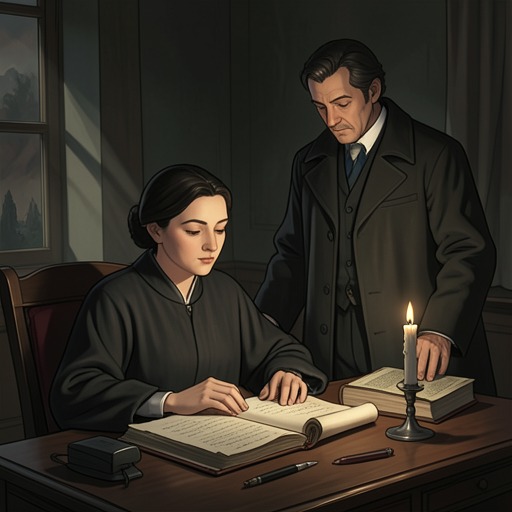
Her position inside Jasnah’s quarters intensifies the pressure. She occupies a small stone-carved chamber within the underground Kharbranthian Conclave, furnished only with a small bed, a nightstand, and a writing table. Her clothing remains in her trunk; there is no rug and no window. The austere room reflects the narrowness of her immediate purpose, while the spanreed correspondence with her family keeps the larger crisis present. When asked how long it will take before she can make the switch, Shallan admits that she does not know. Jasnah wears the Soulcaster throughout the day, locks it in a safe at night, and wears the key around her neck. The object she intends to steal is therefore continuously guarded, making patience and observation central to her strategy.
The Soulcaster Reversal
The plan collapses because Shallan has misunderstood the object at its center. During a terrifying transformation in her bedroom, the ordinary furnishings—the bed, nightstand, sketchpad, walls, and ceiling—seem to become tiny dark glass spheres. She finds herself in a black sky beneath a distant white sun, falling backward amid beads while flames hover around her like candle tips moving in wind. The scene turns the supposedly stable material world into something unstable and unreadable, preparing a direct challenge to her assumptions about objects, identity, and control.
When Shallan later confronts Jasnah, she does so with surprising calm. Jasnah threatens imprisonment for what Shallan has done, but Shallan states that the Soulcaster Jasnah wears is fake and had been fake even before the attempted switch. The revelation reverses the entire logic of the theft. Shallan had spent weeks unable to understand why Jasnah had not noticed the replacement or used Soulcasting during that time. The answer is that the stolen Soulcaster itself was a decoy. Shallan’s elaborate operation has not outwitted a careless owner; it has uncovered a deception already built into Jasnah’s public identity.
The reversal also changes the balance between the two women. Shallan realizes that Jasnah knows she has leverage. If Shallan spreads the truth, Jasnah’s strange powers could provoke accusations that she is some kind of Voidbringer, which explains why Jasnah created the decoy in the first place. Yet Shallan does not use the discovery simply to blackmail or flee. The secret gives her a new form of access, and she makes the request that reveals her transformed objective: she wants to be part of whatever Jasnah is researching.
Relationships and Narrative Role
Shallan’s relationship with House Davar is defined by obligation expressed through concealment. Her brothers help maintain the fiction of their father’s continued activity, while Shallan undertakes the more dangerous role of infiltrator. She is not merely acting for personal advancement; the functioning fabrial represents food, quarries, solvency, and the possibility of preserving the household from destruction. At the same time, her willingness to deceive Jasnah and consider framing her enemies shows how thoroughly family responsibility has pushed her into ethically compromised choices.
Her relationship with Jasnah Kholin develops through a sharp contrast between appearance and knowledge. Shallan first sees Jasnah as a scholar and heretic whose guarded Soulcaster must be stolen. Jasnah, in turn, controls the spaces, routines, and information surrounding the device. Their encounter eventually reveals that both women are performing identities before one another: Shallan as a prospective ward whose motives are concealed, Jasnah as a Soulcaster user whose public instrument is false. The discovery does not resolve their conflict, but it converts it into a more complex negotiation grounded in mutual exposure.
Shallan’s drawing pad and the transformed bedroom further connect her practical identity as an observer with her unstable understanding of reality. She arrives in Kharbranth carrying the pad against her chest, an instrument associated with recording and interpretation; later, even the sketchpad becomes part of the material world that dissolves into beads. The recurring disturbance of objects complicates her initial belief that the Soulcaster can be treated as a transferable tool whose value is purely economic. What appears to be a device is also a secret, a disguise, and a threshold into knowledge Shallan had not originally known to seek.
By the end of the supplied arc, Shallan has not yet repaired House Davar’s finances or secured the fabrial her family needs. Her achievement is instead a change in the terms of her journey. She begins as a sheltered daughter attempting to preserve an inherited house through substitution and deception. She ends as someone who has crossed into Jasnah’s dangerous intellectual world and openly asks for participation in it. The theft fails as a theft, but succeeds as a threshold crossing: Shallan’s immediate plan is defeated, while the larger movement from confinement toward knowledge has begun.