Shattered Plains
The Way of KingsThe Shattered Plains are an enormous riven expanse of rock at the center of the Alethi war against the Parshendi. Their defining image is geological fragmentation: the plain has been split into uneven plateaus separated by dark chasms, some twenty or thirty feet wide, so extensive that a traveler cannot see from one side to the other. The landscape resembles a stone platter broken apart and reassembled with narrow gaps between its pieces. This physical division becomes the setting’s governing condition, turning movement into a military problem and mirroring the political fragmentation of the people who fight there.
Geography and Physical Setting
The Shattered Plains extend across a landscape of large and tiny plateaus cut apart by deep crevasses. The chasms vanish into darkness, and the fractured terrain forms a jagged mosaic rather than a continuous field. Its scale overwhelms Kaladin when he first sees it: the sight matches the stories he has heard, but its reality is even more daunting because the opposite side remains beyond his vision.
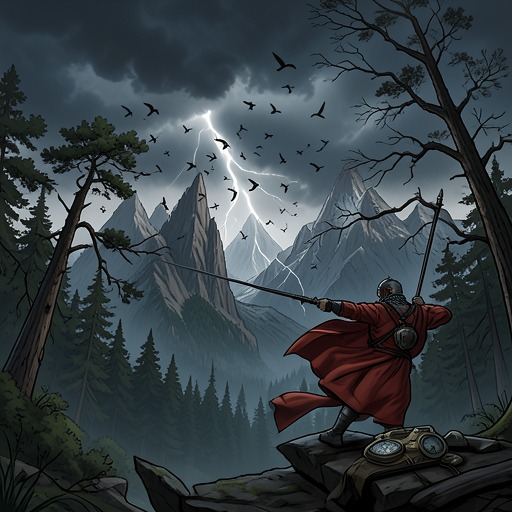
The terrain is dangerous not only because of the chasms but also because of the creatures that inhabit the surrounding spaces. The eastern and southern edges are effectively impassable, with some plateaus weathered into narrow spires too distant for the Parshendi to cross by jumping. Mountains border the Plains, while chasmfiends prowl among the broken land. These natural barriers make the region both a battlefield and a defensive enclosure, limiting possible routes and helping determine which forces can reach one another.
The Shattered Plains are also exposed to highstorms. A force that camps directly upon them must endure the storms while depending on large numbers of fragile bridges to cross the gaps. The combination of storm exposure, broken ground, and predatory chasmfiends makes any campaign there costly even before opposing armies meet.
War and Military Strategy
By the time the main narrative reaches the Shattered Plains, Alethkar has been fighting the Parshendi there for nearly six years in an extended siege. Dalinar Kholin helped devise the siege strategy because a direct assault on the Parshendi base would require the Alethi to live on the Plains, withstand highstorms, and rely on bridges vulnerable to failure. If one battle went badly, an Alethi army could be trapped and surrounded without a route back to fortified positions.
The same geography that protects the Parshendi can also confine them. Their base lies somewhere eastward, at the center of the Plains, while the impassable edges, mountains, and chasmfiends restrict movement around the perimeter. The result is a war shaped less by open maneuver than by controlled crossings, plateau assaults, and the struggle to secure routes through a terrain that can isolate an army as effectively as an enemy can.
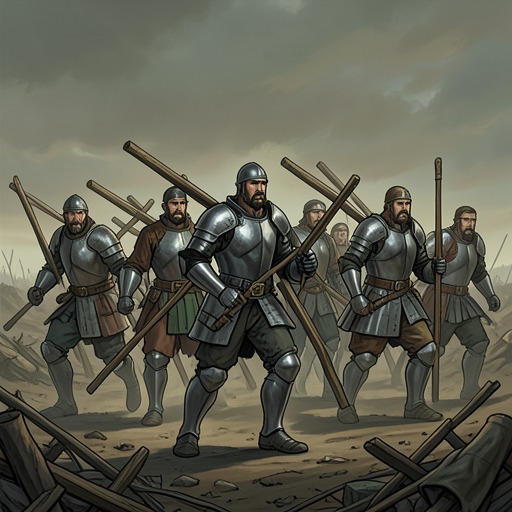
The military encampments surrounding the Plains reveal the scale of the conflict. Kaladin sees an army stretching for miles north and south, beneath a thousand banners bearing different family glyph pairs. Most soldiers live in large stone barracks rather than tents, a sign of the Soulcasters that support the camps. Among these banners he recognizes the deep-blue standard of House Kholin, marked with white glyphs representing a sword before a crown. The sight places the fractured battlefield within the authority of the king’s house, even as the many banners testify to the competing powers gathered there.
Political and Economic Center
The Shattered Plains are not merely a place where armies seek victory. Their gemhearts make them an economic prize, and the highprinces’ pursuit of those resources has helped turn the war into a competition among Alethi armies. Dalinar Kholin condemns this arrangement as empty when the highprinces quarrel and pursue individual gains while neglecting the larger purpose of defeating the Parshendi.
Dalinar’s proposed answer is to transform the ten separate armies into a coordinated national force. After becoming Highprince of War, he intends to enforce the Codes in all ten warcamps, decide which armies undertake which plateau assaults, and have all gemhearts won for the Throne before distributing them as spoils. The Shattered Plains therefore expose a contradiction in Alethi state power: the kingdom can assemble immense military forces, yet its leaders remain divided by rivalry and private advantage. Dalinar sees the battlefield as the place where that division must either be overcome or continue to consume the war effort.
The political significance of the Plains also reaches backward into Alethkar’s history. Dalinar remembers that Gavilar Kholin once favored a system in which each of Alethkar’s ten highprinces held a specialized responsibility for governing the kingdom. The arrangement had been intended to force the highprinces to cooperate, but it had disappeared after Alethkar fragmented into ten autonomous princedoms. On the Shattered Plains, Dalinar attempts to recover the principle of coordinated authority through military command, using the war itself to rebuild a unified kingdom.
Crossroads of People and Knowledge
The Shattered Plains attract people from across Roshar and connect the war to a much wider world. Kaladin arrives after leaving an army commanded by Amaram, and the sight of the Plains fulfills a desire associated with Tien: reaching the place where the king’s army fights the Parshendi. His arrival is therefore both geographic and personal, bringing him to the landscape that had existed for years as an object of stories, ambition, and loss.
The location is linked by movement and communication to distant societies. A spanreed bound to Jasnah Kholin flashes with a message while Dalinar is working in the camp, showing that information from outside the Plains can reach its military center. The Plains are thus not isolated from the wider world; they are a node through which royal decisions, scholarly investigations, and military concerns converge.
Their importance becomes even greater when Jasnah Kholin decides that she and Shallan Davar must travel there to investigate whether the Parshendi were once ordinary parshmen and what transformed them into soldiers. Jasnah believes the answer could reveal how ordinary parshmen might be changed again, making the Plains the place where a military mystery and a potentially catastrophic weapon intersect. She also identifies the Ghostbloods as another group seeking the same secrets, connecting the battlefield to assassination, espionage, and the hidden struggle over knowledge.
The Plains are framed against a network of other locations and cultures. The narrative moves from the Purelake, where Ishikk fishes in shallow transparent water, and from distant cities such as Sesemalex Dar, to Kharbranth, where Szeth-son-son-Vallano arrives as a porter, before returning attention to the war zone. These contrasts make the Shattered Plains feel like the gravitational center of a world in motion: distant customs, trade, religion, and political systems all become relevant because the war there may determine the fate of more than Alethkar alone.
Division and Narrative Significance
The central irony of the Shattered Plains is that their broken geography reflects the broken political order surrounding them. The plateaus are separated by chasms, while the Alethi war effort is divided among ten highprinces who often value rivalry over coordination. Dalinar’s repeated desire to unite them is therefore not an abstract political slogan. It is a response to a landscape in which every gap can become a trap and every isolated force can be destroyed.
The setting also converts distance into suspense. The Parshendi base is somewhere at the center, hidden beyond the visible reaches of the broken plain. Armies must cross exposed bridges and vulnerable plateaus to approach it, while highstorms and chasmfiends make the terrain an active force rather than a passive backdrop. Every advance carries the possibility of isolation, and every retreat depends on the fragile infrastructure that made the war possible in the first place.
Finally, the Shattered Plains hold together the novel’s military, political, personal, and investigative strands. They are the destination Kaladin once imagined through Tien’s hopes, the arena in which Dalinar tries to turn competing armies into a real army, the source of the gemhearts that intensify highprince rivalry, and the site Jasnah chooses for research into the Parshendi and the Voidbringers. Their decisive significance lies in this convergence: the Plains are physically shattered, but they are also the point at which the book’s separated stories begin to meet.