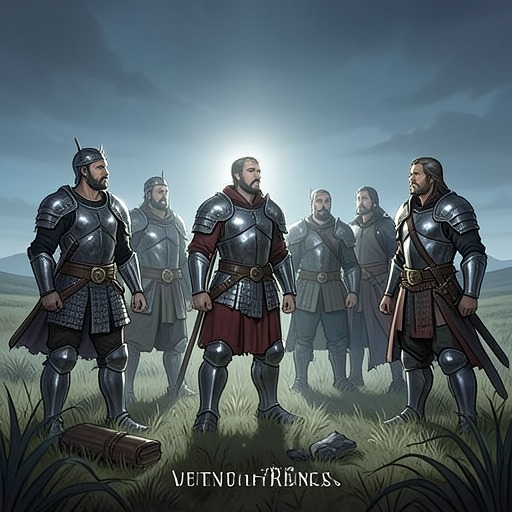
The Knights Radiant must stand again.
The Way of Kings“The Knights Radiant must stand again.” is the decisive summons of The Way of Kings: not merely a prediction that an ancient order will return, but an imperative that someone must make its return possible. Joined to the ancient oaths and the command to return the Shards once borne by its members, the expression converts the Knights Radiant’s ruined legacy into a present obligation. Its force lies in the contrast between what has been lost and what the surviving world now requires.
Meaning and Form
The expression appears as the culmination of a sequence that begins with the ancient oaths: “Life before death. Strength before weakness. Journey before destination.” The speaker then calls for those oaths to be spoken again and for the Shards once borne by the Knights Radiant to be returned to men. The final sentence gives that restoration a collective object and a historical direction. The order must not simply be remembered; it must stand once more.
The wording is therefore both declarative and performative. It describes a necessity while also issuing a command. “Again” carries the entire burden of the expression: the Knights Radiant have already fallen, their orders have been absent for centuries, and their weapons and armor remain as remnants of a vanished discipline. The sentence reaches backward toward that broken inheritance while pressing forward toward renewal.
Place in the World of the Novel
The expression answers the condition of Roshar, a world shaped by violent storms, ruined landscapes, and the disappearance of the ten consecrated orders. The Knights Radiant survive in fragments: Shardblades and Shardplate remain objects powerful enough to decide battles and kingdoms, while the principles that once gave those objects meaning have largely been severed from them. The call to make the Knights Radiant stand again therefore joins moral restoration to the recovery of extraordinary power.
That contrast also clarifies the novel’s treatment of war. On the Shattered Plains, armies fight separately against a single foe, and leaders treat ordinary soldiers as expendable. Against this fragmentation, the expression proposes a different model of strength—one grounded in shared oaths rather than possession alone. The Knights Radiant are significant not simply because they were formidable warriors, but because their return would reunite power with duty.
Dalinar’s Recognition
The expression is spoken directly to Dalinar Kholin in a vision-like encounter. The figure explains that men must face their enemies together and warns that division will allow the enemy to make them forget, turn against one another, and become their own enemies. The declaration thus gives language to the danger already confronting Dalinar’s world: apparent victory belongs to the past, while the present is defined by continuing loss.
Dalinar answers that he cannot comprehend how the restoration can be achieved, but that he will try. His response is important because it does not claim understanding or certainty. The sentence creates a task larger than his knowledge, and his acceptance transforms him from a troubled observer of visions into a participant responsible for acting on their warning. The expression becomes, in effect, the governing demand of his political and moral awakening.
Narrative and Thematic Significance
The phrase functions as a hinge between an age of collapse and a possible future. It gathers the book’s recurring tensions—memory against forgetting, unity against rivalry, inherited power against neglected responsibility—into one compact imperative. The ancient order’s return is presented not as nostalgia for a heroic past, but as a response to a present crisis in which people are already losing because they remain divided.
Its placement at the close of the supplied vision gives the expression an especially strong prophetic charge. The surrounding words insist that the old stories of victory conceal a harsher truth: the defenders lost, and they are still losing. Within that frame, “The Knights Radiant must stand again.” is less a triumphant promise than an alarm. It names the condition for reversing a defeat that the characters have not yet fully recognized and makes renewal inseparable from collective action, renewed oaths, and the responsible use of the Shards.