The Stormfather
The Way of KingsThe Stormfather is the immense intelligence manifested through the highstorm, a presence whose scale makes ordinary human categories inadequate. He is encountered not as a stable body but as weather, voice, and an aged face as wide as the sky, with eyes full of stars. His appearances turn the storm from a natural disaster into a speaking power, while his fragmentary statements disclose the ancient history and future danger governing the wider conflict.
Manifestation and Identity
The Stormfather first appears in the evidence through Syl’s intervention during a moment of extreme danger. As Kaladin stands with one foot over the void, a soft but piercing call causes him to freeze. A translucent form moves toward him through weakening rain, lunging, sinking, and surging upward as though carrying a heavy burden. Syl lands on his hand in the shape of a skyeel clutching a dark object, then changes into the familiar form of a young woman holding a narrow dark green leaf with a three-part point: blackbane. The scene does not identify the Stormfather directly, but it establishes the supernatural environment in which his storm-borne power operates and places Syl between Kaladin and death.
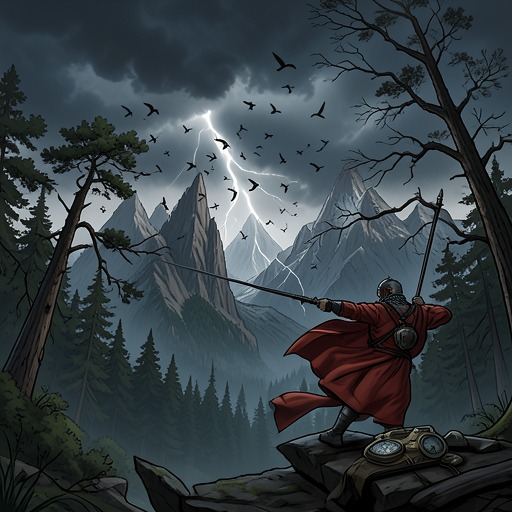
His most explicit manifestation comes during the highstorm. Kaladin watches a raging wall of wind-driven water and debris approach with the sensation that the end of the world is descending. The stormwall crosses the lumberyard, strikes him with such force that it nearly knocks him unconscious, and presses him against a barrack while rocks and branches crash around him. When the blast passes, turbulent winds seize him, drag him sideways, and lift him into the darkness until he hangs from a rope like a kite tied to the roof. The physical violence of the storm supplies the Stormfather’s first defining quality: he is not merely present within the weather, but inseparable from its overwhelming force.
Voice of Ancient History
The Stormfather’s voice reaches beyond Kaladin’s immediate crisis and gives the storm a historical consciousness. While Kaladin is caught in the highstorm, an old source concerning Urithiru is presented: the city was not built in Alethela but placed westward, nearest to Honor. The passage is described as perhaps the oldest surviving original source to mention Urithiru, and its wording remains difficult to translate because it belongs to the Dawnchant. Set against Kaladin’s struggle inside the storm, this fragment makes the Stormfather’s domain a meeting place between present danger and inaccessible antiquity.
The historical material also enlarges the significance of Urithiru. Its western placement was not arbitrary; it was associated with proximity to Honor. The Stormfather therefore appears alongside evidence of a vanished sacred and political order, even though the scene does not provide a complete explanation of that order. His presence gives the old record an uncanny pressure: the past is not safely buried in a book, but remains connected to the storm moving through the living world.
Revelation of the Oathpact and Odium
The Stormfather delivers his clearest disclosures when Kaladin is carried through the storm. The voice identifies him in an unsettling sequence as a child of Tanavast, a child of Honor, and a child of one long since departed. The wording presents the speaker as heir to a lineage tied to Honor while also marking a separation from an earlier figure. It is not a conversational explanation; it is a proclamation that shakes Kaladin and makes him flounder in the air.
The next declaration is that the Oathpact was shattered. This transforms the apparent chaos of the highstorm into evidence of a broken ancient structure. The statement is brief, but its consequence is large: the world’s present instability is connected to the failure of a pact rather than being an isolated series of wars or disasters. The Stormfather reveals the condition without supplying a full account of who broke it, when the break occurred, or how its remnants operate, preserving the sense that Kaladin has been brought close to a truth much larger than his understanding.
The Stormfather then names the approaching danger: Odium comes, described as the most dangerous of all the sixteen, and Kaladin is ordered to go. The command ends the encounter’s movement toward explanation. Even as Kaladin seeks understanding, the Stormfather offers warning rather than instruction. The threat is identified, but the means of confronting it remain outside the scene.
Communication, Scale, and Narrative Function
Kaladin responds to the Stormfather’s revelations by admitting that he does not understand and asking why there is so much war and whether people must always fight. The questions emerge in the tempest rather than from a prepared argument, suggesting that the Stormfather’s appearance forces immediate moral and existential reflection. The storm answers only with a rumble likened to a thoughtful aged father; then the enormous face vanishes, breaking apart into droplets of water. Communication therefore remains radically unequal. Kaladin speaks as a human caught in the weather, while the Stormfather answers through atmospheric force and compressed declarations.
This imbalance gives the Stormfather a dual narrative role. He is a source of knowledge, because he reveals the shattered Oathpact and the coming of Odium, but he is also a threshold figure who prevents that knowledge from becoming comfortable or complete. His face is recognizable as aged and paternal, yet its width is that of the sky and its eyes contain stars. The familiar image of a father is thus expanded into cosmic scale, producing both authority and dread.
The Stormfather’s appearances also alter the meaning of survival. Syl’s arrival with blackbane interrupts Kaladin’s movement toward the void, while the Stormfather’s storm carries him into revelations about Honor, Urithiru, the Oathpact, and Odium. In each case, weather and supernatural agency are bound to a decision about whether Kaladin continues. The result is not a simple rescue narrative: the forces that preserve his life also expose him to truths and dangers beyond ordinary human control.
Contrast with Human Suffering
The Stormfather’s vast perspective stands in stark contrast to the intimate violence surrounding Kaladin. Elsewhere, Kaladin tries to save a dying darkeyed youth of sixteen, holding bloodied hands over an arrow wound while the man’s final delirium invokes a shattered world. The scene reduces catastrophe to a body on stone: an open wound, crimson blood, and a dagger slipping from Kaladin’s fingers. Against that human scale, the Stormfather’s storm is literally world-sized, with winds that fling a man into darkness and a face that fills the sky.
The contrast does not separate private suffering from cosmic history; it joins them. The young man’s death occurs amid war and images of a world breaking apart, while the Stormfather explains that an ancient pact has already been shattered and that Odium is coming. Kaladin’s repeated experience of individuals being wounded and dying therefore becomes part of a larger pattern whose causes exceed any single battlefield. The Stormfather embodies that pattern without making it comprehensible or merciful.
As a character, The Stormfather is consequently defined less by sustained conversation than by scale, interruption, and disclosure. He appears through the highstorm, speaks in prophetic fragments, turns weather into agency, and leaves Kaladin with more urgent knowledge than he can assimilate. His final image—an aged face dissolving into water—captures the paradox at the center of his role: he is both a father-like speaker and an impersonal force, both a witness to ancient history and the immediate pressure of the present storm.