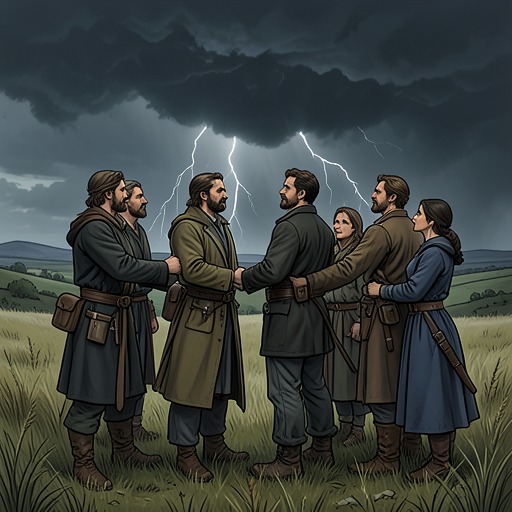
There are two kinds of people in the world.
The Way of Kings“There are two kinds of people in the world.” is not merely a saying but a moral boundary passed between Lirin and Kaladin. Lirin uses it to define the surgeon’s calling: some people save lives, while others take them. Kaladin first resists that division, imagining a third group who kill in order to save, but experience gradually forces him to reconsider his own categories. Across surgeries, war, class privilege, and political violence, the expression becomes a recurring ethical test whose force lies in the choices made under pressure.
Origin and Formulation
The saying enters Kaladin’s moral imagination through his father. Lirin tells him that the world contains those who save lives and those who take lives, presenting the distinction as fundamental rather than situational. When Kaladin asks about people who protect and defend by killing, Lirin rejects the proposed compromise: protection cannot be achieved through killing, just as a storm cannot be stopped by blowing harder. The exchange establishes the expression’s central tension. Kaladin sees violence as potentially instrumental, while Lirin treats the act itself as a decisive moral classification.
Lirin’s position is grounded in the practical discipline of surgery rather than abstract innocence. When Sani’s hand is badly injured, Kaladin recognizes that the shattered third finger must be removed because trying to preserve it would allow the damage to fester and kill the finger. Lirin performs the amputation with precise care, saving what can still be saved while removing what cannot recover. The scene gives the maxim a concrete medical counterpart: a surgeon may cut, but the purpose is restoration, not destruction. Lirin’s related instruction that a wise surgeon must know what to remove and what to save makes judgment, restraint, and preservation the expression’s governing practices.
Kaladin’s Reconsideration
Kaladin initially believes that Lirin is wrong. He imagines a third category consisting of people who kill in order to save, a position shaped by his desire to become a soldier and fight for his highprince and the lighteyes. His ambition places the saying under pressure before he fully understands it: he wants the honor and usefulness associated with military strength, yet his instinctive response to wounds is to repair rather than destroy. Lirin notices that Kaladin nearly cries whenever someone is brought into the surgery and becomes anxious even during simple procedures, asking what makes him think he could truly hurt another person. Kaladin answers that he will become stronger, but Lirin calls the aspiration foolishness and insists that surgeons are needed more than soldiers.
The expression returns when Kaladin confronts the consequences of war. After Gadol dies, the wounded Leyten is brought in with arrows in his shoulder and arm, a torn stomach wound, a crushed leg, and severe blood loss. Kaladin immediately turns from the dead man to the living one. He presses a bandage against Leyten’s side, orders the damaged leg elevated, applies a tourniquet, cauterizes the wound, removes one arrow, and leaves another in place. His mind is numb, but his hands remember Lirin’s instruction. The battlefield therefore does not erase the surgeon’s ethic; it relocates it into a scene where saving a life requires speed, instruments, and authority amid repeated deaths.
Later, Kaladin recognizes that his earlier third category was a mistake. Speaking with Syl, he recalls his father’s distinction and says that he had once believed people could kill in order to save. He now sees a larger third group, but not the one he had imagined. The revised understanding exposes a moral failure beyond the simple opposition of healer and killer: people may participate in systems that kill without fitting comfortably into either category. The saying survives, but Kaladin’s relation to it becomes more troubled and more self-accusing, because his own history has placed him inside the violence he once treated as a possible form of protection.
Surgical Ethics and Unequal Lives
The maxim is also enacted through Lirin’s treatment of patients whose social rank would normally determine whose life matters most. When Rillir and other wounded people are brought for treatment, Lirin follows three guidelines for choosing between patients. If their wounds are equally serious, the youngest is treated first; if the wounds differ in danger, the worst wound comes first. These rules make medical urgency, not status, the basis of action. Lirin refuses to let Roshone’s authority turn the treatment room into a hierarchy of privileged lives.
Lirin’s refusal becomes explicit when he explains why he is not a killer. He says that somebody must begin by doing what is right because it is right, so that others can follow. He condemns the lighteyes for trying to kill themselves and others while Roshone has abandoned Alds and Milp, two townsmen left behind so that the wounded Rillir could be transported more quickly. Lirin would not have allowed Roshone to die even without Kaladin’s presence, because the surgeon’s obligation extends to the person whose choices and class have helped produce the suffering. Saving life is therefore not a reward for virtue. It is a responsibility that must be maintained even when the patient has failed to show the same regard for others.
The hospital led by Taravangian presents a darker inversion of the same medical imagery. It contains hundreds of beds and many healers, but the work being done there involves draining patients’ blood. When Szeth questions whether such efforts could redeem the violence Taravangian has commanded, Taravangian rejects the description of the activity as humanitarian work. The hospital’s appearance of care is separated from Lirin’s ethic by its purpose and secrecy. Treatment, bodily intervention, and organized medical labor do not automatically belong to the side of life; the expression requires attention to what an action serves, not merely to the tools or setting in which it occurs.
War, Law, and the Corruption of Protection
The saying also illuminates the dispute over military practice. Dalinar objects that Sadeas’s bridges waste many lives, while Sadeas defends them as fast and practical on the plateau terrain. Dalinar invokes the Codes, which state that a general may not ask a man to do anything he would not do himself, and challenges Sadeas to run at the front of the bridges. Sadeas answers that he would not eat gruel or cut ditches either, treating the bridge crews’ suffering as another unpleasant military necessity. Dalinar draws a sharper distinction: the bridges are sent into combat without armor or shields, conditions he would not accept for himself in Shardplate. The argument turns the maxim into a question of responsibility. A commander who claims to protect an army while assigning expendable men to die has converted protection into organized taking of lives.
Amaram’s betrayal gives the same conflict a more personal form. After Kaladin’s squad helps kill a Shardbearer, Amaram says that the surviving men cannot be allowed to tell what they witnessed. He plans to claim that the squad assisted the Shardbearer while he alone killed him, taking the Shards for himself on the grounds that he is trained in the sword and accustomed to Plate. His language frames theft and murder as service to Alethkar. The expression’s opposition between saving and taking therefore exposes the gap between declared purpose and actual conduct: an army may invoke collective good while its leaders protect reputation, rank, and possession through killing.
Dalinar’s confrontation with Elhokar offers another version of coercive protection. Dalinar has the guards obey orders not to enter the room or permit anyone else to enter, even if the king calls for help. When Elhokar begs for the guards, Dalinar explains that they are his men, trained and placed there by him, and loyal to him. The scene makes loyalty an instrument of control and shows how protection can become indistinguishable from confinement when one person claims authority over the conditions under which another may be defended. The maxim does not supply an easy answer; it forces the question of whose life is being protected, from what danger, and at whose expense.
Recurrence and Significance
The expression’s recurrence connects private education, emergency medicine, military exploitation, and hidden political violence. In Lirin’s surgery, the distinction is embodied by careful hands, triage rules, and the removal of an irreparably damaged finger. In Kaladin’s battlefield work, it appears as remembered procedure applied to a dying soldier. In the military disputes, it becomes a challenge to leaders who spend other people’s lives while claiming necessity. In Taravangian’s hospital, it becomes a warning that medical appearances can conceal acts directed toward purposes unrelated to healing.
Its deepest significance lies in the instability of the proposed categories. Lirin speaks as if the choice were clear, but the surrounding world repeatedly blurs it: surgery wounds in order to preserve; soldiers may claim to kill in order to protect; commanders may call sacrifice duty; healers may work inside a system whose purpose is not humanitarian. Kaladin’s development is marked by his movement from a simple third category toward recognition that many people participate in killing without honestly naming themselves killers. The saying consequently functions less as a settled classification than as an accusation directed at every justification that makes another person’s death sound like care.