Vengeance Pact
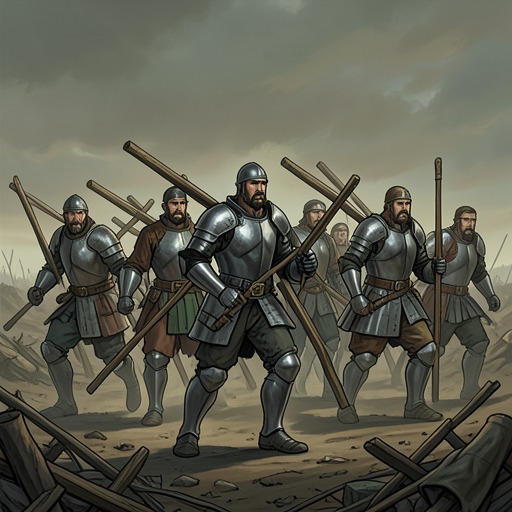
The Way of KingsThe Vengeance Pact is the Alethi campaign against the Parshendi, undertaken after the assassination of Gavilar Kholin and sustained as an obligation of vengeance. It gives the war on the Shattered Plains its public purpose, but the story repeatedly tests whether vengeance is justice, policy, or merely a language that permits rulers to pursue power. By the time Dalinar Kholin proposes a different course, the pact has become both an unresolved national grievance and the justification for a wasteful system of competing armies.
Origin and Stated Purpose
The pact is rooted in the killing of Gavilar Kholin, an act for which the Alethi hold the Parshendi responsible. Its emotional force is visible in the way Dalinar Kholin regards the gemheart campaigns as empty unless they advance the vengeance everyone came to pursue. The war is therefore not presented as an ordinary struggle for territory or resources: gemhearts are valuable, but they are secondary to the demand that the Parshendi pay for the king’s death.
That purpose is complicated by the limited knowledge behind it. Dalinar Kholin later admits that the Alethi abandoned the question of why the Parshendi killed Gavilar Kholin too quickly. He considers the possibility that rebels or miscreants acted against their own people and argues that the Alethi should investigate Parshendi culture before deciding how to end the war. His alternative would preserve a demand for repayment, potentially including the delivery of the Parshendi king for execution, while granting peace rather than continuing an indefinite campaign. The pact thus contains a tension between a clear demand for retribution and an uncertain account of responsibility.
War as an Institutional Practice
The Vengeance Pact operates through the fragmented military structure of Alethkar. The highprinces prosecute the war from separate camps and compete for gemhearts, while the common soldiers bear the physical cost. Dalinar Kholin invokes the Alethi Codes against Torol Sadeas’s bridge policy, arguing that a general may not demand what he would not do himself. His challenge is directed at a system in which bridge crews are sent into battle without armor or shields, making the pact’s promised honor dependent on practices that expose darkeyes to near-certain danger.
The same contradiction appears in the recruitment of soldiers. When the army requires replenishment, Amaram explains that volunteers will be taken first but that the army must still be supplied, with the citylord deciding which men to send. The Vengeance Pact therefore reaches beyond battlefield speeches: it authorizes the extraction of bodies from subject communities and turns military need into a duty imposed by local authority. Its language of national honor coexists with coercive selection and unequal risk.
The pact also depends on assumptions about hierarchy that are not universal. In Shinovar, warriors are treated as the lowest class, while farmers receive respect and attention; in Babatharnam, political authority increases with age rather than eye color. These contrasts sharpen the specifically Alethi character of the war’s justification. The pact is not a neutral law recognized across Roshar, but an Alethi political commitment carried into a world of different social orders, customs, and ideas of legitimate rule.
Dalinar Kholin’s Proposed Fulfillment
Dalinar Kholin initially seeks to fulfill the pact through decisive military action rather than endless plateau-by-plateau competition. He proposes luring a large number of Parshendi onto the Plains and ambushing them, destroying their capacity to wage war if possible; failing that, the Alethi should strike at the Parshendi center and kill or capture its leaders. He compares the strategy to stopping a chasmfiend by decapitating it. In this formulation, vengeance becomes a finite operation with a defined enemy, objective, and endpoint: either annihilate the opposing army’s ability to fight or remove its leadership, then go home.
Yet Dalinar Kholin’s later position is more cautious and more politically ambitious. He says he would return to Alethkar not from fear of battle but from fear for the homeland’s stability and the loyalty of the highprinces. He would send envoys and scholars to investigate the assassination, seek a better understanding of Parshendi culture, and pursue repayment through negotiation if the circumstances warranted it. He would also look for a method of holding the territory without relying solely on gemheart hunting, including mass homesteading across the Unclaimed Hills.
This shift does not amount to abandoning vengeance. Dalinar Kholin explicitly preserves the demand while changing its method. The pact’s meaning moves from immediate emotional retaliation toward a combination of inquiry, diplomacy, territorial settlement, and military preparedness. The distinction matters because it separates the desire to punish from the assumption that prolonged war is the only proof of resolve.
Political Consequences and Transformation
The pact’s failure to produce a conclusion exposes the weakness of Alethkar’s divided leadership. Dalinar Kholin recalls an older proposal in which the ten highprinces would each hold a specialized responsibility for governing the kingdom, forcing them to cooperate rather than act as autonomous rivals. Gavilar Kholin had regarded that arrangement as a device for compelling collective authority, but the system had long since disappeared as Alethkar fragmented into ten independent princedoms. Dalinar Kholin’s effort to unite the highprinces therefore treats the war as a test of state formation, not simply as a sequence of battles.
After Torol Sadeas abandons Dalinar Kholin’s army, Dalinar Kholin rejects the idea that Sadeas alone is morally exceptional. He argues that any highprince might betray his fellows if the opportunity arose without personal risk. His response is not to demand a trial for Sadeas but to redesign the conditions that make such betrayal profitable. As Highprince of War, he intends to enforce the Codes in all ten warcamps, coordinate which armies attack which plateaus, and ensure that gemhearts are won for the Throne and distributed by the king as spoils. The Vengeance Pact is thus converted into an instrument for replacing aristocratic competition with coordinated national war.
That plan requires personal sacrifice and a new concentration of authority. Dalinar Kholin has already given away his Shardblade to fulfill one promise and plans to give his Shardplate to Renarin Kholin to fulfill another. He proposes to lead the war without the symbols that traditionally define a Shardbearer, while using the office of Highprince of War to make the ten armies function as one force. The pact’s political afterlife is consequently bound to a paradox: a war begun in the name of national vengeance may require stronger central coordination, stricter obligations, and less individual aristocratic freedom than the Alethi are accustomed to accept.
Significance
The Vengeance Pact is the book’s central example of a justifying principle that changes as it passes through institutions. It gives grief a public form and gives Alethkar a reason to remain at war, but it does not by itself establish who is guilty, what repayment would be sufficient, or how much suffering the pursuit may authorize. Its repeated association with bridge crews, forced recruitment, gemheart competition, and highprince betrayal shows the distance between a noble collective purpose and the practices performed under its banner.
Dalinar Kholin’s challenge is therefore not simply whether the Alethi can defeat the Parshendi. It is whether vengeance can be made compatible with knowledge, law, military responsibility, and the survival of Alethkar. His answer is not forgiveness and not surrender. It is an attempt to fulfill the pact by ending the wasteful war that has grown around it, discovering what the assassination meant, and transforming a retaliatory coalition into a functioning state.