
The Battle for the POW Camp
The Wind-Up Bird ChronicleThis conflict follows Lieutenant Mamiya’s passage from a secret mission and captivity into Boris Gromov’s controlled camp, where coerced cooperation becomes a failed attempt at resistance.
increasing Bearing strength in each event
 decreasing
Bearing strength in each eventdecreasingA Secret Crossing
The Mission Across the River
An Unequal Command
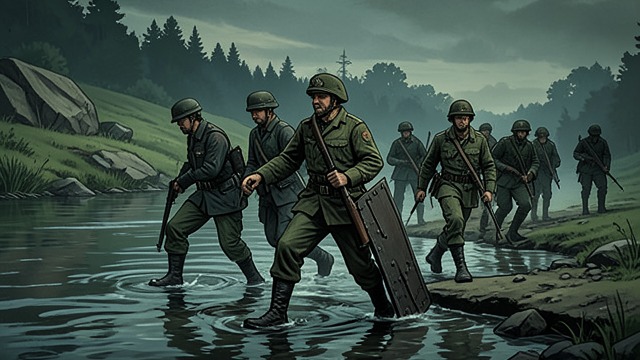
Lieutenant Mamiya is assigned to accompany Yamamoto, Hamano, and Oishi Honda on a mission near the disputed border. Though Mamiya nominally commands the group, Yamamoto clearly controls its decisions.
The party crosses the Khalkha River into Outer Mongolian territory, where a Mongolian contact takes Yamamoto away. Mamiya and the others are left waiting in dangerous ground with a hidden document they do not fully understand.
Captured Before Escape
An Outer Mongolian patrol captures Mamiya and Yamamoto before they can recross the river. Hamano is killed, and the document disappears, leaving the prisoners unable to explain their mission without risking further consequences.
The secret operation becomes an immediate struggle over survival and information. Mamiya has no authority to change the situation and must wait for the captors to decide his fate.
Boris’s Threat
Terror as Interrogation
A Choice Under Force
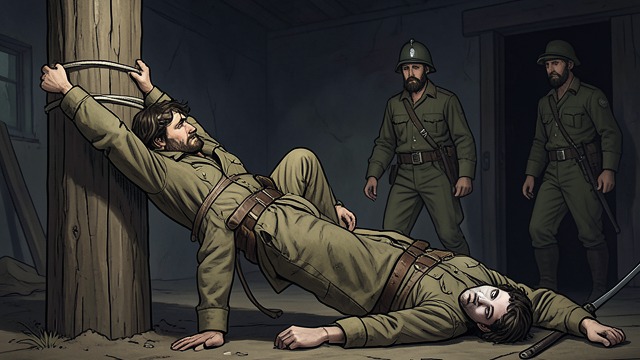
A Soviet officer asks Yamamoto for the missing document and threatens both captives. When Yamamoto refuses to provide information, the officer orders him bound and subjected to a prolonged, deliberate execution.
Mamiya is forced to watch. The violence is staged as a method of extracting knowledge, but it also demonstrates the captors’ power to turn a human body into a warning.
A Survival Bargain
After Yamamoto dies, the officer tells Mamiya that he will be given a chance to survive. Mongolian soldiers take him to a dry well and force him to choose between being shot or jumping into it.
Mamiya leaps into the darkness, badly injured but alive. His later survival does not erase his exposure to violence; it marks the start of a conflict with death that he will carry for decades.
A Prisoner Recruited
Boris Reclaims the Encounter
Recognition in Captivity
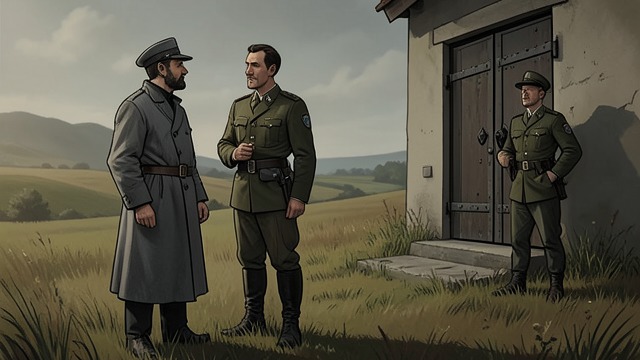
Years after the Khalkha River incident, Mamiya recognizes the Russian officer who ordered Yamamoto’s death. The former officer, Boris Gromov, is now a prisoner assigned to road work in the Siberian camp.
Boris recognizes Mamiya too. Instead of exposing him, he approaches him privately and offers influence, protection, and improved conditions for Japanese prisoners in exchange for cooperation.
A Dangerous Alliance
Mamiya refuses to become a spy but is drawn into a secret arrangement with Boris and the Japanese prisoners’ representative. The promise of limited autonomy is compelling in a camp marked by violence and deprivation.
Mamiya understands Boris’s history but hopes the arrangement may improve conditions. His decision sets him inside a power struggle whose consequences are not yet visible.
Autonomy Turned Against Them
Control Behind Reform
A Brief Improvement
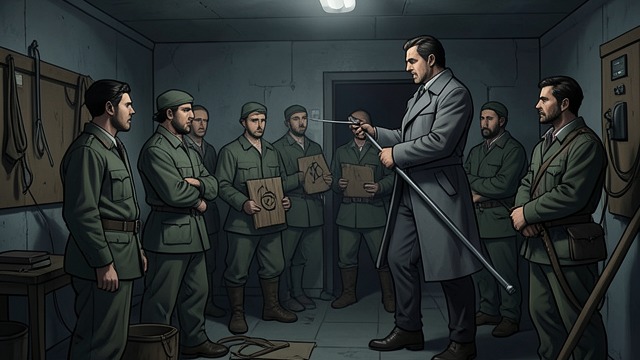
Boris initially secures some reduction in violent treatment and allows the Japanese prisoners to establish a representative committee. The change creates a short period in which the prisoners hope conditions may improve.
Behind that apparent reform, Boris builds a network of guards, collaborators, and informers. He uses bribery and threats to bring committee members under his influence while keeping his own role difficult to challenge.
The Colonel’s Murder
When the committee chairman confronts Boris over the prisoners’ interests, Boris arranges for Japanese collaborators to kill him by suffocation. The death is disguised as illness, and the committee replaces him with a candidate loyal to Boris.
The promised autonomy has become a mechanism of surveillance and control. Mamiya’s earlier involvement now feels like complicity, even though he did not intend the result.
The Failed Shot
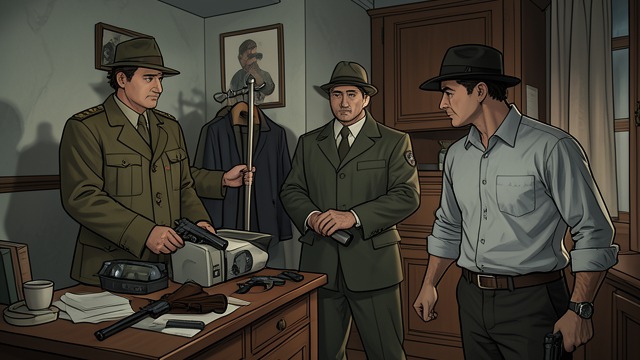
A Last Attempt at Resistance
The Apparent Opening
When the Japanese prisoners’ repatriation approaches, Boris offers Mamiya the chance to remain in the Soviet Union as his assistant. Mamiya sees the offer as an attempt to keep him within Boris’s system and preserve his silence.
One night, Boris leaves his Walther pistol on a coat rack. Mamiya takes it and confronts him, believing the opportunity may be his only chance to end the threat.
The Curse of Failure
The pistol is unloaded. Boris reveals that he anticipated Mamiya’s intention and places two live bullets on the floor, challenging him to try again. Mamiya loads them but misses twice, even at close range.
Boris lets him live and curses him to a life without love or happiness. Mamiya leaves for Japan when repatriation begins, but he understands that escape from the camp has not freed him from what happened there.
Spring 1938, before the Battle of Nomonhan
During the capture on the far bank of the Khalkha River
Spring 1947, in a Siberian coal mine camp
Several months after Boris’s arrival in the camp
The final winter before Mamiya’s repatriation
