Blue-Black Cheek Mark
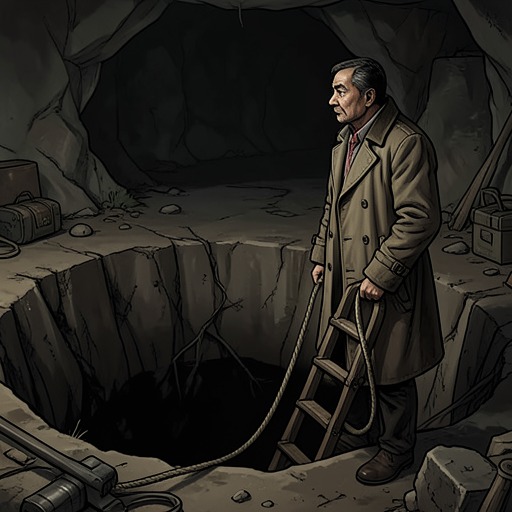
The Wind-Up Bird ChronicleThe Blue-Black Cheek Mark is a palm-sized stain that appears on Toru Okada’s right cheek after he passes through a hotel-room wall in a dreamlike episode in the well. Its precise location recalls the heat he felt during that passage, and its persistence makes the mark a bodily record of an event whose reality he cannot establish. It is at once a physical change, a source of speculation, and a visible sign of Toru’s growing estrangement from his body and the world around him.
Appearance and Discovery
The mark comes to light after Toru has emerged from the well and returned to the neighborhood. Shaving carefully, he notices a blue-black patch beyond his right cheekbone, about the size of an infant’s palm. He first suspects that he has smeared something on his skin, but washing and scrubbing do not remove it. The discolored area feels slightly warmer than the rest of his face, though otherwise it has no unusual sensation.
Before its appearance, Malta Kano asks Toru whether he has noticed a major physical change. He checks his reflection and his palm but can identify nothing; Malta can offer no description, only the expectation that the change should be obvious to someone looking at him. Her question anticipates the mark without explaining it. When it appears, Toru considers waiting to see whether it will fade or consulting a doctor, but neither a medical cause nor a course of treatment is established.
The stain’s position supplies its most immediate connection to the well. Toru remembers that his cheek felt hot at the moment the Telephone Woman led him through the wall, away from someone entering the hotel room. He cannot explain how that passage could have produced a mark. The resemblance between the remembered heat and the skin’s slight warmth is concrete, while the causal link remains uncertain.
The Mark and the Well
Toru interprets the stain as a possible brand left by the passage through the wall. In that reading, the mark insists that the episode was not merely a dream: it would make the experience materially present each time he looked in a mirror. Yet he does not arrive at a settled explanation. The episode can be called a dream, an illusion, or something else, and the mark confirms neither a supernatural event nor an ordinary physical cause.
The mark’s appearance follows a period in which Toru’s sense of bodily existence has already become unstable. In the well’s total darkness, he cannot see his own body and grows less certain that he exists; he uses his voice, touch, and the contact of his fingertips to check that he is there. He feels his body losing density, as if his mind were drawing it into its own territory. The cheek mark reverses that uncertainty without resolving it: a body that seemed to dissolve acquires a sharply localized, visible alteration, but its origin lies in an experience that remains difficult to classify.
Toru’s thoughts about the mark also connect it to Creta Kano’s account of living without pain or sensation. Creta describes checking her body from head to foot each morning, unable to tell whether pain is absent or merely unfelt, and feeling separated from the body she sees in the mirror. Toru’s mark is different: it does not hurt, but its slight warmth makes the altered skin perceptible. Both episodes make the body a problematic measure of selfhood, rather than a transparent possession that can simply be inspected and understood.
Recognition and Interpretation
When Creta Kano sees Toru’s face over breakfast, she shows no surprise and asks no question about the mark. Toru touches it and confirms that it remains slightly warm but painless. Creta says only that it looks like a mark. Her response recognizes its appearance without supplying a cause, diagnosis, or interpretation, leaving Toru’s own uncertain account intact.
May Kasahara later places her palm over the mark while resting her other hand on Toru’s knee. She tells him he will take on many things before he knows it and will have no choice, comparing that inevitability to rain falling in a field. Her gesture makes the mark a point of contact as well as something to be seen: May’s hand covers the very sign Toru associates with an unexplained crossing. The scene offers no medical or supernatural explanation, but it places the mark within a relationship in which Toru is addressed as someone who will be drawn into burdens he cannot fully choose.
Persistence and Significance
The stain neither grows nor shrinks, produces no fever or pain, and retains the same size, color, and shape. At first Toru checks it in the mirror and tries to conceal it with sunglasses or a low-brimmed hat. Over time he stops hiding it and gradually forgets that it is there. Other people sometimes stare or look away; exactly four acquaintances voice concern: the cleaning-shop owner near the station, Toru’s barber, a young man at the Omura liquor store, and the woman at the neighborhood library counter. Toru answers each with a vague claim that he has had a little accident.
Its steadiness contrasts with Toru’s increasing distance from himself. He begins to feel that he is looking through his own hand; he speaks to almost no one, and even cold seems uncertain until a thermometer confirms it. The mark stays legible where experience does not: it gives the face a constant visible feature, but it cannot make Toru feel anchored to himself or to ordinary reality.
That tension also resonates with Kumiko’s later message describing herself metaphorically as slowly dying from an incurable disease that would disintegrate her face and body. She stresses that her body is not literally disintegrating, while insisting that the metaphor comes close to the truth of her condition. The mark is likewise neither a complete explanation nor an empty symbol: it is physically present, yet its meaning depends on an uncertain crossing between bodily fact and experience. Its decisive function is to preserve that uncertainty on Toru’s face, where it can be seen even when its cause cannot be known.