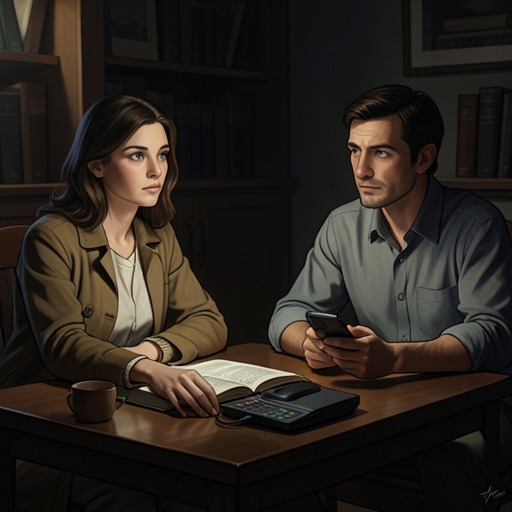
Cinnamon’s computer
The Wind-Up Bird ChronicleCinnamon’s computer is more than a machine for storing stories: it regulates what Toru can read, when he can read it, and where his inquiry must stop. It first gives him access to one document in a larger narrative program, then closes the surrounding files behind Code R24; after five nights, it summons him back and permits him to open document #17. The computer thus makes access itself part of the story, a boundary whose rules Toru can experience but cannot master.
The Program and Its Gatekeeping
After reaching the end of “The Wind-Up Bird Chronicle #8,” Toru returns to the original menu and selects document #9, expecting the continuation. Instead, the computer displays an access-denied message citing Code R24 and tells him to choose another document. The interruption is not a narrative ending he can simply read past: the program itself refuses the next step.
Toru tries other files. Documents #10 and #11, the rest of the collection, and even #8 are now inaccessible. He reasons that opening and closing #8 may have locked every document, perhaps because the program permits only one file at a time. This is a conjecture, not an explanation supplied by the machine. What he can establish is the consequence: the earlier opening has become a lost opportunity, and further clicking cannot restore it.
The computer’s restrictions give the story a precise but opaque order. Toru understands that he is encountering rules rather than random malfunction, yet he does not know what those rules are or how to act within them. With no available next move, he gives up and shuts the machine down. The scene makes reading resemble entry into a system whose boundaries are firm even when its logic remains concealed.
A Narrative Directed by Cinnamon
Toru suspects that Cinnamon has been monitoring his conversation with Kumiko and may know everything that takes place on the computer. He infers that Cinnamon waited until the conversation was over before presenting “The Wind-Up Bird Chronicle,” and that the selection was deliberate rather than the result of chance or whim. The program has shown him one story while also making him aware that a much larger cluster of stories may exist.
That distinction matters: the computer does not simply contain an accessible archive. Its presentation is selective. Toru receives a particular narrative at a particular point, while the other possible documents remain present as inaccessible possibilities. He can infer purpose from the timing and arrangement, but he cannot see the whole design or confirm exactly what Cinnamon intends.
The scene sharpens this uncertainty through Toru’s attention to the screen. He imagines Cinnamon inside it, where the silent words live and breathe as stories capable of thinking, seeking, growing, and giving off heat. Yet the monitor remains silent, hiding those words in what Toru perceives as a labyrinthine forest. The contrast is between the imagined vitality of the stories and the inert, unreadable surface that withholds them. The computer makes Cinnamon’s writing seem active without making its author—or its system—available for explanation.
Stories, History, and Interwoven Marks
The document Toru has read draws him into comparisons between its figures and people whose histories he knows. The veterinarian’s story associates the wind-up bird’s cry with ruin and with people whose choices seem overruled by forces they cannot control. Toru connects this pattern to the veterinarian’s fatalistic outlook, and the computer’s single presented story consequently feels less like an isolated file than one strand in a potentially extensive design.
Toru also recognizes a cluster of correspondences: Cinnamon’s grandfather, the nameless veterinarian, and Toru share a facial mark, a baseball bat, and an association with the cry of the wind-up bird. He wonders whether his own presence has entered the story and whether that has altered its details. The shared mark has already helped Nutmeg find him on the streets of Shinjuku, so the resemblance is not merely an abstract puzzle; it is tied to a concrete encounter and to the routes by which characters become connected.
A further resemblance concerns Lieutenant Mamiya. The officer in Cinnamon’s story, who directed the executions of Chinese cadets, reminds Toru of the real Lieutenant Mamiya, who served at Kwantung Army Headquarters in Hsin-ching during that period. Toru knows the differences: Mamiya belonged to the mapmaking corps rather than serving as a paymaster officer, and he returned to Japan after the war, having lost his left hand, rather than being hanged. Even so, Toru cannot dismiss the possibility that the story’s officer was Mamiya. The parallel remains an uneasy inference, not a confirmed identity.
These crossings leave Toru with a puzzle in which truth and fact do not necessarily coincide. The computer’s controlled access reinforces that unsettled relation: it has supplied enough material to provoke connections among narrative, memory, and personal history, but not enough to settle them. The story’s fragments invite interpretation while the locked documents prevent Toru from checking what might lie beyond them.
The Return of Access
After the denial, Toru returns to Cinnamon’s office and sits at the desk, staring at the screen. He senses Cinnamon’s presence within the computer, but the machine tells him nothing more than it has already revealed. The screen’s silence marks a pause in both access and understanding: Toru is back at the interface, but not yet back inside the program.
During the night of the fifth day, a little after two in the morning, Toru hears faint sleigh bells again. He gets up from the sofa, puts a cardigan over his pajamas, passes through the kitchen, and peeks into Cinnamon’s office. The computer is calling him back. This time its message announces that he has gained access to “The Wind-Up Bird Chronicle” and offers a choice of documents numbered one through seventeen. Toru clicks #17, and the document opens.
The change is exact but unexplained. The same computer that had barred every file now restores access and extends the choice to seventeen documents, yet Toru is given no account of why the restriction has lifted. That return makes the machine a narrative threshold rather than a simple repository: it can withhold and release the next piece of the story on terms that remain outside Toru’s control. Its significance lies not in solving the mystery of Cinnamon’s program, but in making the conditions of reading part of the mystery itself.