Dry Well in the Outer Mongolian Desert
The Wind-Up Bird ChronicleThe Dry Well in the Outer Mongolian Desert is where Lieutenant Mamiya is abandoned during a secret mission near the Khalkha River, and where he comes to believe that the living part of his life ended even though his body survived. First encountered as an instrument of coercion, the well becomes a sealed world of injury, waiting, and brief sunlight. Mamiya’s account makes it not merely a place of physical danger but the point from which he understands his later numbness and estrangement from life.
Setting and Military Context
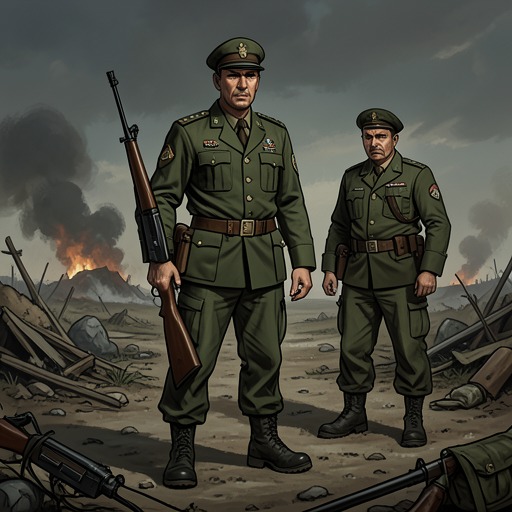
In the years before the Battle of Nomonhan, Lieutenant Mamiya was assigned to accompany Yamamoto across a sensitive border region. He was chosen partly because his work concerned the topography of western Manchukuo near the Khalkha River: he had surveyed the area by plane and was expected both to support the mission and to improve maps of the district. The existing maps of the Hulunbuir Steppe were crude, while the political authorities preferred to leave the precise border indefinite rather than provoke conflict with the Soviet Union or Outer Mongolia. Yet a future war would require detailed combat maps showing routes, encampments, artillery positions, water sources, and supplies. The mission therefore joined intelligence gathering to a broader military problem: an immense, poorly mapped landscape that strategic planners might soon have to fight over.
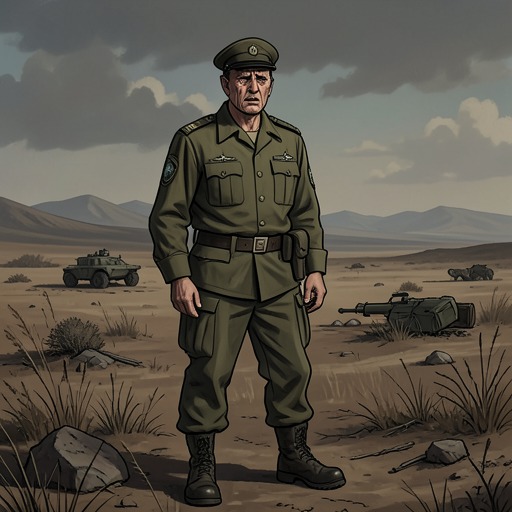
After five days of preparation, the party traveled by train from Hsin-ching to Hailar and then by truck toward a Manchukuo Army border observation post near the river. The last stretch crossed empty terrain without clear landmarks. Mamiya’s map could scarcely be checked against the land itself; he had to estimate their position from the time spent traveling. In this landscape, the well appears as a sharply bounded site within a region otherwise difficult to measure or orient oneself in. Its depth and darkness replace the uncertain distances of the open steppe with an immediate, inescapable enclosure.
The Forced Descent
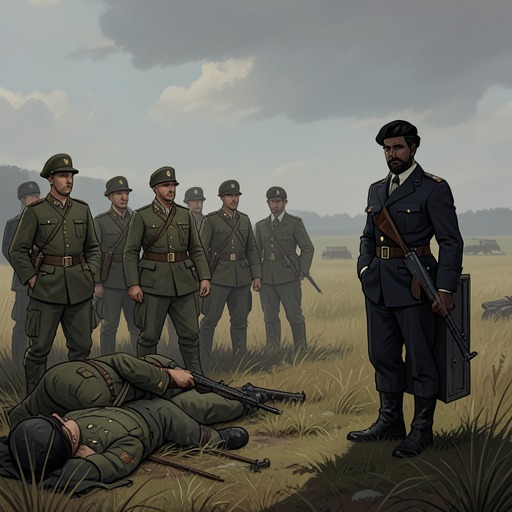
After Yamamoto was killed, Mamiya was taken north for more than two hours and brought to a well near an oboo, a stone devotional mound that also served as a desert landmark. Its stone curb stood about three feet above the ground. A Mongolian noncommissioned officer dropped a fist-sized rock into the shaft; the delayed sound of stone striking sand showed that the well was dry and deep. It had once held water, but a change in the underground watercourse had left it dry.
The captors presented Mamiya with a choice: be shot immediately or jump into the well and face the risk of dying from the fall or later at its bottom. Given five seconds to decide, he leaped when the officer counted to three. He had hoped to catch the wall and descend more gradually, but his hands missed it and he fell. He remembered his distant hometown, his parents, his younger sister, and an oak-leaf-wrapped rice cake before striking the sandy floor and losing consciousness briefly. The soft ground had spared him a worse impact, but his leg was almost certainly broken and his shoulder might have been dislocated or fractured.
The men left without returning. Unable to see his own body, Mamiya initially doubted whether his perceptions in the darkness were reliable. His mind was awake, but he could barely make his body respond. As sensation gradually returned, so did intense pain. His abandonment transformed the well from a threat of death into a place where dying might go unnoticed: he feared that if he died there, no one would know or care. The opening above connected him to the distant surface only through intermittent sounds of wind, while the shaft enclosed him in darkness and isolation.
Sunlight and the Ordeal’s Meaning
At one point, sunlight reached the bottom of the well. For roughly ten or fifteen seconds, the shaft filled with light, and Mamiya could see its stone walls and the bones of a small animal beside him. In that brief interval, the bones seemed less like a warning of his own death than a companion. The light eased his fear and pain, and its sudden disappearance returned him to the cold, dark well. With no food, water, or clothing, he endured the afternoon and night, watching the stars overhead as evidence that time continued to pass.
The light returned later and seemed stronger and longer-lasting. Mamiya opened his hands toward it, and the experience brought him to a sense of unity so powerful that he felt he could accept death within it. But the light faded, leaving him alive in the same confined darkness. He understood his survival through a prophecy Corporal Honda had given him: he would not die on the continent. Mamiya had previously clung to the prediction as a chance of escape; after the sunlight, he interpreted it more starkly. He had not simply been spared death, he felt, but had become unable to die at the moment when he believed he should have.
Aftermath and Narrative Significance
Mamiya later told Toru Okada that the well was where his real life may have ended. He associated the brief daily sunlight with the exhaustion of his inner life, and described the subsequent years as marked by numbness. Even the later horrors he endured—including the loss of his left hand and the conditions of Soviet internment—seemed to him unable to reach what had already died within. The well therefore remains the central reference point in his account of survival: physical life continued, but he experienced that continuation as an emptied existence.
The ordeal did not remain a private memory shared openly between Mamiya and Honda. The two men were separated after arriving in Hailar and forbidden to meet or speak. Honda was wounded at Nomonhan and sent home; Mamiya remained in Manchuria until the war ended, then was sent to Siberia. They met again only years after Mamiya’s repatriation and corresponded, but both avoided discussing the mission. Their silence became a way of sharing an experience that each found too immense to revisit directly.
For Mamiya, survival did not restore what the well had taken from him. When he returned to Japan after losing his hand and twelve years, his parents and sister were dead, and the woman to whom he had been secretly engaged had married someone else and had children. He found his own grave in a cemetery and felt there was nothing left for him. He later taught geography and history, but described himself as not truly alive. The well’s narrative force lies in this contrast: it preserves Mamiya’s life, yet becomes the place through which he explains his conviction that the essential part of that life ended. Its short-lived light offers no lasting rescue; instead, its memory fixes the divide between bodily survival and emotional return.