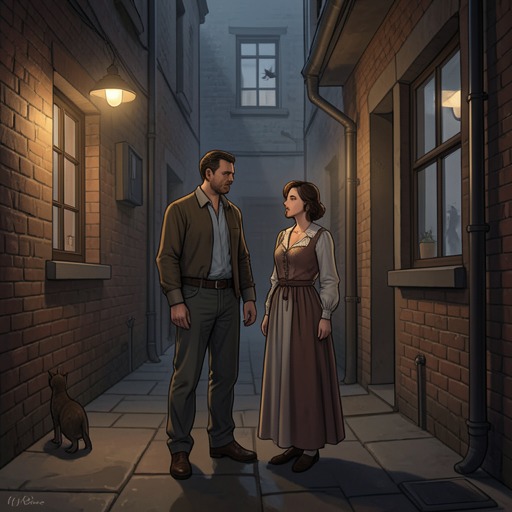
Duck people
The Wind-Up Bird ChronicleThe Duck people are the ducks May Kasahara watches at a remote pond near the factory where she works. They are ordinary animals in a specific, seasonal habitat, yet they become more than scenery: May’s patient attention to their daily lives gives her a rare, self-sustaining happiness, and she comes to regard them as a kind of protection. Their disappearance when the pond freezes turns their presence into a bond she can carry beyond the pond, including in her final farewell to Toru Okada.
Habitat and Seasonal Conditions
The Duck people live at a pond within the extensive grounds of May’s workplace, amid woods and away from the usual paths of visitors. May estimates that there are about twelve of them. She does not know how their family or social arrangements work, but she has never seen them fight. The account leaves their group life partly unknowable rather than pretending that prolonged human observation reveals everything about them.
Winter alters their habitat. By December, ice has begun to form, though open water remains where the ducks can still swim. May has heard that when the pond freezes thickly, girls come there to skate; the Duck people then have to move elsewhere. She dislikes skating and hopes the pond will not freeze, but recognizes that the cold is part of the conditions of their life there. Their eventual departure follows that seasonal change, not a choice described from their perspective.
May’s Regular Companions
May visits the pond on weekends and can spend two or three hours watching the ducks without noticing the time pass. Bundled against the cold in tights, hat, scarf, boots, and a fur-trimmed coat, she sits alone on a rock and sometimes feeds them old bread. The solitude is part of the scene: she observes them without an audience, finding companionship in an activity other people would consider an eccentric use of an afternoon.
Her attention is directed toward particular behaviors, not merely toward ducks as a general emblem. When they flap down onto the ice, their feet slip and they fall; their orange feet, she thinks, seem ill-suited to walking on the frozen surface. May finds their mishaps funny, but also distinguishes her amusement from their intentions: they are trying to live their own serious lives, not perform for her. She wonders what they think of the ice and imagines that they may simply endure it. The scene holds together her affectionate projection and her recognition that the animals have lives not organized around her response.
The walks to the pond also affect May apart from the time spent watching. She follows the wooded path over ground still crunchy with snow and ice, with birds around her, breath visible in the cold, and bread in her pocket. Thinking about the Duck people as she walks, she realizes that she feels happy in a way she has not for a long time. That happiness grows from a repeated, ordinary practice—walking, watching, and sometimes feeding—not from a dramatic encounter or a demand that the ducks communicate with her.
Protection, Imagination, and Absence
May gives the Duck people a protective meaning. In a letter to Mr. Wind-Up Bird, she says that they have become an important kind of magic, like a protective amulet. The significance is grounded in her own experience: the warmth she associates with their company persists when she is alone. During a solitary moment in moonlight, she thinks of them sleeping near the pond and recalls the happy feeling they have created together during the day. Their role is therefore not simply that of a metaphor supplied by an outside narrator; May names the protection she draws from a relationship built through attention and routine.
The pond’s frozen surface eventually confirms that the ducks have moved elsewhere. When Toru visits May, she apologizes that she cannot show him the Duck people, explaining that they left after the pond froze and inviting him to return in spring. The empty, ice-covered pond makes their absence tangible, while the invitation keeps their presence within a future they might share. The Duck people are not presented as having vanished permanently; their relocation is tied to the season, though the account does not describe where they go.
The Farewell to Toru Okada
In May’s parting words to Toru, the Duck people remain part of her address to him. She asks him to call out loudly if anything ever happens to him—to her and to the ducks. The appeal joins a human friendship to a bond with animals who are absent from the frozen pond, making the Duck people part of the support she offers rather than a spectacle she can show him at that moment.
After the train leaves, Toru thinks of May in her blue hat, alone on the bus returning to the factory in the hills, and of the Duck people asleep somewhere in the grassy shadows. He then turns his thoughts to the world he is returning to. This sequence places the animals within his memory of the farewell, alongside May and the journey back, without suggesting that he has met them or knows their whereabouts. Their narrative significance lies in the modest but lasting connection they help sustain: May’s happiness at the pond becomes a source of comfort, a shared possibility offered to Toru, and an image he carries away.