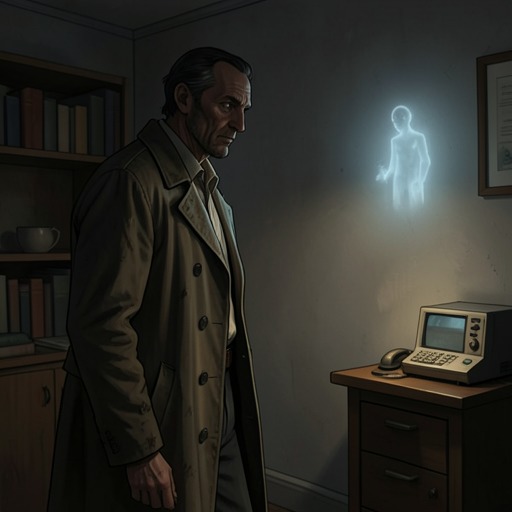
Empty-Shell Existence
The Wind-Up Bird ChronicleEmpty-Shell Existence names Lieutenant Mamiya’s condition after the well in the desert of Outer Mongolia: he survives, but believes that the core of his life burned away in the brief light at its bottom. The image gathers his numbness in war and captivity, his losses on returning to Japan, and the emotionally vacant routine that follows into one distinction between continuing to live and feeling alive.
The Well and the Lost Core
Lieutenant Mamiya locates the beginning of this existence in the well, where an intense light reached him for only ten or fifteen seconds a day. He describes himself as having burned up the very core of his life in that light. The experience remains beyond explanation, but its consequence is clear in his account: thereafter, whatever happened to him, he could no longer feel anything in the bottom of his heart.
The numbness persists through events that might ordinarily be understood as overwhelming: Soviet tank units, the loss of his left hand, and the hell of Soviet internment camps. Mamiya does not present survival of these ordeals as a restoration or triumph. He feels that something inside him had already died, and concludes that he should have died in the light, though he also recognizes that he could not die there. The well thus becomes the measure of a death that occurred inwardly while his physical life continued.
Return Without Restoration
Mamiya returns to Japan after losing his hand and twelve years. By the time he reaches Hiroshima, his parents and sister are dead. His younger sister had been working in a factory when the bomb fell; his father was on his way to see her and also died. His mother, overcome by the shock, eventually died in 1947. The woman to whom Mamiya had been secretly engaged had married someone else and had two children. At the cemetery, he finds his own grave: the return confronts him with a place prepared for him and a life that has gone on without him.
He feels there is nothing left for him and that he should not have come back. Although he becomes a high-school social-studies teacher, teaching geography and history, his occupation does not restore inward participation in life. He performs the mundane tasks handed to him one after another, without a real friend, human ties with his students, or the capacity to love. The shell is therefore not simply a figure for wartime trauma: it describes a lasting separation between the continuation of everyday functions and the vanished ability to form attachments or experience love.
Repetition, Memory, and Isolation
The experience returns in recurring dreams. Mamiya sees Yamamoto skinned alive, again and again watching the skin peeled away until Yamamoto becomes a lump of flesh and hearing his heartrending screams. In other dreams, Mamiya himself slowly rots alive at the bottom of the well. At times the imagined well seems more real than the life he leads in Japan, reversing the ordinary distinction between nightmare and waking existence.
His isolation is also expressed in what remains unsaid. Years after the events at the Khalkha River, Mamiya and Corporal Honda meet again, correspond, and see each other a few times, but both avoid discussing what happened. Mamiya describes their silence as a way of sharing an experience too enormous to discuss. His emptiness is thus not represented as an absence of memory: the violence returns vividly, while connection and ordinary life remain inaccessible.
The Empty Shell as a Judgment on Survival
At the Khalkha River, Mr. Honda had told Mamiya that he would not die on the continent. Mamiya says he wanted to cling to that prediction, whether or not he believed it, and thinks Mr. Honda may have offered it to comfort him. The prediction comes true in its literal sense: Mamiya survives the continent and returns. Yet survival brings no joy, and he describes his later existence as that of an empty shell. The apparent fulfillment of the reassurance therefore sharpens its limit: not dying is not the same as being restored to life.
Mamiya makes the distinction explicit. However many years an empty shell continues, he says, its heart and flesh give birth only to the life of an empty shell. His final statement that he has no wife, parents, or siblings and is entirely alone gives the metaphor a concrete human ending. Empty-Shell Existence is not mere physical survival after catastrophe; it is survival deprived of felt attachment, in which the person remains present while the inner capacity to live seems to have ended.