Guitar-Case Man
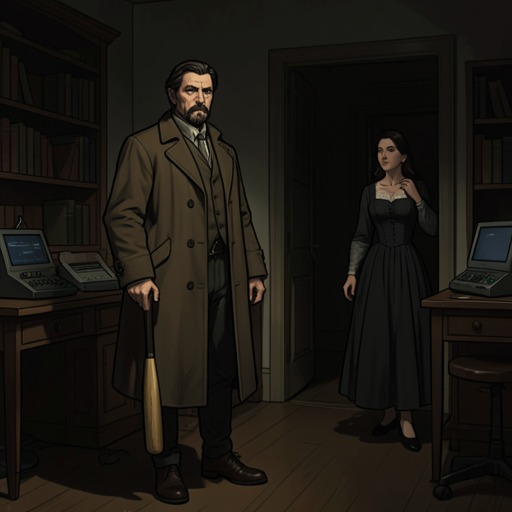
The Wind-Up Bird ChronicleGuitar-Case Man is an unidentified young man who appears in Toru Okada’s search for a way out of confusion. Recognized as a singer Toru once saw in Sapporo, he leads Toru to a vacant apartment building and attacks him with a baseball bat. The encounter ends not with an explanation but with an empty guitar case, while a subsequent dream transforms the attack into an image of the assailant’s skin covering Toru. Guitar-Case Man’s importance lies in that conjunction of an ordinary, recognizable figure with a violent encounter whose meaning remains unresolved.
Identity and First Recognition
On the evening of the eleventh day Toru has spent watching people in Shinjuku, he spots a young man carrying a black guitar case. The man is of average height, wears black plastic-framed glasses and blue denim, has shoulder-length hair, and walks in worn sneakers. Toru recognizes him as the singer he saw three years earlier in a Sapporo snack bar. The identification gives Toru a practical reason to follow him, but it does not explain why the singer is now in Tokyo or what he intends to do.
Toru trails him at a short distance and considers approaching him about the Sapporo performance. The man’s unhurried walk initially makes the pursuit seem like an opportunity for an ordinary conversation. Instead, he enters a deserted alley and goes into an empty-looking apartment building. The shift from public street to abandoned interior turns recognition into suspense: Toru has found someone familiar, yet has no shared understanding with him beyond a performance remembered from years before.
The Vacant Apartment and the Attack
The building appears to be a two-story wooden apartment house, with the kind of entrance and room arrangement Toru remembers from student housing. Its windows are shut and curtained despite the heat; the entrance door has a blank strip where a nameplate seems to have been removed. Toru sees no sign that anyone lives there and suspects the building is awaiting demolition. After waiting outside without seeing movement, he pushes open the unlocked door and steps in.
Inside, the air is stale, and Toru notices that its musty quality recalls the bottom of the well. He intends to check whether anyone still lives there, but discovers that Guitar-Case Man is hiding behind a tall shoe cabinet just inside the entrance. Toru begins to address him, but the man suddenly strikes him with a baseball bat. He swings again, hitting Toru’s arm. The attack is abrupt, and the story supplies no clear motive, warning, or explanation for it.
Toru responds with kicks, disarms the attacker, and continues fighting after Guitar-Case Man has fallen. He realizes that he seems divided between the part of himself that knows he should stop and another that continues the assault. Guitar-Case Man smiles and laughs as Toru hits him, an unnerving response that does not make the confrontation intelligible. Toru eventually stops and leaves him on the floor. The encounter has reversed the roles Toru might have expected from following a man he recognized: the observer has become a participant in violence, and the familiar singer offers no answer to the question of why.
The Empty Case and Aftermath
After the fight, Toru notices the black guitar case beside the shoe cabinet and opens it. It is entirely empty. The case had marked Guitar-Case Man as a musician and helped Toru connect him to the Sapporo performance, but its contents confirm none of that identity; there is no guitar inside. The discovery sharpens the encounter’s central uncertainty. Toru has recognized the man by a past performance, yet the object that seemed to substantiate that recognition contains nothing.
Toru leaves the building and finds a bus stop for Shinjuku Station. He tries to tell himself that he had only been looking at people’s faces, but the passengers’ reactions make him notice the blood on his white shirt and the baseball bat he is still carrying. Guitar-Case Man remains behind, laughing. Toru’s passage back into public space does not restore the ordinary meaning of what has happened: he cannot make the assault fit his purpose for spending the eleven days, or explain the man’s behavior by what he knows about him.
Dream and Narrative Significance
After returning home, Toru hopes to sleep without dreaming, but Guitar-Case Man returns in a dream that repeats the pursuit, entry into the building, attack, and prolonged fight. The dream then departs from the remembered event: the man takes a knife from his pocket but does not attack Toru with it. Instead, he removes his clothes and peels away his own skin while laughing. The skin then moves toward Toru and covers him until he can no longer see. Toru wakes at that point.
The dream does not establish what Guitar-Case Man intended in the apartment, nor does it provide a verified account of anything beyond the attack. It does, however, carry the encounter forward by changing its form: the violence Toru enacted against another person becomes an image of that person’s skin enclosing Toru. The empty guitar case and the dream’s altered repetition both resist a stable explanation. Guitar-Case Man functions less as a fully disclosed biography than as a figure through whom the narrative stages recognition without knowledge, violence without an intelligible cause, and Toru’s difficulty separating an external encounter from its disturbing return in sleep.