Hamano
The Wind-Up Bird ChronicleHamano is a seasoned Japanese sergeant whose battlefield experience and candid moral judgment distinguish him from the inexperienced officers and enlisted men around him. Assigned to accompany Yamamoto on a covert mission near the Khalkha River, he becomes Lieutenant Mamiya’s trusted companion before Mongolian soldiers kill him while he is on guard. His death turns an already dangerous assignment into a personal ordeal for the surviving party.
Identity and Assignment
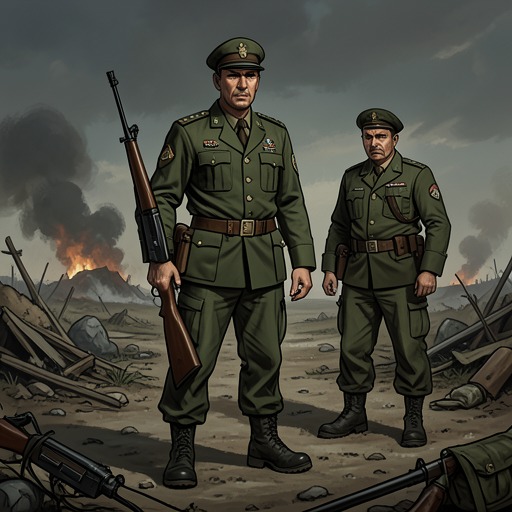
Hamano had worked his way up through the ranks and distinguished himself in combat in China. He was a large, fearless soldier, and Mamiya regarded him as the only member of the small escort whose fighting ability they could confidently rely on. The group consisted of Hamano, Mamiya, and Corporal Honda; its small size was intended to avoid attracting attention from Outer Mongolian troops along the border. Unlike Hamano, Mamiya had no battlefield experience, while Honda was also new to the area and seemed unlikely to help in a fight.
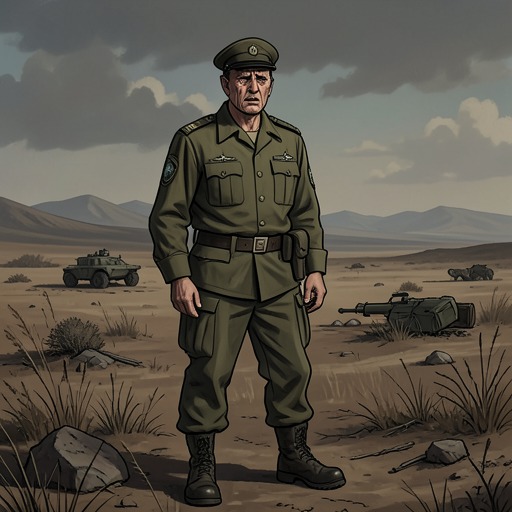
Mamiya’s own appointment as commanding officer rested on his knowledge of the western border’s topography, not on combat experience. He was responsible for improving maps of the Khalkha River district, where the existing surveys of the Hulunbuir Steppe were crude and the unsettled border made official mapping politically sensitive. The mission therefore combined topographical work with a need for military intelligence: in the event of war, combat maps had to show routes, campsites, artillery positions, water supplies, and the needs of horses and marching troops. Hamano’s experience supplied a practical counterweight to the mission’s cartographic and covert aims.
A Soldier’s Judgment of the War
During the expedition, Hamano and Mamiya grew close despite the difference in their ranks and backgrounds. Mamiya was a young officer educated at a nonmilitary college; Hamano respected that education, while Mamiya made a point of respecting Hamano’s combat experience and practical judgment. Their shared ties to western Japan also made conversation easy. At camp, Hamano spoke openly about the war in China and his doubts about its purpose.
Hamano did not reject soldiering or the possibility of dying in battle for his country. What troubled him was a war without a clear front, in which advancing Japanese forces could not reliably distinguish combatants from civilians. He described how Chinese soldiers could shed their uniforms and blend into the population, after which Japanese troops killed civilians under the stated rationale of pursuing irregulars or remnants of enemy units. Supply failures also led soldiers to seize food, and prisoners were killed when the army lacked the facilities and provisions to hold them. Hamano regarded these practices as wrong and saw the impoverished farmers caught beneath competing armies as the people who paid the price.
His testimony includes his own unit’s participation in atrocities at Nanking: he said that soldiers threw dozens of people into a well and then dropped grenades after them. He could not bring himself to discuss everything his unit had done. The account gives his opposition moral weight because it comes not from an outsider but from a veteran who accepts the obligations of military service while refusing to treat the violence inflicted on civilians as justified.
Death on the Border Mission
After Yamamoto left camp with a Mongolian guide, he ordered Mamiya to wait, keep a sentry posted at all times, and report to headquarters if he had not returned within thirty-six hours. The three escorts had to remain inconspicuous on the open steppe; even a small campfire or puff of smoke risked revealing their presence. Hamano, Mamiya, and Honda ate cold provisions and kept watch in the exposed border country.
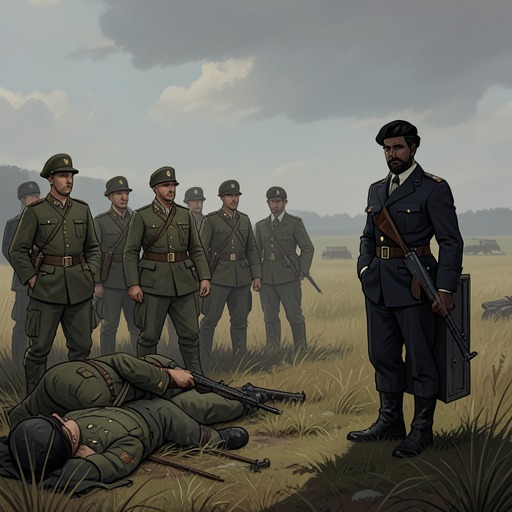
A short time later, Mongolian soldiers returned with Hamano’s body. He had apparently been caught by surprise and killed while standing guard. The soldiers had already taken his boots and searched his belongings, dividing his cigarettes and taking his money. Among the things they found was a photograph, probably of his mother; they discarded it. The scene establishes the abruptness and vulnerability of his death: the experienced fighter on whom the escort depended was killed during the very duty meant to protect the camp.
Hamano’s killing changes the mission’s stakes for Mamiya and Honda. The expedition’s danger is no longer a matter of remote border tensions or the possibility of future combat; it has become a direct loss within their small unit. Hamano’s earlier account of a war that crushes powerless civilians also stands beside the violence that overtakes the escort, linking his personal fate to the wider collapse of distinctions between military duty, political purpose, and human cost.
Narrative Role
Hamano is presented through Mamiya’s recollection as both a capable soldier and an unusually frank critic of the campaign in China. His experience makes him the escort’s principal source of practical confidence, while his conversation exposes the moral damage concealed by the army’s language of necessity. His death removes that steady presence early in the border mission and leaves Mamiya to confront the consequences of the expedition without the comrade whose judgment he had come to trust.