Japanese POWs’ Brief Self-Government
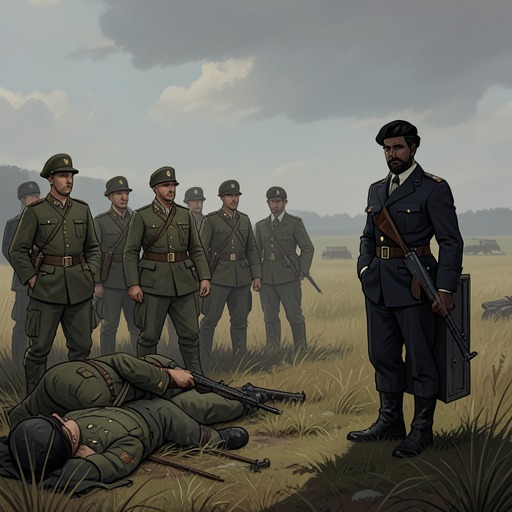
The Wind-Up Bird ChronicleJapanese POWs’ Brief Self-Government is the temporary autonomy granted to Japanese prisoners in a Siberian camp after Boris promises reform. The prisoners gain a representative committee, some relief from guard violence, and a modest reduction in labor hardship; Boris uses that interval of calm to secure influence over the committee and prepare to replace overt disorder with calculated control.
Origins and Conditions
The reform comes after the collapse of Manchukuo and the defeat of the Japanese position in the region. As Soviet forces advance, the Kwantung Army withdraws its main force, leaving border garrisons and Japanese civilians exposed. The capital, Hsin-ching, is left in a political vacuum, while Chinese soldiers in the Manchukuo Army desert or revolt rather than fight the advancing Soviet Army. The prisoners’ later hopes for change therefore arise from a wider wartime collapse, not from a stable political settlement.
The camp itself is organized around production and coercion. It is run as a strategic facility under the authority of political leaders and guarded by a military force; its director treats workers’ lives as expendable so long as output rises. Prisoners die from harsh working and living conditions, and new groups are brought in to replace them. Against this background, any reduction in violence carries immediate practical value, even when the authority behind it remains unchanged.
The Promise of Autonomy
Under Boris’s policy, the Japanese prisoners are allowed to form a representative committee, with their colonel as chairman. Russian civil and military guards are told to stop their violent behavior, and the committee is made responsible for order within the camp. The arrangement is explicitly conditional: the prisoners are to avoid trouble and meet their production quotas. Its apparent grant of self-government thus remains bounded by the camp’s demands and by Boris’s power to set the terms.
For the first few months, the change improves daily conditions. The committee secures a slight easing of the labor burden, and prisoners no longer have to fear the same routine violence from the guards. After their earlier suffering, they experience this period as genuine calm and begin to hope that conditions may continue to improve. The interval is brief, but its relief is real; the later betrayal depends on the prisoners having something tangible to lose.
Boris’s Consolidation of Power
The reform also gives Boris time to strengthen his position. While he leaves the Japanese prisoners’ internal arrangements apparently intact, he focuses on controlling the Russian guards and building his foothold elsewhere in the camp. He then works privately on Japanese committee members, using bribes or threats to bring them under his influence. Because he avoids conspicuous violence and proceeds cautiously, the committee’s autonomy conceals the gradual loss of its independence.
The contrast defines the episode: random guard violence diminishes, but calculated violence takes its place. Boris does not simply restore the old conditions. He uses the promise of improved order to make the camp more controllable, securing cooperation through selective pressure and the quiet capture of its representative structure. By the time the prisoners recognize what the apparent concession has enabled, Boris has already improved his position.
End of the Brief Calm
After six months of consolidating control, Boris turns directly against the Japanese committee. Its colonel, who had represented the prisoners’ interests in disputes with Boris, is killed by fellow Japanese acting on Boris’s orders. His death is officially attributed to illness, while the prisoners understand who is responsible and know that speaking openly is dangerous. Boris then secures the colonel’s replacement by having the committee elect a candidate of his choosing.
The self-government ends not with a formal abolition but through the capture of its leadership and the threat surrounding any dissent. Its consequences are therefore double: it briefly improves life for prisoners, yet it also helps Boris convert a disorderly system of force into a more deliberate and efficient one. The episode presents autonomy as a fragile arrangement whose apparent protections can be turned into instruments of control when the authority granting it remains unchecked.