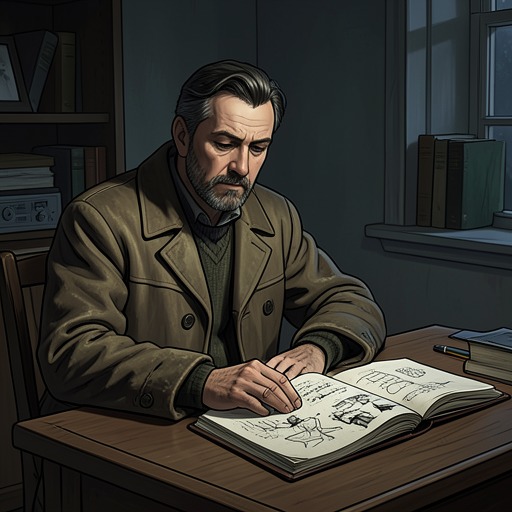
Khalkha River incident
The Wind-Up Bird ChronicleThe Khalkha River incident is the failed secret mission that transforms Lieutenant Mamiya’s life: an assignment to gather military intelligence and improve maps becomes a border violation, the capture and death of Yamamoto, and Mamiya’s confinement in a desert well. Corporal Honda ultimately saves him, but Mamiya remembers the well not as a narrow escape from death so much as the place where his inner life ended. The incident’s consequences extend beyond the expedition, shadowing his later captivity, return to Japan, and encounter with Toru Okada.
Mission and Border Crossing
In 1938, as Japan’s war in China intensified, Mamiya was living what seemed like a peaceful officer’s life in Hsin-ching. That calm existed alongside a widening war and growing concern about the limits of Japan’s occupation. The army’s uncertain borders in western Manchukuo reflected a larger political hesitation: making an official map could provoke the Soviet Union or Outer Mongolia, while a future conflict would require detailed military maps. Mamiya’s assignment joined topographical work to that strategic need.
The escort was deliberately small. Mamiya was its only officer; Sergeant Hamano had combat experience, while Corporal Honda appeared to be an unlikely choice for a dangerous mission. Their leader, Yamamoto, was presented as a civilian investigating Mongolian life and customs, but Mamiya recognized him as a professional soldier. After five days of preparation, the group traveled from Hsin-ching to Hailar and onward to a border observation post near the Khalkha River. The vast, featureless steppe made Mamiya’s mapping work difficult: he had few landmarks against which to check his maps, and the empty terrain unsettled his sense of himself and his surroundings.
After two days of travel along the river, Yamamoto told Mamiya that the party would cross before dawn. The opposite bank was Outer Mongolian territory, where their presence would constitute an unmistakable border violation. The Khalkha was swollen with snowmelt, and the current made the crossing dangerous. Mamiya also had no direct authorization from his superior for such an action. Yamamoto said the matter had been cleared at the highest levels and that a concealed crossing point made the operation possible, but the expedition proceeded under a risk Mamiya could not independently verify.
Capture and the Loss of the Document
Before the crossing could take place, Mongolian soldiers discovered the party’s tents. Mamiya awoke to armed captors; Yamamoto lay nearby under guard, while Hamano and Honda were missing. The group’s plan had collapsed before it could reach the far bank, leaving Mamiya and Yamamoto in the hands of the troops whose territory they had intended to enter.
Yamamoto was pressed to disclose the location of a classified document. He did not speak, and a Russian officer directed a Mongolian officer to torture him in an attempt to make him reveal what he knew. Mamiya was forced to witness Yamamoto’s death. The scene establishes the document’s central importance to the mission and makes the cost of its secrecy immediate: Yamamoto dies without yielding it, while Mamiya is kept alive and taken away.
Honda’s absence had a different explanation from Mamiya’s initial fears. Honda had sensed that the Mongolians were coming and slipped away before the capture, taking the document from Yamamoto’s bag. He judged that the group could not defeat or escape the attackers together; protecting the document and surviving to act later required him to leave alone. He concealed it with supplies previously buried in the desert, then followed the captors on foot. Hamano’s fate is not established in Mamiya’s account of the rescue.
The Well and Honda’s Rescue
After traveling north for more than two hours, the captors stopped at a Lamaist devotional mound and brought Mamiya to a stone-curbed well. A rock dropped into it struck sand below, revealing that it had long been dry. The well had once served as a desert water source, but a change in the underground water vein had left it empty. Mamiya was made to look into its darkness and then faced with the possibility of being killed there.
On the third morning, Honda found and rescued him. He had watched the capture and Yamamoto’s death, but had to reach the well without a horse and without knowing which direction the captors had taken. The rescue followed a chain of resourceful decisions: Honda secured the document, hid it, and pursued Mamiya despite the uncertainty of finding him. His success turned the well from Mamiya’s presumed execution site into the place from which he emerged alive.
Mamiya later remained unsure about parts of the mission. He wondered who the Mongolian officer encountered in the desert had been, why Yamamoto had not crossed the river alone, and whether Yamamoto might have intended to use the escort as a decoy. He also entertained the possibility that Honda had suspected such a plan. These remain questions in Mamiya’s recollection, not established explanations for the expedition’s events.
Aftermath and the Meaning of Survival
Mamiya and Honda were separated after reaching Hailar and forbidden to meet or speak. They later served on different paths: Honda was wounded at Nomonhan and sent home, while Mamiya remained in Manchuria until the end of the war and was then sent to Siberia. They eventually met again after Mamiya’s repatriation and corresponded, but neither readily discussed what had happened by the Khalkha. Their silence becomes part of the incident’s aftermath: the experience was shared, yet too overwhelming for ordinary conversation.
Mamiya describes the short-lived light at the bottom of the well as the point at which his real life may have ended. He recalls that it shone for only ten or fifteen seconds a day, and says that he felt his capacity for emotion had been consumed there. Honda’s prediction that Mamiya would not die on the continent proved accurate, but survival did not restore him. Mamiya later lost his left hand, endured Soviet internment, and returned to Japan after twelve years away. His parents and sister were dead, and the woman to whom he had been secretly engaged had married someone else. He found his own grave in a cemetery and came back to a life he experienced as empty.
The incident also shapes Mamiya’s distrust of political conviction. In later reflection, he connects the well, Yamamoto’s death, and the violence he witnessed to his inability to believe in ideologies or the people and systems claiming to enact them. The Khalkha mission’s military purpose was tied to the practical demands of maps and intelligence; its human consequences expose how official secrecy, disputed borders, and war turn individuals into expendable instruments. For Toru Okada, hearing Mamiya’s account brings the desert well and its brief light into the novel’s recurring pattern of descent, survival, and emotional vacancy.