Kongdengren
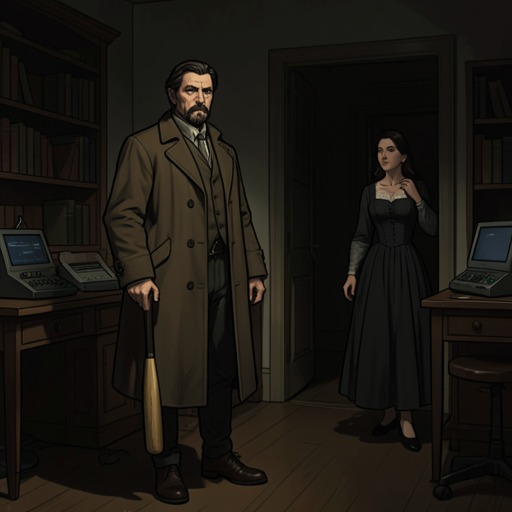
The Wind-Up Bird ChronicleThe hollow man is a faceless figure who appears to Toru Okada in the darkness of the otherworldly hotel and guides him toward Room 208. Neither a conventional rescuer nor a fully knowable companion, he claims to be on Okada’s side while admitting that his knowledge and authority are limited. His airy, shell-like presence and abrupt disappearance make his help inseparable from the strangeness of the place he inhabits.
Identity and Introduction
The hollow man first becomes recognizable through his voice. He addresses Okada as “Mr. Okada,” says that they have met in that place before, and assures him that he is on his side. Okada recognizes the voice as belonging to the man with no face, but remains cautious rather than answering immediately. The scene establishes both familiarity and uncertainty: the figure knows Okada, yet his identity and the terms of their earlier meeting remain unexplained.
His defining disclosure comes when Okada asks who he is. The faceless man answers, “I am the hollow man.” He gives no personal name or history. Instead, his self-description fuses his absent face with an image of inner vacancy, making him a figure defined less by biography than by the peculiar conditions of his existence in the hotel world.
Guide Through the Hotel
The hollow man urges Okada to leave quickly, warning that others will come to find him when the lights go on. He offers a shortcut and switches on a penlight, whose narrow beam gives Okada enough light to follow. Later, at the top of a staircase, he tells Okada to hold on to his jacket. Okada grasps its lower edge and is led through turns, another staircase, a small secret door, a low-ceilinged hidden passage, and further corridors. The route unfolds not as a direct approach but as a winding passage through the concealed interior of the hotel.
The guide’s help is practical and carefully bounded. He listens for sounds before opening a door onto a corridor and keeps moving when he judges that they must hurry. At Room 208, he illuminates the number and tells Okada that the door is unlocked. He gives him the flashlight, explains that he can walk back in the dark, and instructs him to lock the door once inside. The exchange makes clear that he can guide Okada to the threshold but will not accompany him into the room or take responsibility for what happens there.
Knowledge, Limits, and Warnings
The hollow man does not present himself as an all-knowing authority. He explains that the hotel is a big place and that his responsibility centers on the lobby, leaving much of what happens there beyond his knowledge. Asked about the whistling waiter, he says he knows nothing of such a waiter and adds that, if Okada saw one, it was not really a waiter but something pretending to be one. His answer offers a warning about deceptive appearances without explaining what the apparent waiter is.
He also cautions Okada that the place is dangerous and that Okada is an intruder there. He describes himself as the only person on Okada’s side, but provides no account of why he is helping or what his own interests might be. When Okada asks whether he knows where Kumiko is, the man says nothing. His silence leaves the central question unanswered, sharply distinguishing the assistance he can offer—a route to Room 208—from the knowledge Okada most wants.
Appearance and Narrative Role
The scene makes the hollow man’s unusual nature tangible through touch and light. When Okada bumps into him in the corridor, his flesh feels strangely light and airy, like an empty cicada shell. The image gives physical form to the hollowness in his chosen identity: even contact offers no assurance of solidity. His penlight, meanwhile, supplies only a small, local illumination. It makes the next steps visible without dispelling the darkness around them, matching the limited scope of his guidance.
At the door to Room 208, the hollow man passes the flashlight to Okada like a baton, a gesture that marks the transfer of responsibility. He waits for Okada to respond, then disappears silently; a moment later, the light reveals only the dull white wall. The quick erasure of his presence preserves the scene’s uncertainty rather than resolving it. He functions as a threshold guide, enabling Okada to proceed while remaining an opaque inhabitant of the dangerous world he has entered.