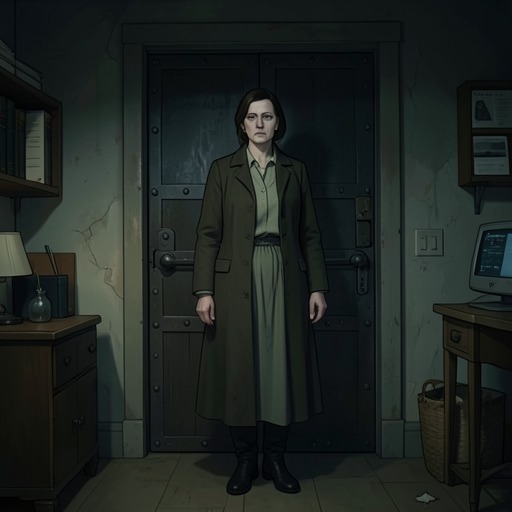
Kumiko Okada’s disappearance
The Wind-Up Bird ChronicleKumiko Okada’s disappearance turns a departure without explanation into the central uncertainty of Toru’s life. The decisive clue is mundane—a blouse and skirt collected from the cleaner at eight in the morning—but it transforms an apparently ordinary trip to work into evidence that Kumiko had prepared not to come home. Her whereabouts remain unknown, and the explanations supplied by others cannot replace the conversation Toru insists must take place between the two of them.
The Departure and Its Clues
Kumiko had left the house the previous day in her usual work clothes, carrying the shoulder bag she took to the office. When Toru called her workplace at eleven the next morning, he was told that she had not reported for work; the same office had no knowledge that she planned to be absent. Her colleagues regarded her unexplained absence as a serious problem and said she was not the sort of person to disappear without a word. The matter is therefore not presented as a known journey or an announced separation: its first form is a gap in the day’s expected routine.
Toru searched the closet and dresser for signs that Kumiko had packed. Almost all her dresses, blouses, skirts, accessories, and other belongings remained in their usual places. He knew her clothing reasonably well because he often took things to the cleaner’s and collected them, but her shoulder bag had been too small for a change of clothes. At first, the untouched wardrobe offered no clear account of what she intended. It also made the absence harder to read: Kumiko was gone, while the objects that might ordinarily document a departure stayed behind.
A routine call from the liquor store sharpened that uncertainty. The employee had delivered two cases of beer and a case of juice and mentioned that a little girl had been seriously injured by a reversing van near the station that morning. After the employee left, Toru found that he could no longer remain in the house. He went out without locking the door, leaving the windows open and the kitchen light on, and wandered toward the cleaner’s after remembering that Kumiko’s blouse and skirt were still there. The domestic setting he left behind was not secured or put in order; his discovery begins in a sudden flight from it.
At the cleaner’s, the owner checked his notebook and told him that Mrs. Okada had already picked up the blouse and skirt. When Toru asked whether this had happened the previous evening, the owner insisted that it was the previous morning, at eight o’clock, and that Kumiko had been his first customer of the day. The detail supplied a tangible trace of her last known movements, but it made the apparent routine of her departure less convincing rather than more so.
Toru reasoned that carrying freshly pressed clothes on crowded commuter trains would have been inconvenient and would have wrinkled them. Kumiko, who was particular about such things, could easily have collected them on her way home or asked Toru to do it. He concluded that she must have known she would not return that evening and had collected the clothes to give herself at least one change of clothing. She had her credit cards, an ATM card, and her own bank account, so she could go wherever she wished. The conclusion that she had left with a man was Toru’s inference, not something he had witnessed; at this point, neither the man’s identity nor Kumiko’s destination was known to him.
A Separation Explained at a Distance
The account Toru received from Noboru Wataya supplied a reason for the separation without resolving its circumstances. At a gathering with Malta Kano present, Toru rejected the idea that others could decide the marriage for him and argued that only he and Kumiko could talk to each other and settle what would happen. He wanted to know where she had gone, what she was doing, and whether she was with the other man. Noboru said he did not know the man’s identity or Kumiko’s location, and that even if he knew, he would not tell Toru. He also said that she did not want to speak to her husband.
Noboru reported that Kumiko had told him she was involved with another man and wanted to settle everything once and for all. He had advised her to divorce Toru; she had said she would think about it. This information confirmed that the departure concerned a relationship and a possible decision about the marriage, but it reached Toru through her brother rather than through Kumiko. The distance between what Toru needs to know and what he can establish is part of the event: her absence is accompanied by explanations, but not by direct communication.
Later, Toru described the departure to May Kasahara as the culmination of clues he had failed to understand. He said that, for months while Kumiko was still living with him, she had been sleeping with another man. Looking back, he recalled her coming home at unusual hours and flinching when he touched her, signs he had not interpreted because he trusted her and had not considered that she might be having an affair. He told May that Kumiko had left after breakfast in her ordinary outfit, with only her handbag, and had neither said goodbye nor left a note. This retrospective account makes the silence at departure part of a longer period of concealed change, while remaining Toru’s reconstruction of what he had previously missed.
The Alley, Memory, and the Changed Neighborhood
The disappearance is framed by Toru’s repeated movement through a narrow alley as he searches for the missing cat, an errand that also gives him a reason to leave the house and its unanswered phone. The passage had once served as a shortcut between two streets. During the rapid economic growth of the mid-1950s, new houses squeezed it into a narrow path; neighbors who disliked strangers passing close to their yards screened one end with a fence, while another resident sealed the other with a cinder-block wall. Barbed wire blocked the remaining end. With no through passage and no one needing it, the alley became an abandoned canal-like strip between back gardens, where spiders spread webs through the overgrowth. Its blocked route gives physical form to movement that cannot simply proceed from one place to another.
On one rainy outing, Toru noticed how unusually quiet the alley was. He heard neither birds nor street noises, and the gray sky seemed to absorb not only sound but perception. He slipped between walls and obstacles in shoes that made no sound on the grass; a radio talk show faded behind him until it seemed as though the callers themselves might have vanished with it. In the context of Kumiko’s absence, this passage makes ordinary surroundings feel unreliable: familiar houses remain nearby, but the world beyond them seems to recede from reach.
The darkness of the well later becomes a setting in which Toru’s memories acquire an unfamiliar vividness. There he recalls meeting Kumiko eight years earlier in a university hospital waiting room, where she was visiting her mother, who was being treated for a duodenal ulcer. Toru had been at the hospital to meet a client about an inheritance. This remembered meeting sets the abrupt disappearance against the earlier beginning of their relationship, but memory does not disclose where Kumiko has gone or restore the conversation missing from their separation.
After emerging from the well, Toru finds the neighborhood altered in feeling, as if a new reality had taken the place of the old one while he was below ground. In winter he returns to the alley and looks through gaps in a high plank fence at the site of the vacant Miyawaki house. The house, yard, well, trees, antenna, and bird sculpture are gone; there is only bulldozer-compacted earth and scattered weeds. May Kasahara is no longer at her house, either. The physical changes do not explain Kumiko’s disappearance, but they extend the story’s pattern of absence: places once associated with people and events become inaccessible, emptied, or difficult to recognize.
Narrative Significance and Unresolved Outcome
The episode develops through a shift in the meaning of small objects and routine actions. A cleaner’s notebook and two garments, initially just a record of a transaction, become stronger evidence of intention than the nearly untouched wardrobe. The contrast between the ordinary breakfast and workday departure and the absence of a goodbye or note lets the separation arrive first as a break in routine, then as an inference about preparation, and finally as information relayed by Noboru. The story slows down to examine what Toru can verify, what he reconstructs after the fact, and what remains beyond his knowledge.
The outcome remains unresolved within these scenes. Toru believes Kumiko may never return of her own accord, and he suspects that she is with the man with whom she had an affair, but he cannot confirm either her location or their present circumstances. His insistence that the decision belongs to him and Kumiko confronts the limits of the information delivered by her brother. The disappearance is thus more than physical absence: it suspends the marriage between a private history Toru revisits, an explanation he receives secondhand, and a conversation that has not occurred.